


10 Ecommerce Packaging Design Ideas with Original Examples

The best packaging design ideas do three jobs at once: protect the product, help the customer understand it and make the brand recognisable. An attractive box that arrives crushed—or a secure mailer that leaves the buyer unsure how to use or return the product—is not a successful design.
The ten concepts below are original illustrative examples, not copied brand campaigns. Use them to identify a direction, then adapt the structure, materials, information and production method to the product you actually sell.
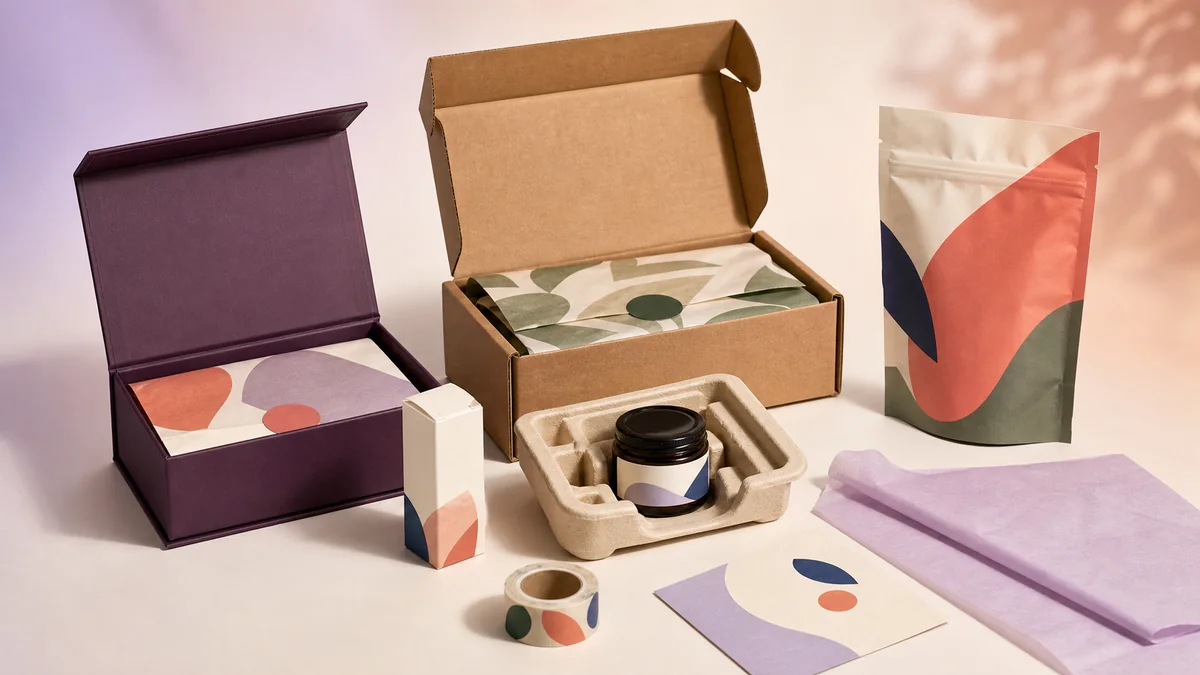
Choose an idea that fits the product
| If you sell | Start with | Main design priority | Common mistake |
|---|---|---|---|
| Skincare or wellness products | Minimal system with strong hierarchy | Variant and usage clarity | Making every label look identical |
| Food, drinks or consumables | Bold pattern family | Fast flavour recognition | Letting decoration hide required information |
| Clothing or soft goods | Right-sized mailer with a paper sleeve | Low weight and easy opening | Using an oversized box for presentation |
| Fragile homeware | Protective insert system | Controlling movement and impact | Designing the graphics before testing the structure |
| Premium accessories | Restrained unboxing sequence | Material quality and order of reveal | Adding components that create waste but no value |
| Refills or repeat-purchase products | Refill-ready primary pack | Clear compatibility and disposal instructions | Calling a format sustainable without evidence |
| Handmade or low-volume products | Modular stamps, sleeves and stickers | Consistency at small quantities | Buying too many printed sizes too early |
Packaging is a system, not a single decorated surface. Decide how the product reaches the customer before deciding what it should look like.
1. Build a recognisable minimalist system
Minimal packaging works when every remaining element has a clear role. It does not mean removing useful information or placing pale text on a pale background.
Give the brand mark, product name, variant and essential instruction visibly different levels of emphasis. Keep the structure consistent across the range, then use one controlled variable—such as a colour block, number or pattern—to help customers distinguish products.
Best for: skincare, supplements, home fragrance and products where a calm, considered presentation supports the positioning.
Watch for: minimal designs often fail at range navigation. Put several variants together and check whether a customer can identify the correct one without reading every line.

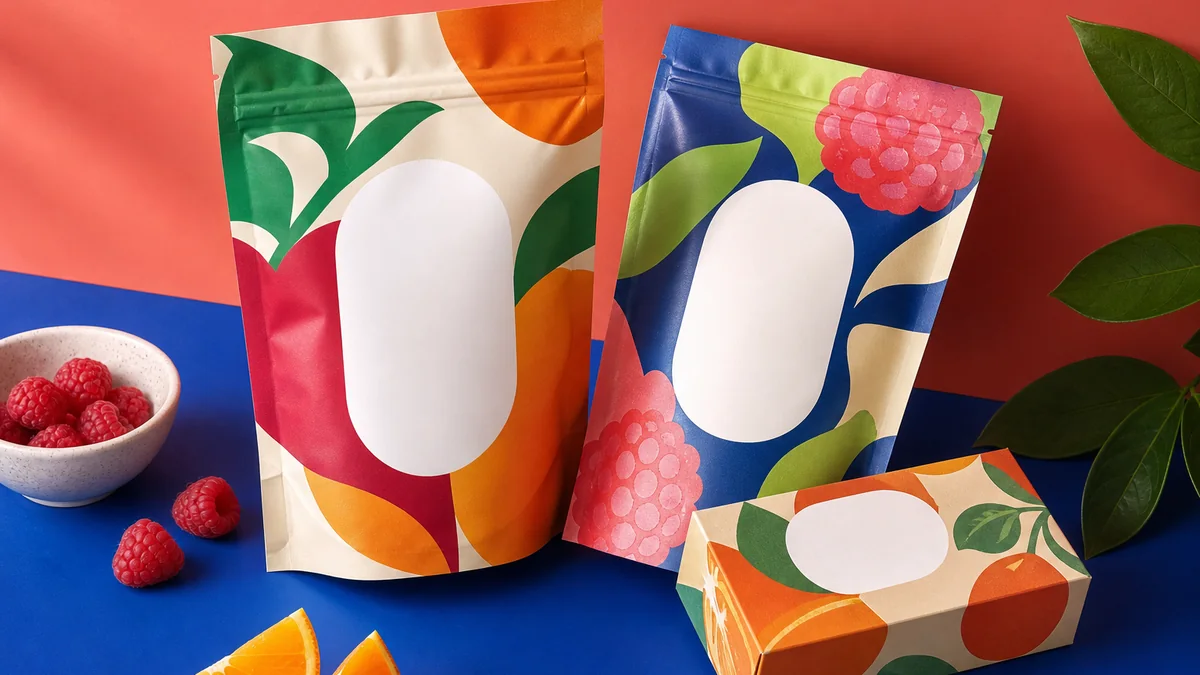
2. Use a bold pattern to organise a product family
A pattern can make packaging visible in a product grid, social post or crowded shelf. The useful approach is not to decorate every surface differently; it is to create a repeatable visual grammar.
Keep the label position and basic layout stable. Change the illustration, dominant colour or crop to represent each flavour or variant. This lets the range feel related while still helping buyers tell products apart.
Best for: food, drinks, pet products, stationery and giftable items.
Watch for: check the design at thumbnail size. If the product type and variant disappear when the image is reduced, the pattern is doing too much work.
3. Make the shipping box fit the product
Right-sizing is less glamorous than a foil finish, but it affects protection, packing speed, storage and delivery. Start with the product dimensions, vulnerable points and likely order combinations.
A good shipping pack limits unnecessary movement without making removal difficult. For a range with several product sizes, a small set of carefully chosen box formats is usually easier to operate than a different box for every item.
Best for: every physical ecommerce product, particularly fragile or heavy goods.
Watch for: test the most awkward real order, not only a single hero product. Include mixed baskets, accessories and any paperwork your fulfilment team adds.
4. Let the protective insert become part of the design
An insert can locate the product, separate components and control the opening sequence. Folded board and moulded-pulp formats can also present a product neatly without hiding it under layers of loose fill.
Design the insert around how the item moves during transport. A cut-out that looks precise in a mock-up may perform poorly if the product can rotate, press against a cap or escape when the parcel is inverted.
Best for: bottles, ceramics, electronics, sets and products with vulnerable accessories.
Watch for: a protective claim needs testing. Ask the supplier what test method and transport conditions the structure was designed for; do not infer performance from appearance.

5. Design refills as a complete customer journey
A refill format should make three things obvious: what it fits, how to transfer or install it and what to do with each component afterwards. A smaller pouch is not automatically easy to use, and a material is not automatically recyclable in every location.
Keep compatibility information near the product name. Put the use sequence where the customer encounters it before opening the refill, and make disposal wording specific to the material and market.
Best for: personal care, cleaning, beverages, pet care and other replenishment products.
Watch for: avoid vague claims such as “green” or “planet friendly”. Environmental statements should describe a specific, supportable attribute.
6. Create an unboxing sequence, not a pile of extras
Premium packaging earns attention through order and material quality. The customer should know where to open, what to lift and where the product sits. One well-made pull tab or fabric pouch can contribute more than several ribbons, cards and filler layers.
Map the sequence in four frames: parcel closed, first opening, product reveal and product removal. Remove anything that does not protect, inform or meaningfully improve one of those moments.
Best for: jewellery, accessories, gifts, limited editions and products whose presentation is part of the purchase decision.
Watch for: premium should not mean difficult to recycle, slow to pack or frustrating to return. Test repacking as carefully as opening.

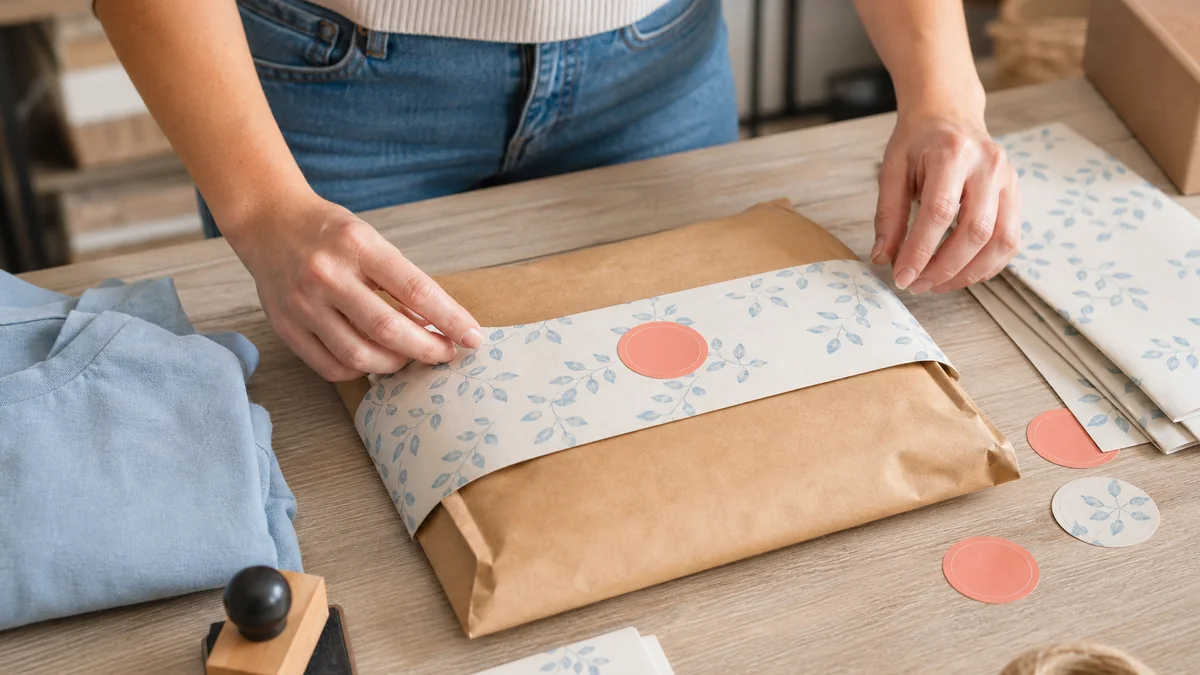
7. Use modular branding when order volume is still small
Custom-printed packaging can be difficult to justify before the product range and box sizes are stable. A modular system uses standard mailers or boxes with a consistent sleeve, stamp, sticker or paper tape.
Choose one or two elements the team can apply accurately. Record the placement so different packers produce a consistent result. When volume grows, the same design can inform a custom print specification instead of being discarded.
Best for: handmade goods, first product launches, seasonal runs and businesses validating a new format.
Watch for: count the packing steps. An inexpensive component can become operationally expensive if it takes too long to align, fold or attach.
8. Make the insert genuinely useful
An insert should answer a question the customer is likely to have at that moment. Useful examples include first-use instructions, care guidance, a return route or a short explanation of why a material was chosen.
A generic promotional card competes with the product and often goes straight into the bin. If you include a QR code, print the destination in words as well, maintain the page and test the code on both iOS and Android devices before production.
For order-confirmation and post-purchase wording, the existing guide to thank-you messages for ecommerce orders provides examples that can be adapted to a card without turning it into another sales pitch.
Best for: products that need setup, care, authentication or a clear support route.
Watch for: do not place essential safety or legal information only behind a QR code unless the applicable rules allow it.
9. Make returns possible without destroying the pack
Tear strips can improve opening, but the customer may still need the package for a return. A second adhesive strip, clear fold line or reversible closure can make repacking easier.
Test the complete return journey: open the parcel, remove the product, put it back, close the pack and attach the return label. If the box collapses or the mailer cannot close, the design transfers the problem to the customer and support team.
Returns involve more than the physical pack. The business also needs a clear policy and operational process; the comparison of ecommerce returns management software explains the wider workflow.
Best for: apparel, footwear, accessories and any category with regular size or preference returns.
Watch for: tamper evidence and resealability serve different purposes. Confirm which one the product and market require.
10. Put practical information where it is needed
Packaging has limited space, so organise information by the point at which a customer needs it. The front identifies the product. Side or back panels explain use, ingredients, compatibility, warnings and disposal. The shipping layer carries delivery information and any handling marks.
Do not shrink text simply to preserve a spacious design. Print a full-size prototype, view it in normal light and ask someone unfamiliar with the product to locate the variant, quantity, important warning and support route.
Best for: every product, especially regulated, technical or multi-variant ranges.
Watch for: labelling obligations differ by product and destination. A visual example is not a legal template.
Understand the three packaging layers
Before briefing a designer, separate these layers:
- Primary packaging directly contains or touches the product, such as a bottle, pouch or jar.
- Secondary packaging groups or presents the product, such as a folding carton around a bottle.
- Shipping packaging protects the order during fulfilment and delivery, such as a mailer, corrugated box and insert.
One component can sometimes perform two roles. A sturdy product carton may also become the shipping pack, but only if it protects the item, carries the necessary delivery information and reaches the customer in an acceptable condition.
Thinking in layers prevents a common design error: making the secondary box beautiful while treating the shipping box, fill and return experience as somebody else’s problem.
A practical packaging design process
1. Write the constraints before collecting inspiration
Record product dimensions, weight, fragile points, storage conditions, shelf life, likely order combinations, fulfilment method, target countries and required information. Inspiration is more useful after these limits are clear.
If packaging is part of a wider launch, connect this work to the ecommerce website launch and marketing plan so photography, product pages, stock arrival and campaign assets use the same approved design.
2. Define the job of each layer
Decide what directly contains the product, what presents it and what protects it in transit. Identify which layer carries instructions, warnings, variant information and the customer-support route.
3. Compare concepts using the same criteria
Score each concept from one to five for:
- Product protection
- Customer clarity
- Packing time
- Storage efficiency
- Shipping efficiency
- Ease of opening and returning
- Material-claim confidence
- Visual recognition
- Suitability across the product range
A weighted score is more useful than asking a team which concept looks best. For fragile products, protection may carry twice the weight of decorative flexibility. For subscription items, packing speed and storage may matter more.
4. Build a plain structural prototype
Test size, closure, insert position and opening before paying for finished graphics. A blank prototype reveals structural problems that attractive artwork can hide.
5. Add information at actual print size
Print the design at 100%. Check the smallest text, contrast, barcode quiet area, folds, seams and places where labels or delivery stickers may cover artwork.
6. Run packing, delivery and return trials
Ask the fulfilment team to pack several realistic orders. Record the time, number of components and mistakes. Then test transport conditions appropriate to the product with qualified packaging or logistics specialists.
7. Collect useful post-delivery feedback
Ask specific questions: Was the product easy to remove? Was anything damaged? Could the customer identify how to dispose of each component? Could they repack it for a return? “Did you like the packaging?” is too broad to guide the next revision.
Packaging can support retention, but it is only one part of the experience. Delivery accuracy, product performance and follow-up communication also belong in a measured Shopify customer-retention strategy.
Treat sustainability claims as factual claims
Material choice involves trade-offs. Weight, protection, recycled content, local collection infrastructure, reusability and product waste can all affect the result. A lighter pack that causes more damaged products may be a poor overall decision.
In the US, the FTC’s environmental-claims guidance warns against broad, unqualified statements such as “green” or “eco-friendly” and recommends clear, specific qualifications. The claim should also make clear whether it applies to the product, the packaging or one component.
UK businesses may also have packaging-data and fee responsibilities depending on turnover, packaging weight and activities. The current UK extended producer responsibility guidance explains who may need to collect and report information. Requirements vary by country and product category, so obtain appropriate compliance advice before printing a large run.
The article on supporting sustainable-product store customers also explains why material and certification questions need evidence rather than generic environmental language.
What happens after the parcel is opened?
Good packaging reduces uncertainty, but it cannot anticipate every question. Customers may ask how to assemble an item, whether a mark indicates damage, which component can be recycled locally or how to start a return.
How AeroChat handles post-delivery questions
AeroChat is an AI agent platform that helps ecommerce brands run customer service on autopilot. It can use the business’s approved product, delivery and returns information to answer suitable questions across supported channels. Shopify merchants can review the current AeroChat Shopify integration, while a conversation that needs judgement can move through human handover.
AeroChat does not design packaging or verify environmental claims. Its role begins when the packaging, product page or post-delivery message generates a customer conversation. Keep the source information accurate and route damage, safety or disputed-return cases to a person.
Packaging brief checklist
Give a designer or supplier the following information before requesting concepts:
- Product dimensions, weight and tolerances
- Fragile, leak, temperature or contamination risks
- Primary, secondary and shipping-pack requirements
- Expected order combinations
- Fulfilment and storage constraints
- Target markets and applicable labelling requirements
- Brand assets and range-navigation rules
- Required product, safety and disposal information
- Barcode, batch, date or variable-data areas
- Opening and return requirements
- Material evidence and claims that may be made
- Prototype, transport and print-test responsibilities
- Approved file formats, colour specifications and production deadlines
The strongest packaging idea is not necessarily the most decorative. It is the one the business can produce consistently, the fulfilment team can pack correctly and the customer can understand, open and dispose of responsibly.