
10 Reasons Customers Stop Replying to Businesses

Customers rarely stop replying without a reason.
In most cases, they do not wake up one morning and suddenly decide to ignore your business. Instead, conversations gradually lose momentum because something interrupts the customer journey.
It might be a delayed response. It might be information overload. It might be that the customer became distracted, started comparing competitors, or simply wasn’t ready to make a decision yet.
The challenge is that businesses often interpret silence as rejection.
In reality, customer silence usually signals friction somewhere in the conversation.
Understanding what causes customers to disengage can help businesses improve response rates, recover more opportunities, and create a smoother customer experience.
Why Customers Stop Replying
Customers typically stop replying because of slow response times, unclear next steps, competing priorities, communication friction, or a loss of buying momentum.
|
Common Cause |
Impact on the Conversation |
|---|---|
|
Slow replies |
Customer loses interest or contacts competitors |
|
No clear next step |
Conversation stalls |
|
Information overload |
Customer delays making a decision |
|
Wrong communication channel |
Messages get ignored |
|
Trust concerns |
Customer hesitates to move forward |
|
Competing priorities |
Business is no longer top of mind |
The good news is that many silent conversations can be prevented or recovered when businesses understand why customers disengage in the first place.
Why Customer Silence Is Often Misunderstood
One of the biggest mistakes businesses make is assuming every non-response means a lost opportunity.
Think about your own behaviour.
How many emails have you left unanswered?
How many WhatsApp messages did you intend to reply to later?
How many conversations were interrupted by meetings, deadlines, family responsibilities, or unexpected distractions?
Customers behave the same way.
Modern consumers are constantly bombarded with notifications, emails, social messages, advertisements, and work-related communication. Even highly interested prospects can go silent temporarily when other priorities take over.
That is why businesses should focus on understanding the reason behind the silence rather than assuming the conversation is over.
The Four Types of Customer Silence
Not all customer silence means the same thing.
Understanding the type of silence can help determine the right follow-up strategy.
|
Type of Silence |
What It Usually Means |
|---|---|
|
Temporary Silence |
Customer is busy or distracted |
|
Comparison Silence |
Customer is evaluating alternatives |
|
Friction Silence |
The buying process became difficult |
|
Lost-Intent Silence |
The need or priority disappeared |
Let’s look at each one more closely.
Temporary Silence: The Customer Got Distracted
This is the most common form of customer silence.
The customer may still be interested, but life gets in the way.
Work meetings, travel, family commitments, urgent projects, and everyday distractions can push your conversation down their priority list.
The mistake businesses make is assuming the opportunity is gone.
In many cases, a thoughtful follow-up a few days later can restart the conversation.
Comparison Silence: The Customer Is Evaluating Options
Most customers do not make decisions immediately.
Before committing, they often compare:
-
pricing
-
reviews
-
support quality
-
features
-
competitors
This is especially common for SaaS, professional services, automotive enquiries, and high-ticket purchases.
The customer is still interested.
They are simply gathering information before making a decision.
Businesses that maintain consistent communication during this phase usually perform better than those that disappear after the first interaction.
Friction Silence: The Process Became Too Difficult
Sometimes customers stop replying because the process itself creates friction.
Examples include:
-
long forms
-
confusing pricing structures
-
too many options
-
unclear instructions
-
delayed responses
When the effort required to continue the conversation becomes too high, engagement drops.
Many businesses discover these issues only after noticing repeated signs that their customer support workflow is broken, such as delayed responses, duplicated conversations, and inconsistent customer experiences.
Lost-Intent Silence: The Need Has Changed
Occasionally, the customer’s situation genuinely changes.
The project may be postponed.
The budget may disappear.
Another priority may take over.
In these situations, no amount of follow-up will immediately restart the conversation.
However, maintaining a positive relationship still matters because future opportunities may arise later.
How Slow Response Times Cause Customer Drop-Off
Few factors influence customer engagement more than response speed.
When customers contact a business, they are often actively researching solutions.
Their interest is highest at that exact moment.
Every hour of delay creates risk.
The customer may:
-
contact competitors
-
find another solution
-
postpone the decision
-
lose interest entirely
This is why businesses increasingly study the psychology behind faster customer responses. Faster replies do more than answer questions. They build trust, create momentum, and keep customers engaged during critical decision-making moments.
Response speed is no longer a competitive advantage.
For many industries, it has become a basic customer expectation.
Why Customers Stop Replying After Receiving Too Much Information
Many businesses assume that providing more information is always helpful.
In reality, too much information can slow decision-making.
A customer asks a simple question and receives:
-
a long email
-
multiple attachments
-
several pricing options
-
technical explanations
Instead of helping the customer move forward, the response creates decision fatigue.
When customers feel overwhelmed, they often delay taking action.
The delay becomes silence.
The silence eventually becomes a lost opportunity.
The best customer communication is not necessarily the longest.
It is the clearest.
Why Messaging Channels Affect Customer Response Rates
The channel you use matters more than many businesses realize.
A customer who ignores email may respond within minutes on WhatsApp.
Someone who never answers phone calls might actively engage through website chat.
The problem is that many businesses still communicate based on their preferred channel rather than the customer’s preferred channel.
Customer expectations have shifted significantly over the past few years.
People increasingly prefer:
-
WhatsApp
-
Facebook Messenger
-
Instagram DMs
-
website chat
because these channels feel faster and more convenient.
This shift is one reason businesses are investing in omnichannel support workflows. Customers no longer follow a linear path. They may discover a business through Facebook, browse products on a website, ask questions through chat, and continue the conversation later through WhatsApp.
When communication becomes fragmented, customer engagement often declines.
Businesses that centralize conversations across channels typically provide a smoother experience and reduce the likelihood of customers disappearing midway through the journey.
Why Customers Stop Replying After Asking for Pricing
One of the most confusing situations for businesses happens when a customer asks for pricing and then goes completely silent.
The immediate assumption is often:
“The price was too high.”
Sometimes that is true.
However, pricing-related silence can happen for many reasons.
The customer may be:
-
comparing multiple vendors
-
waiting for approval
-
reviewing budgets
-
discussing options internally
-
evaluating return on investment
In many cases, the price itself is not the issue.
The customer simply needs more time to make a decision.
This is particularly common in:
-
B2B services
-
software subscriptions
-
consulting
-
automotive sales
-
high-ticket purchases
Instead of immediately offering discounts, businesses should focus on understanding where the customer is in their decision-making process.
How Conversation Momentum Influences Customer Decisions
Many businesses focus heavily on generating leads.
Far fewer focus on maintaining momentum.
Momentum is what keeps conversations moving forward.
For example:
Customer:
“Do you offer same-day delivery?”
Business:
“Yes. Would you like to see today’s available delivery slots?”
The conversation naturally progresses.
Now compare that to:
Business:
“Yes.”
Technically the question was answered.
But there is no next step.
No direction.
No momentum.
Strong customer communication guides the conversation naturally toward the next action.
Weak communication forces the customer to figure out what comes next.
That small difference often determines whether a conversation continues or disappears.
Why Small Teams Struggle to Maintain Customer Engagement
As businesses grow, customer conversations increase rapidly.
The challenge becomes even greater for smaller teams.
A business owner or support team may be handling:
-
website enquiries
-
WhatsApp messages
-
Facebook conversations
-
Instagram DMs
-
support requests
all at the same time.
As volume increases, response times often suffer.
Messages get missed.
Follow-ups become inconsistent.
Conversations lose momentum.
This is one reason many growing businesses are exploring how AI helps small teams handle more customer conversations without significantly increasing headcount.
The goal is not replacing human interaction.
The goal is ensuring customers receive timely engagement before interest fades.
The Hidden Cost of Customer Silence
Most businesses measure:
-
sales
-
revenue
-
conversion rates
But few measure the cost of abandoned conversations.
Every silent customer represents:
|
Potential Loss |
Business Impact |
|---|---|
|
Missed lead |
Lost revenue opportunity |
|
Delayed decision |
Longer sales cycle |
|
Poor engagement |
Lower conversion rates |
|
Missed follow-up |
Reduced customer trust |
|
Slow response |
Increased competitor risk |
Customer silence is rarely just a communication issue.
It often becomes a growth issue.
As customer volume increases, many businesses notice that rising conversation volume creates operational challenges similar to the reasons support tickets keep increasing as businesses grow.
The more conversations a business receives, the harder it becomes to maintain consistent engagement manually.
How Businesses Can Reduce Conversation Abandonment
There is no way to eliminate customer silence completely.
However, businesses can significantly reduce it.
Respond Faster
The longer customers wait, the more likely they are to disengage.
Even small improvements in response speed can have a measurable impact on engagement.
Use The Customer’s Preferred Channel
Customers are more likely to reply when communication happens through platforms they already use regularly.
Create Clear Next Steps
Every conversation should guide customers toward an obvious action.
Avoid ending conversations without direction.
Simplify Communication
Clarity almost always performs better than complexity.
Provide enough information to move the conversation forward without overwhelming the customer.
Maintain Consistent Follow-Up
Follow-up should feel helpful rather than aggressive.
The goal is to maintain visibility and momentum, not create pressure.
How AI Helps Prevent Customer Conversations From Going Silent
One of the biggest causes of customer silence is delay.
Customers ask a question.
The business is busy.
Hours pass.
Sometimes days pass.
By the time a response arrives, the customer has already moved on.
AI helps close that gap.
Modern customer communication platforms can:
-
answer common questions instantly
-
engage visitors after hours
-
qualify leads automatically
-
collect information before human handover
-
maintain conversation momentum
This is particularly valuable for businesses that receive enquiries outside normal operating hours.
Customers increasingly expect immediate answers regardless of when they contact a business.
Where AeroChat Fits
Many customer conversations are lost simply because nobody responds quickly enough.
Customers ask a question while their interest is highest.
If the response is delayed, momentum disappears.
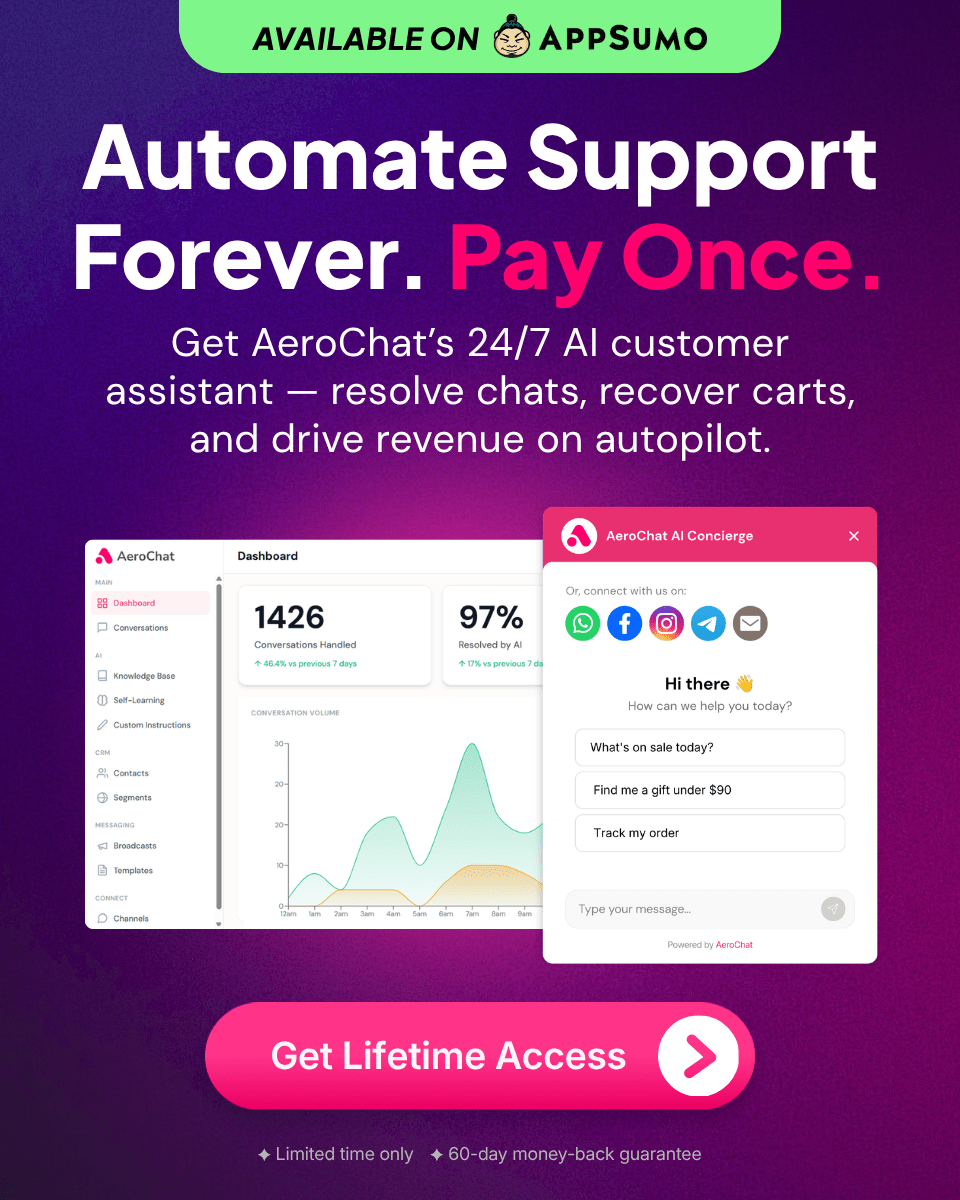
AeroChat helps businesses maintain engagement by providing instant responses across multiple communication channels.
Instead of leaving customers waiting, AeroChat helps businesses:
-
answer frequently asked questions automatically
-
engage website visitors immediately
-
automate repetitive customer enquiries
-
support customers 24/7
-
qualify leads before human involvement
|
Without AeroChat |
With AeroChat |
|---|---|
|
Delayed responses |
Immediate engagement |
|
Missed enquiries |
24/7 availability |
|
Repetitive support workload |
Automated responses |
|
Lost conversation momentum |
Continuous engagement |
|
Fragmented communication |
Centralized conversations |
The objective is not replacing people.
The objective is preventing valuable customer conversations from disappearing before they have a chance to develop.
Businesses that use website live chat, WhatsApp AI chatbots, and AI-powered customer communication tools are often better positioned to maintain engagement throughout the customer journey.
Frequently Asked Questions
Why do customers suddenly stop replying?
Customers stop replying for many reasons including distractions, comparison shopping, slow response times, unclear next steps, and competing priorities.
Does customer silence mean they are not interested?
Not necessarily. Many customers are still interested but need more time, additional information, or internal approval before making a decision.
How long should businesses wait before following up?
The ideal timing depends on the industry, but most businesses benefit from a thoughtful follow-up within a few days rather than multiple messages in a short period.
How can businesses improve customer response rates?
Businesses can improve response rates by responding faster, simplifying communication, using preferred messaging channels, and creating clear next steps.
Can AI help reduce customer drop-off?
Yes. AI can improve response speed, maintain conversation momentum, answer common questions instantly, and ensure customers receive timely engagement.
Final Thoughts
Most customers do not stop replying because they dislike your business.
More often, conversations fade because:
-
momentum was lost
-
responses arrived too slowly
-
communication became complicated
-
priorities changed
-
customers became distracted
The businesses that maintain engagement successfully are usually the ones that make communication easier, faster, and more convenient.
Because in many cases, the difference between a lost customer and a converted customer is not pricing, features, or marketing.
It is simply keeping the conversation alive long enough for the customer to make a decision.