
What Is an Enterprise AI Chatbot?

An enterprise AI chatbot is a chatbot built to operate at the scale, security, and governance level a larger organisation needs: more agent seats, custom integrations into existing systems, and the account support to match. It’s not a separate piece of software from a standard chatbot. It’s the same core technology, licensed and configured for a bigger, more complex operation.
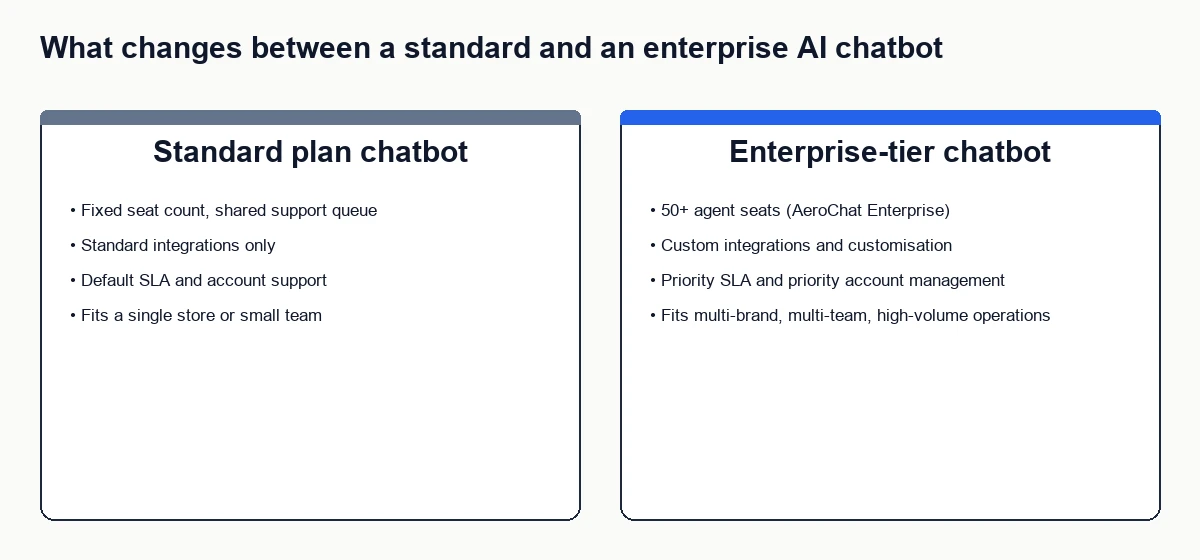
The three things that actually change at enterprise scale
Vendors use “enterprise” loosely, so it helps to know what should genuinely change in the product, not just the price tag.
Seats and team structure
A small store might run a chatbot with two or three agent logins. An enterprise operation needs dozens: multiple support teams, regional shifts, or separate brands under one account. AeroChat’s Enterprise plan, for example, supports 50+ agent accounts, well past what a Starter or Growth plan is built for.
Integrations and customisation
Standard plans usually ship with a fixed set of integrations. Enterprise buyers more often need something specific: a connection to an internal system, a workflow that doesn’t fit the default templates, or a customised setup for how their support and sales teams actually work. That’s reflected directly in AeroChat’s Enterprise tier, which lists custom advanced integrations and custom enterprise customisation as plan features, rather than a fixed integration list.
SLA and account support
The last piece is how fast you get help and how predictable that is. Enterprise plans typically come with a priority SLA and a named or priority account manager, instead of a shared support queue. If your chatbot goes down during a peak sales period, the difference between a standard queue and a priority SLA is the difference between minutes and hours.
Who actually needs this, and who doesn’t
Not every growing business needs an enterprise-tier chatbot, and buying one too early just means paying for seats and customisation you’re not using yet. A rough way to tell:
- You probably don’t need it yet if you’re running one store, one support team, and the built-in integrations already cover the tools you use.
- You’re a good candidate if you’re managing multiple brands or storefronts from one account, your team has grown past what a shared queue can handle, or you’ve hit a wall trying to connect the chatbot to something outside its default integrations.
- You definitely need it if downtime or slow support responses now carry a real financial cost, and a standard SLA isn’t fast enough to protect against that.
How this differs from “agentic AI” and other buzzwords
“Enterprise” describes the scale and commercial terms of a chatbot deployment. It says nothing about how intelligent or autonomous the chatbot actually is. A standard-plan chatbot can be highly capable at handling real actions, and an enterprise-plan chatbot can be configured conservatively. These are separate questions. If you’re trying to understand the capability side specifically, rather than the scale and support side, conversational AI vs agentic AI for ecommerce support covers that distinction directly.
What to actually check when evaluating vendors
Marketing pages describe “enterprise” features in different ways, so it’s worth checking the same handful of things across every vendor you shortlist: the real seat limit at that tier, whether integrations are fixed or genuinely customisable, what the SLA response time actually commits to in writing, and whether account management means a named contact or just a higher support-ticket priority. A detailed side-by-side of specific platforms, including AeroChat, IBM watsonx, Salesforce Agentforce, and others, is covered in 7 best enterprise AI chatbot solutions for ecommerce.
Your next step
Run your own team through the three checks above: real seat count, genuinely customisable integrations, and an SLA response time in writing, not just a name on a page. If you land in the “good candidate” or “definitely need it” group, the shortlist of platforms actually built for this, AeroChat included, is in 7 best enterprise AI chatbot solutions for ecommerce.
Frequently asked questions
Is an enterprise chatbot just a more expensive version of a regular one?
Mostly, yes, but the extra cost should map to something concrete: more seats, real custom integration work, and a faster support commitment. If a vendor’s “enterprise” tier is just a higher price with no seat, integration, or SLA difference, that’s worth questioning during procurement.
Do I need a developer to set up an enterprise chatbot?
It depends on the platform. No-code SaaS platforms like AeroChat are designed so a non-technical team can configure them, even at the enterprise tier, though custom integrations may still involve some technical setup. Pro-code platforms built for extensive customisation generally do require developer involvement.
What’s the difference between “enterprise” and just running multiple stores?
Running multiple stores doesn’t automatically require an enterprise plan. What matters is whether your team, integration needs, and support requirements have outgrown a standard plan. A single large store with a big support team can need enterprise features sooner than a business running several small storefronts.