

What Businesses Can Learn From Customer Conversation Data
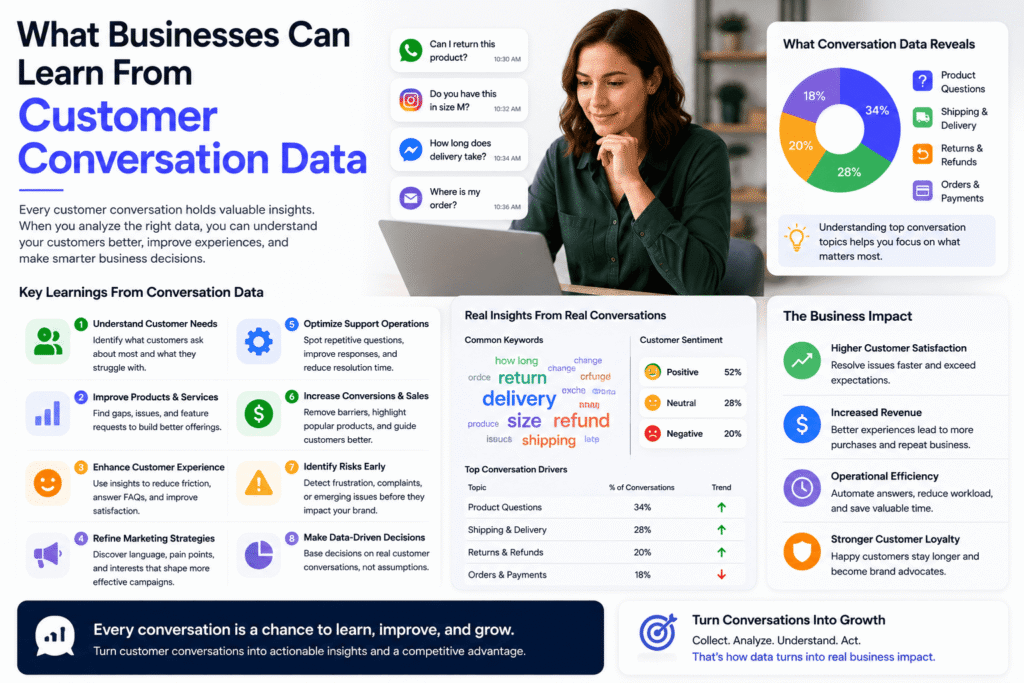
Every message a customer sends is data. The questions they ask before buying, the complaints they repeat, the words they use to describe a problem — all of it adds up to the clearest, least filtered picture of your business you will ever get. Most companies sit on thousands of these conversations and read almost none of them. The ones that do learn things their analytics dashboards and surveys never show.
Customer conversation data tells you what people actually struggle with, why they hesitate before buying, where your product or messaging confuses them, and which problems quietly drive customers away. Analyzed at scale, support chats, pre-sales questions, and complaints reveal recurring patterns — the topics, the sentiment, and the intent behind them — that point directly to what to fix, what to build, and what to say. The biggest lesson is usually that a small number of issues cause most of the friction.
Why Conversation Data Beats Surveys and Analytics
Surveys tell you what customers say when prompted; analytics tell you what they did. Conversation data tells you what they meant — in their own words, unprompted, at the moment a problem was real. A survey asks “how satisfied are you, 1 to 5.” A support chat shows the exact sentence where a customer got stuck. One is a score; the other is a cause.
That difference matters because the most valuable insights are the ones no one thought to ask about. A spike in a question you didn’t know people had, an objection your marketing never anticipated, a feature people keep misunderstanding — these only surface when you read what customers volunteer. Internal language drifts away from how customers actually speak; their conversations are where the real vocabulary, and the real problems, live.
The Five Things Conversation Data Actually Reveals
Raw chats become useful when you sort them into patterns. A few categories carry most of the value:
|
What you analyze |
What it reveals |
What you do with it |
|---|---|---|
|
Recurring questions |
The FAQs driving most volume |
Automate them; fix the page that should have answered |
|
Sentiment & tone |
Where frustration concentrates |
Prioritize the issues that anger customers, not just the frequent ones |
|
Pre-sale objections |
Why people hesitate to buy |
Address objections in copy, product pages, and chat |
|
Complaint themes |
Root causes of churn and refunds |
Fix the source, not just the ticket |
|
Customer wording |
The language customers actually use |
Rewrite product and marketing copy to match |
The pattern most businesses miss: frequency and severity are different. The most common question isn’t always the most damaging one. Conversation data lets you separate the high-volume-but-harmless from the low-volume-but-costly — the questions that quietly kill sales or trigger refunds.
Lesson 1: Most of Your Volume Comes From a Few Questions
When businesses tag their conversations, the result is almost always lopsided — a handful of topics account for the majority of incoming messages. One contact center found that 12% of all calls were simply asking about claim status; a single, automatable question was eating thousands of hours.
This is the most immediately useful lesson because it’s the most actionable. If five questions drive 60% of your messages, you’ve found your automation roadmap and your content gaps in one move. Each repeated question is also a signal that something upstream — a product page, a shipping notification, a policy — failed to answer it first. (Related: reduce repetitive customer questions and why support tickets keep increasing as businesses grow.)
Lesson 2: Complaints Point to Root Causes, Not Just Tickets
A single complaint is a ticket to resolve. A hundred complaints saying the same thing is a problem to fix at the source. Conversation data turns scattered grievances into a ranked list of root causes — the sizing chart that’s wrong, the checkout step that confuses, the delivery promise you can’t keep.
The payoff is real when teams act on it. One company used support-ticket tagging to reprioritize its product roadmap around what customers actually complained about, and cut a key driver of dissatisfaction by half. The complaints weren’t noise; they were a roadmap no one had read. Fixing root causes reduces future volume — every prevented complaint is a ticket that never happens.
Lesson 3: Pre-Sale Questions Show You Why People Don’t Buy
The questions customers ask before buying are among the most commercially valuable data you have, because each one is a hesitation standing between the customer and a purchase. “Does this fit?”, “Is it compatible?”, “What’s your return policy?” — every repeated pre-sale question is an objection your store didn’t resolve on its own.
Read enough of them and a pattern emerges: the specific doubts that stall purchases. Those belong in your product copy, your FAQs, and your chat responses — answered before the customer has to ask. (Related: what customers ask most before buying online and automate pre-sales questions.)
Lesson 4: The Words Customers Use Are Your Best Copy
Marketing teams describe products the way the business thinks about them. Customers describe products the way they actually experience them — and the two are often very different. Conversation data hands you the real vocabulary: the phrases people use to describe what they want, the benefits they care about, the problems in their own terms.
Feeding that language back into product pages, ad copy, and chat replies makes everything resonate more, because it mirrors how customers already think. It’s also free, ongoing market research — generated every time someone messages you, sitting unused unless you look.
Lesson 5: Sentiment Tells You Where to Look First
Not all issues deserve equal attention. Sentiment — the emotion behind a message — tells you which problems make customers angry enough to leave, versus which ones they shrug off. A frequent but mild question is a candidate for automation; a less frequent but furious complaint is a fire to put out now.
Tracking sentiment over time also works as an early-warning system. A sudden rise in negative sentiment around a product, a policy change, or a shipping period often precedes a churn spike — visible in conversations weeks before it shows up in revenue. The conversations are the leading indicator; the lost sales are the lagging one.
How to Turn Conversations Into Insight
Reading every chat by hand doesn’t scale past a few dozen a day. The practical approach is to capture conversations across every channel — website, WhatsApp, Instagram, email — in one place, then tag and group them by topic, sentiment, and intent so patterns surface on their own instead of staying buried in individual threads.
This is where an AI chat system earns its keep beyond answering questions. AeroChat handles customer conversations across channels and, in doing so, naturally consolidates the data — what people ask, where they get stuck, what they complain about — into one place instead of scattered across inboxes and apps. The same automation that deflects repetitive questions also shows you which questions to stop receiving by fixing the source. Honest scope: AeroChat is conversation automation, not a dedicated enterprise analytics suite — but for most ecommerce and SMB teams, simply having every conversation in one organized place, with the routine ones handled, is where the usable insight starts. (See keep customer context across support channels and omnichannel support.)
From Data to Decisions
Conversation data only matters if it changes something. The teams that get value from it close the loop: they spot a recurring question and fix the page that should have answered it; they see a complaint theme and change the product; they hear an objection and rewrite the copy. The conversations point to the action, and the action reduces the next round of conversations. That feedback loop — listen, fix, prevent — is what separates businesses that drown in messages from those that learn from them.
Frequently Asked Questions
What is customer conversation data?
Customer conversation data is the record of interactions between a business and its customers — support chats, pre-sales questions, complaints, and messages across channels. Analyzed at scale, it reveals recurring issues, sentiment, and intent that surveys and analytics miss.
What can businesses learn from customer conversations?
They learn which questions drive the most volume, why customers hesitate to buy, the root causes behind complaints and churn, the exact language customers use, and where frustration concentrates — all pointing to what to fix, build, or say next.
How is conversation data different from survey data?
Surveys capture prompted, after-the-fact opinions as scores. Conversation data captures unprompted, in-the-moment problems in the customer’s own words, revealing causes a survey never thought to ask about.
How do you analyze customer conversation data?
Capture conversations across all channels in one place, then group them by topic, sentiment, and intent — manually for small volumes, or with AI tagging at scale — so recurring patterns surface instead of staying buried in individual threads.
Can a chatbot help collect conversation data?
Yes. An AI chat system handles conversations across channels and consolidates them in one place, organizing what customers ask and complain about, while automating the repetitive questions so teams can focus on the patterns that matter.