
Customer Service Text Messaging: A Practical Guide for Support Teams

Customer service text messaging works best for short, timely and actionable conversations that the customer has chosen to receive. It can confirm an appointment, clarify a delivery problem, request one missing detail or continue a support case. It is a poor channel for long explanations, sensitive account data or disputes that require detailed evidence.
A useful texting service must be genuinely two-way. Customers need to know who is messaging, why they are receiving the text, how to reply and when a person will take over. The business also needs valid consent, secure identity checks, clear queue ownership and a record of opt-outs.
This guide explains how to build that operating model and includes 25 adaptable customer-service text examples. The examples are starting points, not legal templates; requirements vary by country, message purpose, number type and provider.
What is customer service text messaging?
Customer service text messaging is the use of SMS or another business texting service to resolve customer questions and send service-related updates. It may involve a human agent, approved automation or a combination of both.
It differs from SMS marketing. A delivery update responds to an existing transaction; a discount campaign promotes another purchase. The customer's expectations, consent and legal requirements may differ even when both messages use the same phone number.
Do not add promotional content to a service message merely because the customer is likely to read it. Keep the purpose clear.
Which support issues are suitable for text?
| Issue | Text suitability | Why | Better route when unsuitable |
|---|---|---|---|
| Appointment confirmation | Strong | Short, timely and easy to reply to | Phone for urgent clinical or safety concerns |
| Delivery update | Strong | The customer benefits from a concise status and action | Secure tracking page for detailed order data |
| Request for one missing detail | Strong | A single reply can move the case forward | Secure form for sensitive information or files |
| Basic stock or opening-hours question | Strong | The answer is short and low risk | Product page or help centre for full detail |
| Return-status update | Good after verification | The customer needs a clear status and next step | Email or account portal for documents and terms |
| Product troubleshooting | Limited | Suitable for one or two safe checks | Phone, video, help article or specialist support |
| Billing dispute | Weak | Requires evidence, context and secure account access | Secure portal, email or trained agent |
| Complaint involving several events | Weak | SMS fragments make a complex record hard to follow | Email, phone or case-management system |
| Password, payment or identity data | Poor | Ordinary texts may expose sensitive information | Approved secure verification channel |
| Emergency or safety issue | Poor | Delivery and response cannot be assumed | Published emergency or specialist route |
Texting should not become the default for every case. Let the customer's task and the sensitivity of the information determine the channel.
Build the workflow before publishing the number
A support number is not ready simply because it can send and receive texts. Define the following first.
Customer entry point
State where the customer can opt in or start a conversation: checkout, account settings, a support form, an appointment page or an inbound keyword. Explain the sender, message purpose, expected frequency where required, charges that may apply and how to stop messages.
Conversation ownership
Decide which queue receives replies and who owns the next action. If an automated message asks a question, a human team must know when and where the answer will appear.
Identity verification
Specify what can be discussed before verification. A customer may provide an order reference, but the business should not respond with private order details until its approved identity check is complete.
Response expectations
Tell customers when the texting service is monitored. An after-hours acknowledgement should not imply that a person is actively reading the conversation.
Escalation and closure
Define which words, topics or failed attempts trigger a person. Record how the case moves to phone, email, a secure portal or another channel without losing context.
Zendesk's current Text documentation shows one operational model in which incoming SMS messages create tickets that can use workflows, reporting and customer history. It also warns that businesses texting US consumers may need A2P 10DLC registration. Review the provider's current SMS setup requirements rather than assuming every service works the same way.
Consent, sender identity and opt-out are part of the service
Business texting rules are time-sensitive and jurisdiction-specific. Before sending messages, obtain advice appropriate to the country, message purpose and technology used.
For example, Twilio's current policy requires informed consent before messages are sent through its services, clear sender identification and an accessible way to withdraw consent. It also requires an unsubscribe instruction in the initial message and treats promotional messages differently from informational ones. Read the Twilio Messaging Policy if that provider is part of the setup.
US businesses must also consider the Telephone Consumer Protection Act, carrier rules and A2P registration. The FCC has addressed consent and one-time confirmation texts in specific circumstances, but those decisions should not be turned into a universal permission rule. Check current FCC guidance and obtain legal advice for the intended programme.
Operationally, the system should be able to:
- store when, how and for what purpose permission was recorded;
- distinguish service messages from promotional campaigns;
- identify the business in the message where required;
- process standard and natural-language opt-out requests;
- stop future messages promptly after opt-out;
- prevent an agent or automation from bypassing the suppression record; and
- retain only the records needed for the business's lawful and documented purpose.
25 customer service text examples
Replace bracketed fields with verified information. Keep the message short enough to understand on a phone, but do not remove a material condition just to reduce character count.
1. First support acknowledgement
Hi [name], this is [business]. We received your question about [brief topic]. A support adviser will reply here by [time/window]. Please do not send payment-card details by text.
Use this when a case has entered a monitored queue. Do not promise a response window the team cannot consistently meet.
2. After-hours acknowledgement
Thanks for contacting [business]. Our text support is monitored [hours and time zone]. We have saved your message and will reply after [opening time]. For [defined urgent issue], use [approved route].
The urgent route must be real and suitable. Do not describe ordinary support as an emergency service.
3. Identity-verification request
To look up the order, please reply with the order number and the [approved non-sensitive check]. Do not send your password or full payment-card number.
Use the minimum check approved by the business. Avoid requesting extra personal information because text makes it convenient.
4. Order-confirmation clarification
Hi [name], [business] has received order [reference]. We need you to confirm [single missing detail] before [deadline]. Reply [option A] or [option B], or contact us at [secure route].
Do not include a product list or address if the recipient has not been verified and the detail is unnecessary.
5. Dispatch update
Order [reference] has left [business]. Track it through this secure link: [link]. The carrier's current estimate is [range]; this is not a guaranteed arrival time unless stated on the tracking page.
Use a trustworthy branded or clearly recognisable link. Avoid link shorteners that make the destination difficult to assess.
6. Delivery delay
We are sorry – order [reference] is later than expected because [verified reason or "the carrier has reported a delay"]. The latest estimate is [range]. We will update you by [time] if that changes.
Do not invent a reason. If the cause is unknown, say so and state the next check.
7. Delivery confirmation check
The carrier has marked order [reference] as delivered at [time/date]. If you cannot find it, reply MISSING and we will send the next checks.
"Marked as delivered" is more accurate than claiming the customer received it.
8. Failed-delivery next step
The carrier could not complete delivery for order [reference]. Please use [secure link] to choose an available redelivery or collection option. Reply HELP if the link does not work.
Only offer actions the carrier currently supports.
9. Appointment confirmation
[Business]: your appointment is booked for [date] at [time and time zone] at [location/channel]. Reply C to confirm or R to request a change.
If the appointment type is sensitive, keep the text discreet and follow the applicable privacy process.
10. Appointment rescheduling
We can offer [option 1] or [option 2] for your appointment. Reply 1 or 2, or call [number] if neither works. Your existing time remains booked until we confirm the change.
The final sentence prevents two people from assuming the other has completed the change.
11. Service-person arrival window
[Name/role] from [business] is expected between [time range]. We will text if the schedule changes. For safety, verify the team member using [approved method] before providing access.
Do not share unnecessary employee details or live location information.
12. Request for a photograph
To help us assess [issue], please send a clear photo of [specific area] without people, addresses, payment details or other private information in view. If that is not possible, reply AGENT.
Explain how images will be stored and reviewed where required by the business's privacy process.
13. Missing order reference
We can help, but we cannot locate the purchase from this number alone. Please reply with the order reference or use [secure order-lookup link].
Do not expose possible orders while guessing which customer is messaging.
14. Clarifying the requested outcome
To make sure we take the right action, would you prefer [repair/replacement/refund review/other valid options]? Reply with one option. Eligibility will be confirmed after we check [relevant condition].
The customer's preference is not automatic approval. State what still needs checking.
15. Resolution confirmation
We have completed [specific action] for case [reference]. You should see [result] by [realistic window]. Reply REOPEN if the issue is not resolved.
Keep the conversation open long enough for the reply route to work.
16. Refund initiated
[Business] initiated a refund of [amount, if safe and verified] for order [reference] on [date]. It was sent to the original payment method. Your provider controls when it appears; contact us after [window] if it has not arrived.
Do not promise a bank-processing time that the business does not control.
17. Replacement arranged
We have arranged the approved replacement for [item/reference]. It is expected to dispatch by [date/range]. We will send tracking when the carrier receives it.
Distinguish "arranged" from "dispatched".
18. Back-order choice
[Item] is now expected on [date/range]. You can keep the order, choose [verified alternative] or request cancellation review. Reply KEEP, ALT or CANCEL and we will confirm the next step.
Do not substitute a product without the customer's approval.
19. Complaint acknowledgement
I am sorry this has not been resolved. I have recorded the issue as [neutral summary] under case [reference]. A [role/team] will review it and reply by [window].
Use neutral language. Do not admit facts that have not been investigated or minimise what the customer reported.
20. Human-agent handover
I cannot safely complete this request by automation. I am passing the conversation and the details already provided to a support adviser. You do not need to repeat them; the expected reply time is [window].
Only say the context will transfer if the system genuinely provides it to the agent.
21. Move to a secure channel
This request involves information we should not handle by ordinary text. Continue through [secure link/verified phone number]. Your case reference is [reference], so the next adviser can find the conversation.
Explain why the move is necessary without revealing the sensitive detail in the message.
22. Case follow-up
Hi [name], did [specific action] resolve case [reference]? Reply YES, NO or LATER. If we do not hear from you by [date], we will close the case, but you can contact us again.
Do not repeatedly chase customers who have not asked for ongoing messages.
23. Feedback request
[Business]: how easy was it to resolve case [reference]? Reply with a score from 1 to 5, or SKIP. Please do not include account or payment details.
Keep the question focused on the interaction. Do not treat a single rating as proof of overall satisfaction.
24. Service-message opt-in confirmation
You asked to receive [specific service-message type] from [business] at this number. [Required frequency/charge disclosure]. Reply YES to confirm or STOP to cancel. Terms: [link]. Privacy: [link].
Have legal counsel and the provider approve the wording, disclosures and confirmation method before use. This example is not sufficient for every programme.
25. Opt-out confirmation
[Business]: your opt-out has been processed and you will not receive further [programme] messages. Contact [support route] if you opted out by mistake.
Send only the confirmation permitted by the applicable rules and provider. Do not add a promotion or attempt to persuade the person to remain subscribed.
How to personalise texts without exposing private information
Use only context that improves the current task. A first name may help identify the intended recipient, but an order reference or product detail can still reveal information if the phone is shared or the number has changed.
Apply these rules:
- use partial references where they are sufficient;
- move account-specific actions to a secure link;
- do not repeat an address, payment detail or sensitive product name unnecessarily;
- separate customer statements from verified case facts;
- avoid inferred personal traits; and
- provide a route for correcting the number or preference.
Personalisation should reduce effort, not increase exposure.
Decide who owns each reply
Shared texting fails when an incoming response has no owner. Define the state of every conversation.
| Conversation state | Owner | Required action |
|---|---|---|
| New inbound message | Triage queue or approved automation | Identify purpose and risk |
| Routine verified request | Automation or assigned agent | Complete the action or state the limit |
| Customer asks for a person | Human queue | Acknowledge and give a realistic response window |
| Sensitive or disputed issue | Trained specialist | Move to the approved channel and preserve context |
| Customer opts out | Suppression process | Stop eligible messages and record the change |
| No response | Defined closure rule | Close without repeated unwanted follow-ups |
Automation should never keep a conversation because a performance target rewards fewer handovers.
SMS versus WhatsApp, email, web chat and phone
| Factor | SMS | Web chat | Phone | ||
|---|---|---|---|---|---|
| App required | No | Yes | No | No | No |
| Rich media support | Limited (MMS) | Yes | Yes | Yes | No |
| Async or real-time | Async | Both | Async | Real-time | Real-time |
| Opt-in legally required | Yes | Yes | Yes | No (inbound) | No (inbound) |
| Good for complex issues | No | Moderate | Yes | Yes | Yes |
| Transcript available | On device | On device + platform | Yes | Yes | Only if recorded |
| Channel | Best use | Main limitation |
|---|---|---|
| SMS | Short, timely updates and simple two-way actions | Limited context, security and formatting |
| Richer ongoing conversations on an opted-in business channel | Platform templates, account setup and regional expectations apply | |
| Detailed explanations, documents and a durable record | Slower for urgent back-and-forth questions | |
| Automating customer-service email safely covers the setup, risk levels and testing needed before turning on AI email replies. | ||
| Web chat | Help during an active website visit | Conversation may end when the visitor leaves unless continuity is configured |
| Phone | Nuanced, urgent or emotionally difficult issues | Staffing, waiting and limited written record |
If WhatsApp is a better fit, the guide to WhatsApp customer-service automation explains AeroChat's current supported workflow. The comparison of WhatsApp AI chatbot options helps teams evaluate that separate channel.
Where automation helps – and where it should stop
Automation is useful for acknowledgements, status retrieval after verification, routing and predictable next steps. It should stop when:
- identity cannot be confirmed;
- the customer disputes a charge, delivery or previous decision;
- required data is missing or contradictory;
- the issue involves safety, vulnerability or sensitive information;
- the customer asks for a person; or
- the system cannot retrieve a current approved answer.
The existing guide to AI SMS chatbot automation covers that narrower technology topic. This page focuses on designing customer-service texting as an operational channel. Teams comparing broader systems can also review the customer-service applications guide.
Measure service quality, not just delivery
Delivery confirms that a network accepted a message; it does not show that the customer understood it or resolved the issue.
Monitor:
- delivery failures by number type or region;
- time to first useful response;
- percentage of conversations that reach a defined resolution;
- repeat contact about the same issue;
- handover rate and reason;
- unanswered customer replies;
- opt-outs and complaints; and
- cases moved to a secure or more suitable channel.
Set targets from the business's own baseline. Do not adopt an industry percentage without checking the population, channel, message purpose and source.
Where AeroChat fits when SMS is not the only inbox
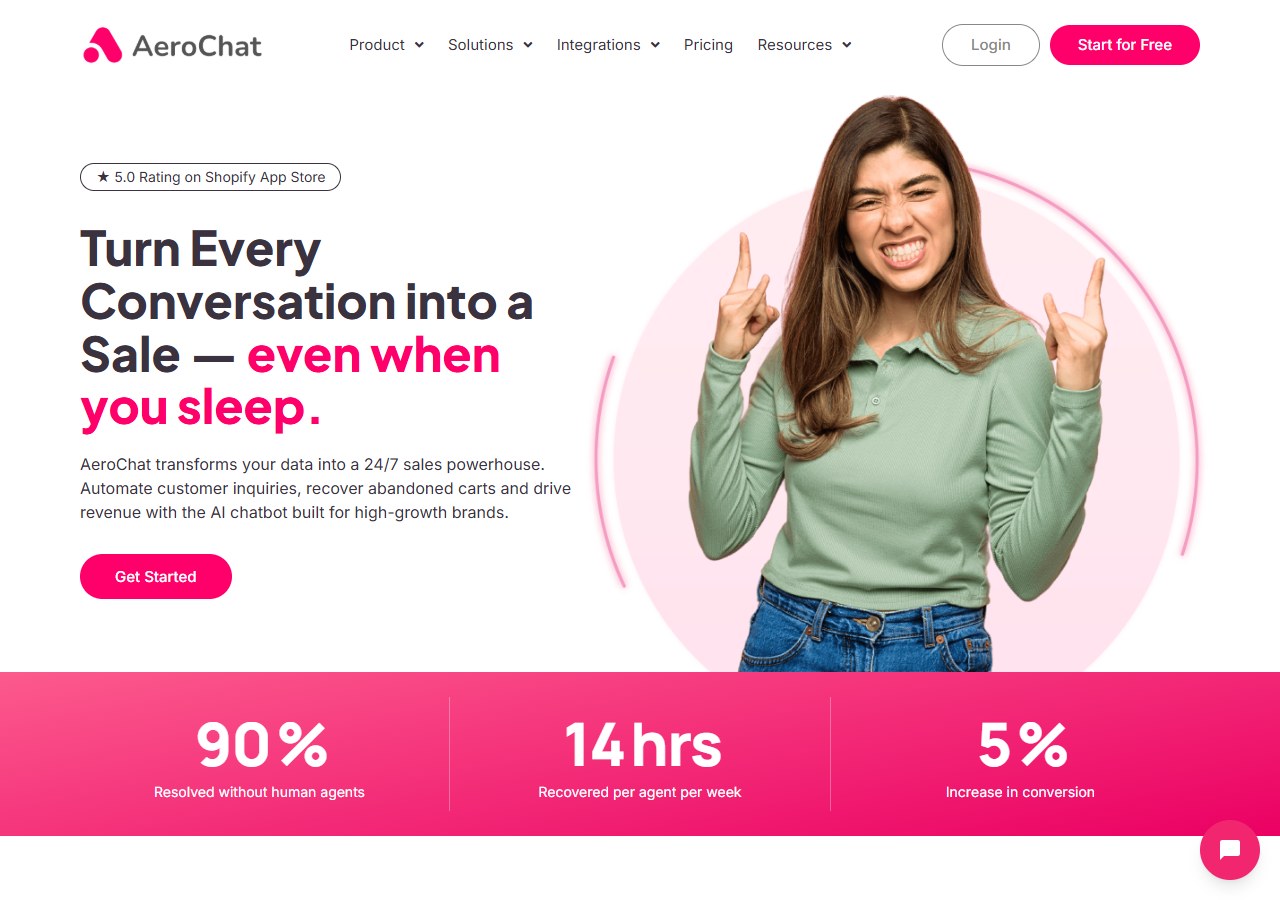
AeroChat is an AI agent platform that helps online businesses run customer service on autopilot. It supports customer conversations across web chat, WhatsApp, Facebook Messenger, Instagram, Telegram and email, with human handover when a conversation needs personal attention.
AeroChat should not be presented as a native SMS provider. A business that needs SMS requires an appropriate texting service and its own compliance setup. AeroChat becomes relevant when the same team also handles repeated customer questions across its supported channels and wants those conversations organised with approved business knowledge.
For a low-volume business, a monitored phone number and clear manual process may be enough. A broader platform becomes more relevant as channel and conversation volume increase. The guide to customer-service automation explains that growth-stage decision.
Customer service texting launch checklist
Before turning the number on, confirm that:
- The customer can understand who is sending each message.
- Consent matches the sender, purpose and programme.
- Opt-out requests stop future eligible messages.
- The business has completed required registration with its provider and carriers.
- Replies enter a monitored queue.
- Each conversation state has an owner.
- Identity checks are proportionate and approved.
- Sensitive issues move to a secure channel.
- Automation cannot block a requested human handover.
- Templates reflect current policy and operating hours.
- Links use a recognisable, controlled destination.
- Delivery, resolution, escalation and opt-out data are reviewed.
Texting earns its place in customer service when it removes a small piece of friction without creating a new privacy, compliance or ownership problem. Start with a few well-defined service interactions, test the reply path end to end and expand only after the team can resolve the responses it receives.