
7 Best Tidio Alternatives for Shopify in 2026 Based on AI & ROI

If you’re searching for a Tidio alternative for Shopify, you’re likely trying to solve one of these problems: slow responses, limited automation, rising support costs, or the need to manage conversations across WhatsApp, Instagram, and Messenger in one place.
Tidio is a reasonable starting point for a Shopify store that needs live chat and basic automation. The free plan gets you running quickly, the interface is clean, and it integrates with Shopify well enough for simple use cases. For a brand new store with low volume and a small team, it does the job.
The problem shows up as volume grows. Tidio’s AI, called Lyro, is sold as a separate add-on starting at $39 per month for 50 conversations. The automation is flow-based rather than conversational, which means it handles predictable queries well but breaks on anything unexpected. And the channel coverage outside web chat is limited unless you move to higher plans and pay for each channel separately.
Most merchants who start evaluating Tidio alternatives are dealing with one of three things: their support volume has grown past what Lyro can handle on the current plan, they need WhatsApp and Instagram from one inbox rather than separate tools, or the AI is not resolving enough conversations to justify the cost. This comparison covers six alternatives with real pricing and no ranking incentive.
What Tidio Does Not Cover Well
The triggers that push merchants to look elsewhere are consistent enough to be worth naming before getting into the alternatives.
Lyro AI is not included in the base price. The $29 per month Starter plan gives you live chat and basic automation rules. Lyro starts at $39 per month separately for 50 conversations. If you want 200 Lyro conversations, that is $99 per month on top of your base plan. Merchants who assume AI is part of what they are paying for get a billing surprise when they try to activate it.
The automation is flow-based, not conversational. Tidio’s chatbot works through decision trees. It handles queries that follow the path you designed. When a customer asks something outside that path, the bot either fails or escalates. This is manageable for simple, predictable support, but it does not scale well when your product range grows or your customers ask in ways you did not anticipate.
WhatsApp is available on higher Tidio plans but through a separate integration that does not share an inbox with your web chat. The same is true for Instagram. Merchants who want one place to manage all customer conversations end up cobbling together multiple tools.
Finally, Tidio’s Shopify integration gives agents order context but the AI does not use that data to answer questions autonomously. An agent can see order history in the sidebar, but Lyro cannot pull order status and reply to the customer with it directly.
What to Check Before Switching
Switching tools has a real cost beyond the subscription fee: data migration, team retraining, and the period where everything is running in parallel. Before committing to any alternative, verify these things first.
Check whether AI is built into the base price or charged separately. Tidio’s model bills AI on top of your plan. Some alternatives include AI in the flat monthly fee. Others charge per conversation or per resolution. Know which structure you are comparing against.
Verify how the Shopify integration actually works. Does the AI pull live order data and respond to customers with it, or does it just show agents the information? The difference determines how much the tool actually reduces your ticket volume versus how much it just organises it.
Check channel coverage from a single inbox. If your customers are on WhatsApp and Instagram alongside your website, you need a platform that handles all of them without requiring separate login, separate management, or separate billing per channel.
Count the real cost at your current conversation volume. Not the starting price, the actual bill at your monthly conversation count including AI. That is the number to compare.
How the Top Tidio Alternatives Compare
| Tool | Best for | Starting Price | Trial |
|---|---|---|---|
| AeroChat | Shopify merchants who want to automate customer service across web chat, WhatsApp, Instagram and more — with self-learning AI, no flowcharts and flat monthly pricing | From $49/month | 7-day |
| Gorgias | Shopify brands wanting deep helpdesk and ticket management | From $10/month (ticket-based) | 7-day |
| Re:amaze | Mid-market teams wanting helpdesk and chat combined | $49/agent/month | 14-day |
| Zendesk | Large support teams needing enterprise helpdesk infrastructure | $55/agent/month | 14-day |
| Intercom | SaaS companies wanting messaging and support combined | $49/seat/month | 14-day |
| Crisp | Small teams wanting simple live chat at low cost | Free plan; $25/month | Yes |
Pricing verified June 2026. Confirm current pricing on each tool’s website before deciding.
AeroChat
AeroChat is an AI agent platform that helps Shopify merchants run customer service on autopilot. Where it differs from Tidio is not just in AI depth but in how the AI works. Tidio’s Lyro is a separate add-on that handles FAQ-style queries through a conversational interface. AeroChat trains directly on your Shopify product catalogue, order data, return policy, and any other business content you connect to it, then uses that to resolve customer queries autonomously rather than routing them through a pre-built flow.
The practical difference matters for a Shopify store. When a customer asks “where is my order,” AeroChat pulls the live order status from your Shopify store and replies with the actual tracking information. Lyro cannot do this without an agent in the loop. When a customer asks whether a product comes in a specific size or colour, AeroChat pulls from your product data and answers accurately. This is why it consistently reduces ticket volume rather than just organising it.
The self-learning AI builds on every conversation it cannot answer, growing the knowledge base over time without manual updates. Human handover transfers the full conversation context to an agent when escalation is needed. WhatsApp, Instagram, Facebook Messenger, Telegram, and web chat all run from the same inbox with no separate billing per channel. No flowcharts, no decision trees, no workflow builders. You connect your data and define how the AI should behave, and it handles conversations from there.
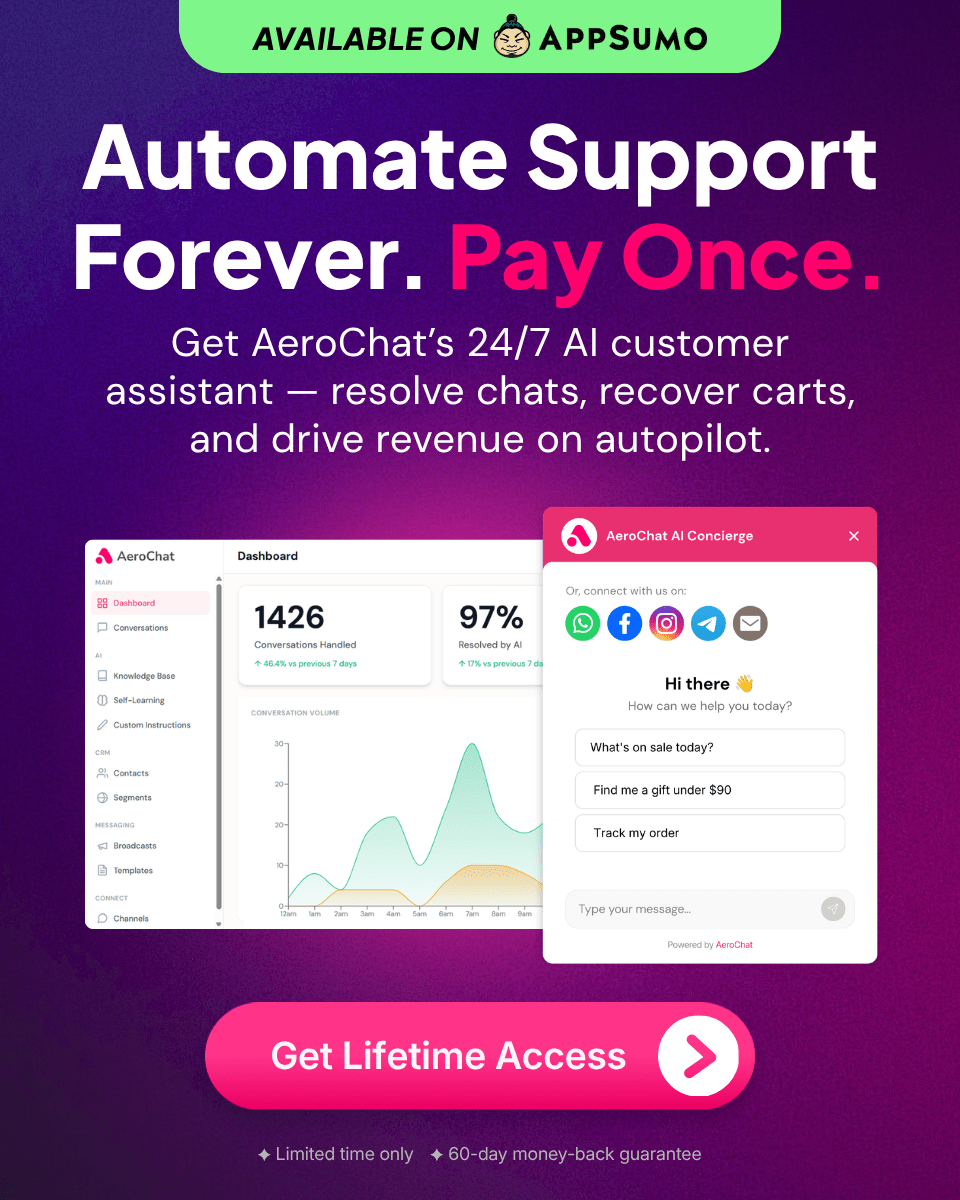
Tidio charges AI separately from the base plan. AeroChat does not. The Basic plan starts at $49 per month and covers web chat, WhatsApp, Shopify integration, WordPress integration, unlimited contacts, and 500 AI responses. Growth at $149 per month adds social channels, AI-powered chat insights, rich media in responses, webhooks, and 2,000 AI responses. Advanced at $349 per month adds self-learning AI, WhatsApp Broadcasts, agent auto-translation, conversion tracking, API access, and 5,000 AI responses. No per-ticket charges. No per-resolution fees. The bill does not change because a campaign sent your conversation volume up.
The limitation to be honest about: AeroChat is not a traditional helpdesk. If your team depends on structured ticket management, macro libraries, and SLA tracking, it will feel narrower than what you are used to. It is built for AI-first automation, not for managing agent workflows. Larger operations that need both will likely run it alongside a helpdesk rather than as a replacement for one.
Start your 7-day trial, no credit card required
Gorgias
Gorgias is the most Shopify-native helpdesk on this list. It pulls order data, refund history, and customer records directly into the support ticket, which is genuinely useful for agents handling complex post-purchase issues. The macro system is mature, the SLA tooling is solid, and it is the natural migration path for Shopify brands that have outgrown manual email management.
The problem the brief flagged is real: ticket-based pricing. Starter covers 50 tickets per month. Basic covers 300 at $60 per month. Pro covers 2,000 at $360 per month. Campaign spikes and Black Friday can push you into the next tier mid-month. On top of that, the AI Agent charges $0.90 to $1.00 per resolution, which also counts against your ticket allocation. One AI-resolved conversation gets billed twice.
For merchants who want deep Shopify helpdesk features and human agents handling most of the work, Gorgias is a strong choice. For merchants whose primary concern is AI resolution rate and predictable billing, the pricing model creates problems at scale. A full breakdown of both platforms is available in the Gorgias vs AeroChat comparison.
Re:amaze
Re:amaze sits between Tidio and Zendesk in terms of scope, which makes it the right answer for a specific Shopify merchant profile. It combines a shared inbox, live chat, and basic chatbot automation with a native Shopify integration that pulls customer and order data into conversations. The per-agent pricing is predictable and the interface is clean enough that teams adapt to it quickly.
Pricing starts at $29 per agent per month on the Basic plan, annual billing. A Starter plan at $59 per month flat covers up to 500 unique customers per month, which is often better value for smaller stores with moderate volume. AI features are included in higher tiers rather than sold separately, which makes cost planning more straightforward than Tidio’s model.
The limitation is AI depth. Re:amaze handles automation at a helpdesk level: routing, auto-responses, canned replies. It is not built for a setup where the AI resolves the majority of conversations without agent involvement. Growing Shopify stores with 3 to 15 agents who want helpdesk structure and order context in one place will find it a strong fit. Stores that want AI to eliminate most of their ticket volume will find it insufficient for that goal. The Re:amaze vs AeroChat breakdown covers the specific differences.
Zendesk
Zendesk is the most feature-complete option on this list and also the most expensive and complex for a typical Shopify store. Ticket management, SLA tracking, advanced workflow automation, agent performance reporting, a large integration library — all of it is there. For a support team of 20 or more agents managing complex routing requirements, multi-brand operations, or compliance requirements, it provides infrastructure that nothing else on this list matches.
For most Shopify merchants, it is too much. Suite Team starts at $55 per agent per month. Professional, where SLAs and advanced reporting live, is $115 per agent per month. The AI Copilot is a separate add-on at $50 per agent per month. A 10-agent team with AI enabled pays $1,650 per month minimum. The setup requires either dedicated internal admin time or outside help. Neither the price nor the complexity is justified for a store that primarily needs to handle order queries, returns, and product questions at scale. The Zendesk chat vs AeroChat comparison covers this in more detail if you are evaluating both.
Intercom
Intercom combines customer support, in-app messaging, product tours, and proactive outreach in one platform. It is the right tool for a specific use case: SaaS companies and subscription businesses where the support tool also needs to handle onboarding nudges, feature announcements, and lifecycle messaging. No other tool on this list does that combination as well.
For Shopify e-commerce merchants, the SaaS-first orientation shows. The platform is built around web app users and user journeys, not around Shopify order data, product catalogues, and post-purchase support workflows. The AI, called Fin, charges $0.99 per resolved conversation on top of seat pricing, which makes cost prediction difficult until you have real resolution rate data. The Essential plan starts at $29 per seat per month but most teams end up on Advanced at $85 per seat once they need meaningful functionality.
Intercom is worth evaluating for Shopify brands that also run a SaaS product or subscription service alongside their store. For pure e-commerce merchants, the fit is narrower and the cost structure is harder to control.
Crisp
Crisp is a lightweight live chat tool with a free plan that covers basic functionality. The free plan gives you one shared inbox, two seats, and simple website chat. Paid plans start at $25 per month for the Mini plan, which adds unlimited conversations and basic automation. The interface is clean and setup takes almost no time.
The ceiling is low but deliberate. Crisp is not trying to be an AI-first platform or an enterprise helpdesk. It is a straightforward shared inbox for small teams that want to manage customer conversations without complexity or significant cost. The AI features are minimal. There is no meaningful Shopify order data integration. Channel coverage outside web chat is limited.
For a very small store or a solo founder who needs basic chat functionality at near-zero cost while getting started, Crisp is a reasonable choice. For any store with real support volume or omnichannel requirements, it will feel constrained quickly.
How to Choose the Right Tidio Alternative for Your Store
If you are switching from Tidio because Lyro is not handling enough conversations and you want AI that actually uses your Shopify data to resolve queries automatically, AeroChat is the direct answer. The flat pricing model, the Shopify and WooCommerce integration depth, and the omnichannel inbox address the three most common reasons merchants leave Tidio. The how to migrate from Tidio to AeroChat guide covers the practical steps.
If you are switching because you need more structured ticket management and your team is primarily human-led, Gorgias or Re:amaze is the better path. Gorgias suits Shopify-first operations with high post-purchase volume. Re:amaze suits teams that want multichannel structure without Zendesk’s complexity.
If you have 20 or more agents and need enterprise infrastructure, Zendesk is the right answer despite the cost and setup overhead.
If you run a SaaS product alongside your store and need lifecycle messaging and support in one platform, Intercom is worth the cost comparison.
If you are very small, very early, and purely budget-constrained, Crisp gives you a working starting point without commitment.
Why Shopify Merchants Are Switching to AeroChat
AeroChat is best for Shopify merchants who want to automate and scale customer service without extra manpower and costs. It is not the right tool for every store. If you have a human-led support team and want better ticket management, look at Gorgias or Re:amaze. If you need enterprise infrastructure, look at Zendesk.
If your problem is agents spending most of their day on the same five questions, a billing model where conversation fees add up unpredictably, and a support stack that handles your website but leaves WhatsApp as a separate manual process, a 7-day trial on your own data will show you what the resolution rate looks like before you commit to anything.
Start your 7-day trial, no credit card required
Frequently Asked Questions
Is there a free alternative to Tidio for Shopify?
Crisp has a free plan that covers basic live chat for up to two seats. Shopify Inbox is also free and connects to your store automatically. Both have significant limitations: no meaningful AI, no omnichannel support, no self-learning. They work as starting points for very small stores. AeroChat’s trial lets you test the full platform for 7 days with no credit card, which gives you a more accurate picture of what AI-first automation actually resolves on your own conversations.
Why do Shopify merchants switch away from Tidio?
The most common reasons are the AI add-on billing structure, which makes the real cost higher than the headline price implies, the flow-based automation that breaks on unpredictable queries, and the lack of a unified inbox for WhatsApp and Instagram alongside web chat. Merchants who want AI that uses live Shopify order data to resolve queries autonomously consistently find Tidio insufficient for that goal beyond basic FAQ handling.
How does AeroChat compare to Tidio for Shopify?
Tidio handles live chat and FAQ-style automation well. AeroChat trains directly on your Shopify product catalogue and order data, which means it can answer order status queries, product questions, and return requests without agent involvement. Tidio’s Lyro cannot pull live order data and reply with it. AeroChat also includes WhatsApp, Instagram, Facebook, and Telegram in one inbox at a flat monthly fee, whereas Tidio charges separately for AI and requires higher plans for additional channels. The Tidio vs AeroChat comparison covers this in full.
What is the cheapest Tidio alternative with real AI for Shopify?
AeroChat’s Basic plan at $49 per month includes AI query handling across web chat and WhatsApp with a flat monthly fee. There are no per-conversation charges on top. For stores handling 100 to 300 conversations per month where Lyro’s per-conversation cost adds up, this is typically cheaper than Tidio once the real AI billing is included in the comparison.
Tidio is most often compared with Gorgias by Shopify merchants looking for something more tightly integrated with their store. The Gorgias comparison for Shopify covers the overlap and the gaps. For teams that want live chat specifically rather than AI automation, the LiveChat competitor guide shows the pricing and feature differences at each tier, and for stores that also need a help desk, Re:amaze alternatives is a useful companion to this guide.