
Can a Chatbot Collect Customer Information Before Passing the Conversation to a Human?

Yes, and doing it well is the difference between a handoff a customer appreciates and one that makes them repeat everything. Before a conversation reaches a human, the chatbot can gather the essentials, who the customer is, what they need, and what’s already been tried, so the person who picks it up starts from context instead of a blank slate.
What to actually collect before a handoff
The goal isn’t to collect everything. It’s to collect the specific things a human would otherwise have to ask for, which is usually a short list.
| Field | Why the human needs it |
|---|---|
| Name and contact method | So the rep can follow up if the chat drops, and address the customer properly |
| Order or account reference | The single most re-asked question in support; capturing it once saves the customer repeating it |
| What they’re trying to do | A one-line summary of the actual goal, not just the topic (“wants to change the delivery address on order 4821”, not “delivery question”) |
| What’s already been tried | So the rep doesn’t suggest the exact step the chatbot already walked them through |
| Urgency or deadline, if mentioned | Lets the rep prioritise correctly the moment they open the conversation |
How this works in AeroChat
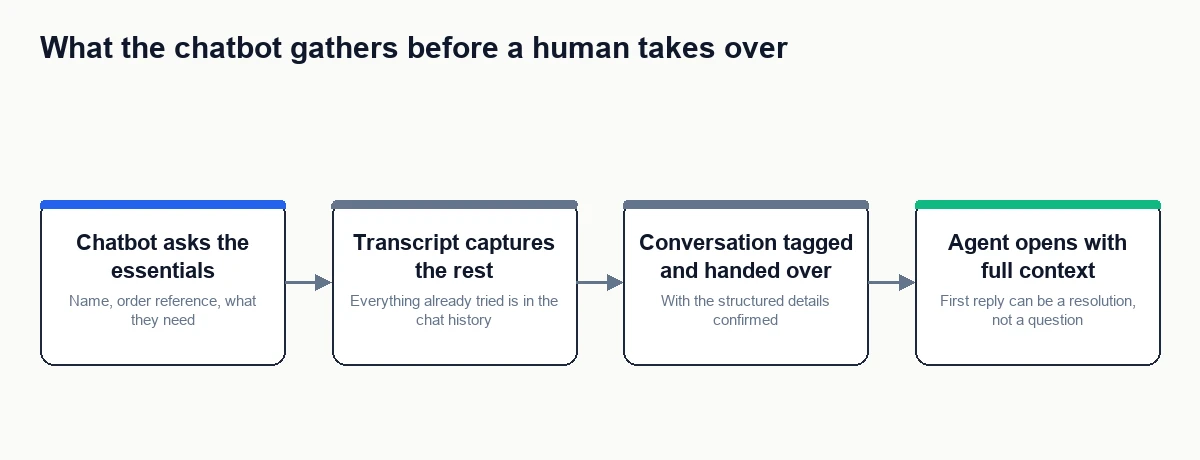
Two features do the work here. Human handover carries the full conversation across to the person taking over, so the transcript itself is always attached, nothing is lost in the switch. On top of that, custom instructions let you tell the chatbot to gather specific details before it escalates a given type of request. For example: “Before handing a delivery-change request to an agent, always confirm the order number and the new address first.”
The transcript covers the “what’s already been tried” automatically, since it’s all there in the chat history. The custom instruction handles the structured details, the order number, the reference, the specific goal, that are easy for a rep to miss when scrolling a long conversation.
A worked example
A customer messages about a damaged item. The chatbot, following a custom instruction for damage claims, asks for the order number and a photo before escalating. It tags the conversation “damage claim”, confirms the order reference, and hands over. The rep opens the conversation and immediately sees: the customer’s name, order 4821, a photo of the damaged item, and the full back-and-forth showing the chatbot already confirmed the item was sealed on arrival. The rep’s first message can be a resolution, not “can you tell me your order number?”
What not to over-collect
There’s a failure mode where the chatbot interrogates the customer through a five-question form before letting them reach a person. That’s worse than collecting nothing, because a customer who explicitly asked for a human and got a questionnaire instead feels stonewalled. Collect what the specific request type genuinely needs, usually two or three things, and let the transcript carry the rest. If a customer is clearly frustrated and asks for a person directly, that’s a signal to hand over fast with whatever context exists, not to run the full collection script.
How this differs from lead capture and CRM sync
This is specifically about the pre-handoff moment. It’s related to but distinct from a few other things:
- Capturing lead details is about recognising and storing contact info during any conversation, sales or support, whether or not a handoff happens.
- Sending customer details to your sales team is about alerting a rep to jump into a live sales conversation, a real-time notification rather than a structured pre-handoff summary.
- Updating customer information automatically is about keeping a contact record current, not preparing a single conversation for a person.
Your next step
List your three or four most common reasons a conversation gets escalated to a human. For each, write one custom instruction naming the two or three details the rep always ends up asking for. Add them in AeroChat, then watch the next week of handoffs and check whether reps are still re-asking anything, if they are, that detail belongs in the instruction too.
Frequently asked questions
Does the human agent see the whole conversation, or just a summary?
The whole conversation. Human handover carries the full transcript, so the rep can scroll the entire exchange. The custom-instruction step just makes sure the key structured details were explicitly captured rather than buried mid-thread.
What if the customer won’t give a detail before handoff?
Hand over anyway. A pre-handoff question is a helpful default, not a gate. A customer who won’t share an order number up front can still give it to the rep, and forcing the issue just adds friction to a conversation that’s already heading to a person.
Does this work across WhatsApp and Instagram, not just website chat?
Yes. Handover and custom instructions apply the same way regardless of the channel the conversation started on.