
How to Automate Customer Support Without Losing the Human Touch

To automate customer support without losing the human touch, automate stable work, answer with relevant context, give the AI clear voice and policy rules, and keep a visible route to a person. Customers need to feel understood and helped, not necessarily see a person type every sentence.
Human-centred automation is therefore an operating discipline. It depends on accurate information, specific replies, continuity and clear ownership when judgement is required.
What does the human touch mean in automated support?
The human touch is observable in how a support system behaves. It understands the question, uses the customer's context, gives a useful next step and admits when personal judgement is needed.
| Customer signal | Weak automated behaviour | Human-centred automated behaviour |
|---|---|---|
| "Will this fit my 15-inch laptop?" | Repeats the full product description | Answers from the dimensions and asks one clarifying question if needed |
| "My order is late" | Sends a generic tracking-page link | Uses current order status and explains the next realistic step |
| "This arrived damaged" | Repeats the returns policy | Acknowledges the issue, gathers evidence and routes it to an authorised person |
A friendly greeting cannot compensate for an irrelevant answer. Accuracy, continuity and accountability matter more than making software imitate emotion.
Seven rules for human-centred customer support automation
1. Automate stable work, not every conversation
Automate enquiries where the correct answer comes from reliable information and the next step is clearly defined. Product facts, standard delivery questions and routine order status are common candidates.
Keep exceptions, complaints and sensitive outcomes under human ownership. The goal is not a 100% automation rate. It is to remove repeat work without making customers fight the system.
2. Answer from current product, policy and order context
A reply feels generic when it ignores information the business should already have. Connect the automation to current product details, approved policies and live order data where the platform supports it.
Do not let static FAQ content stand in for order-specific information. If the system cannot verify a shipment date or refund status, it should ask for what it needs or stop. Merchants can use this practical framework to test an ecommerce AI chatbot before customers depend on it.
3. Write specific brand-voice instructions
"Sound friendly" is too vague. Define the words, promises and sentence style the business actually uses.
For example, a merchant might instruct the system to use short sentences, call customers by their first name when known, avoid slang, never promise a delivery date that is not in the order data and end with one relevant next step. Specific rules create consistency without forcing every reply into the same template.
4. Keep the customer's context across replies and channels
Customers should not have to repeat the order number, product, problem and previous answer each time the conversation moves. Preserve the conversation history and relevant customer details when another channel or person takes over.
Continuity also means recognising the current issue. A returning customer asking about a damaged replacement should not receive the original purchase FAQ again.
5. Make human access clear and proportionate
Human access should become easier as uncertainty, risk or frustration rises. An explicit request for a person should not trigger another cycle of automated persuasion.
Routine questions can remain automated while the answer is accurate and useful. Missing information, repeated failed answers and policy exceptions need a different route. The detailed AI-first support boundary framework explains when automation should continue and when it should stop.
6. Give a person ownership of sensitive outcomes
A person should own decisions that require discretion, recovery or authority. Examples include an unusual refund, a damaged high-value item, a cancellation outside the normal window or a customer who says the proposed remedy is unacceptable.
The automation can collect order details and summarise what happened. It should not make an unapproved promise simply to keep the conversation moving.
7. Review real conversations and correct recurring failures
Pre-launch testing cannot anticipate every product name, customer phrase or policy edge case. Review a sample of real conversations each week after launch.
Look for unsupported answers, repeat contacts, unnecessary transfers and cases where the customer's context was lost. Fix the underlying instruction, source information or routing rule instead of correcting the same symptom one ticket at a time.
Three ecommerce conversations need different treatment
A pre-purchase product question
A customer asks whether a replacement filter fits a particular appliance model. If compatibility data is complete, AI can answer directly and cite the relevant model detail. If the model number is ambiguous, the right response is one clarifying question, not a confident guess.
The human touch comes from specificity. Recommending several unrelated products would be less helpful than briefly explaining why one is compatible.
A routine order-status question
A customer asks, "Where is my order?" If live order data is available, AI can provide the current status, tracking information and the next expected step. This is a strong automation case because the answer is factual and the customer usually wants speed.
If tracking has stalled beyond the store's normal threshold, the issue is no longer routine. The system should explain what it can confirm and pass the investigation to a person.
A damaged-item complaint
A damaged item combines emotion, evidence and a possible financial remedy. Automation can acknowledge the problem, collect photos and retrieve the order. A person should decide the outcome when the case falls outside a pre-approved rule.
This is not a failure of automation. The automated work removes repetition while the person retains responsibility for a sensitive decision.
How do you create brand-voice instructions that do not sound scripted?
Good voice instructions define behaviour, not empty adjectives. A practical template is:
- Tone: calm, direct and respectful; no exaggerated enthusiasm.
- Sentence style: two to three short paragraphs, then one next step.
- Approved language: use the same delivery and returns terms as the website.
- Forbidden promises: never guarantee a date, refund or replacement without confirmed data or authority.
- Clarification: ask one focused question when a missing detail can resolve the issue.
- Stopping rule: hand over after repeated failure, explicit human request or a policy exception.
Test the instructions against ten real enquiries, including misspellings, incomplete order details and frustrated wording. If every reply has the same rhythm or closing line, vary the instruction rather than adding decorative language.
How can you test whether automation still feels helpful?
Before launch, create a test set from real enquiry categories. Include an easy case, an ambiguous case and a case that must reach a person for each major intent.
After launch, review both metrics and conversations. Useful measures include answer accuracy, repeat contact about the same issue, corrections by staff, explicit requests for a person and whether context survived handoff. AI-powered conversation insights can help surface resolved and escalated topics, but merchants should still read a representative sample.
Do not treat a lower human-ticket count as conclusive evidence. Customers may abandon an unhelpful conversation. Check whether the issue was actually completed and remained completed.
How AeroChat can preserve context while routine work is automated
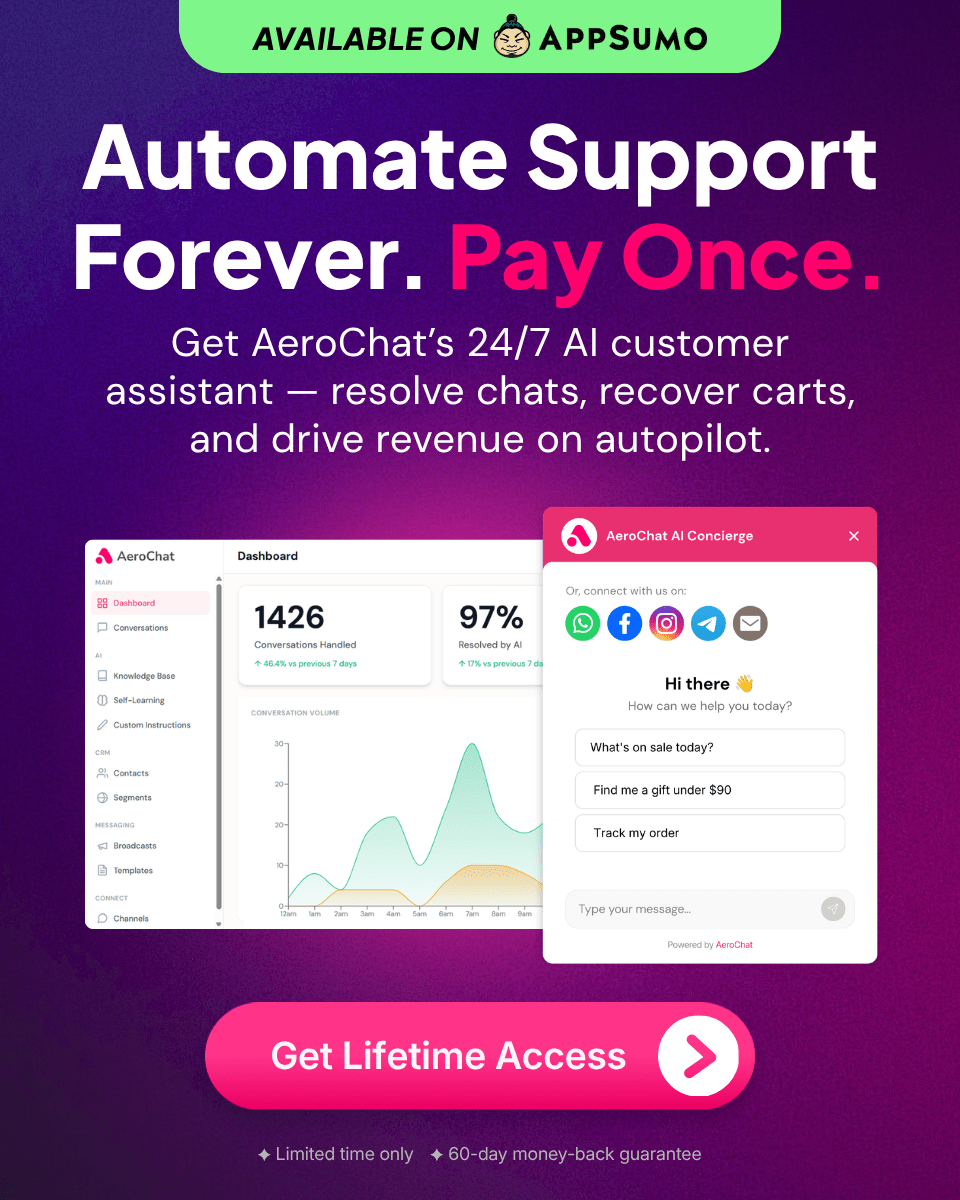
AeroChat is an AI agent platform that helps ecommerce brands run customer service on autopilot. Merchants can use custom instructions to define response rules and train its knowledge from approved business information, while its Shopify connection uses product and order data for relevant enquiries.
When a conversation needs personal attention, AeroChat can pass the case to a human with context across supported channels. This supports continuity, but it does not create empathy or policy judgement by itself. The merchant still owns the source information, brand instructions, escalation rules and quality review.
That makes AeroChat most relevant when routine volume or channel complexity has become visible. It should automate defined work around the human team, not conceal the team from customers.
Human-centred automation is a set of operating rules
Review the store's ten most common enquiry types. Assign each one to automation, AI assistance or human ownership, then document the data and stopping rule for it.
This simple exercise protects the qualities customers notice: a relevant answer, consistent context, honest boundaries and a responsible person when the situation needs one.