WhatsApp vs Email Marketing: Which to Use for Ecommerce

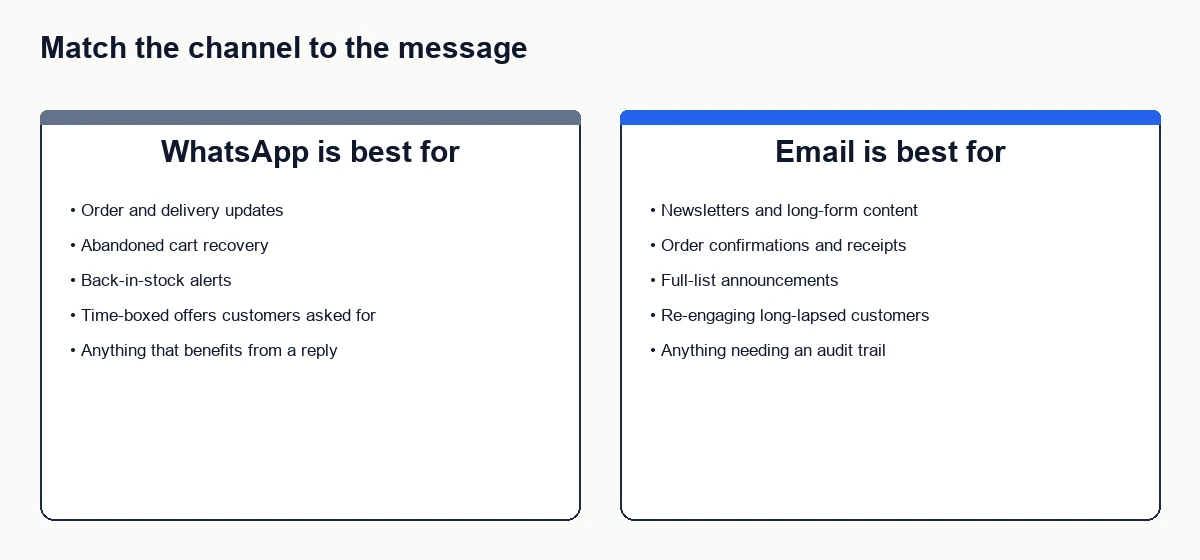
Neither replaces the other. WhatsApp wins for time-sensitive, high-attention messages a customer needs to see now, order updates, back-in-stock alerts, cart recovery. Email wins for volume, depth, and content that can wait, newsletters, long-form announcements, receipts, anything you’d want a permanent searchable record of. Most ecommerce stores that do this well use both, matched to the job.
Where each one actually wins
| Attention | Opened quickly and at a high rate; sits in the same app as messages from friends | Opened at a much lower rate; competes with dozens of other marketing emails |
| Speed of response | Often within minutes; customers reply conversationally | Hours to days, if at all |
| Message length | Short. A few lines, one image, one clear action | Long-form works. Multiple sections, rich layout, several links |
| Cost | Priced per conversation by Meta; adds up at scale | Very low per message; near-free at any volume |
| Opt-in friction | Higher. Customer must actively opt in to receive messages | Lower. A checkbox at checkout is enough in most regions |
| Sending freedom | Constrained. Outside a 24-hour window, only pre-approved template messages | Send whenever you want, subject to spam rules and list health |
| Record keeping | Poor. Chat threads aren’t built for reference | Strong. Searchable, archivable, forwardable |
| List ownership | You own the phone numbers, but delivery runs through Meta’s platform | You own the list outright; portable between providers |
Use WhatsApp for the messages that lose value if they’re late
These are the messages where a same-day open matters and a conversational reply is useful:
- Order and delivery updates, especially exceptions like a delay or a failed delivery attempt.
- Abandoned cart recovery, where a nudge within the hour converts and a nudge two days later mostly doesn’t.
- Back-in-stock alerts, covered in back-in-stock alerts via WhatsApp and Instagram, where the customer wants to act before it sells out again.
- Time-boxed offers a customer genuinely asked to hear about.
- Anything that benefits from a reply, since WhatsApp turns a broadcast into a conversation your team can pick up.
Use email for volume, depth, and the permanent record
- Newsletters and content, where length and layout do the work.
- Order confirmations and receipts, which customers expect to be able to find later.
- Large announcements to your whole list, where WhatsApp’s per-conversation cost would be prohibitive.
- Re-engagement of long-lapsed customers who never opted into WhatsApp and would find a message there intrusive.
- Anything regulated where you need a clear, logged, unsubscribe-respecting audit trail.
How they work together
The strongest setup isn’t picking one. It’s sending the reference material by email and the time-sensitive nudge by WhatsApp. A customer places an order: the confirmation and receipt go by email, the “your order shipped” and “out for delivery today” updates go by WhatsApp. A product they wanted comes back in stock: the WhatsApp alert goes to the customers who opted in for it, the email goes to a broader segment. Each channel does the part it’s good at.
The WhatsApp constraint to plan around
WhatsApp isn’t a free-for-all like email. Outside a 24-hour window after the customer’s last message, you can only send pre-approved template messages, and getting templates approved takes time. This shapes what WhatsApp campaigns are even possible, and it’s covered in detail in how can I automate follow-ups after a customer conversation. Email has no equivalent restriction, which is part of why it stays the better tool for scheduled, list-wide sends.
How AeroChat fits
AeroChat handles the WhatsApp side: WhatsApp broadcast campaigns on the Growth plan and above, reusable templates, and the ability for your team to pick up replies conversationally when a broadcast prompts one. It isn’t an email marketing tool, so email stays with whatever platform you already use. The two run in parallel rather than through one system.
Your next step
Take your current email calendar and mark which sends are genuinely time-sensitive, order updates, cart recovery, restock alerts, urgent offers. Those are your WhatsApp candidates, and only for customers who’ve opted in. Leave the rest on email. Don’t try to move your whole programme to WhatsApp; move the handful of messages that lose their value when they arrive late.
Frequently asked questions
Is WhatsApp marketing more effective than email?
For the right message, yes, it’s opened faster and more often. For the wrong message, a long newsletter, a full-list announcement, it’s more expensive and more intrusive with no upside. Effectiveness depends entirely on matching the channel to the message.
Do I need customer permission for both?
Yes, but the bar is different. WhatsApp requires an explicit opt-in to receive business messages. Email typically requires a clear consent step and a working unsubscribe. Treat WhatsApp opt-in as the more deliberate, higher-intent signal.
What’s the cost difference at scale?
Email is close to free per message at any volume. WhatsApp is priced by Meta per conversation, so a large one-off send costs real money. This is the main reason to reserve WhatsApp for targeted, high-value messages rather than mass broadcasts.