
Top Instagram Chatbot for Solo Founders: When to Automate in 2026
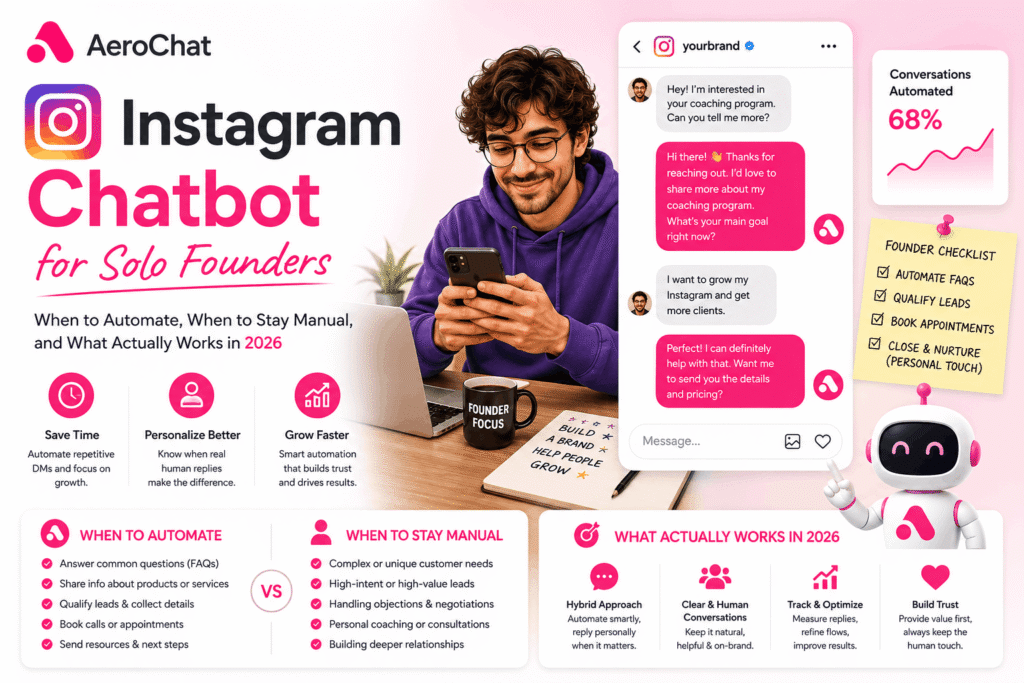
Most articles about Instagram chatbots for solo founders are written by chatbot companies. They have a built-in answer to the question “should you automate your Instagram DMs?” The answer is always yes. Buy our tool.
This post is going to give you a different answer. Not every solo founder should automate Instagram DMs. Some should. Many shouldn’t, at least not yet. Knowing the difference saves you money, protects the early customer learning that builds a real business, and avoids the trap of installing automation before you understand what you’d actually want it to do.
I’ll cover the question honestly: when does Instagram automation make sense for a solo founder, when does it actively hurt, what tools actually fit at different stages, and how to set things up if you’ve decided you’re ready. I’ll also be direct about which tools fit which stages, including being honest about when AeroChat is the right answer and when it isn’t.
The contrarian case: why some solo founders shouldn’t automate yet
You’re a solo founder. You get fifteen DMs a day on Instagram. You’re spending 45 minutes a day responding to them. The chatbot vendors will tell you that’s 22 hours a month you could automate away. The math sounds obvious.
Here’s what the math misses.
Those 45 minutes a day are how you’re learning your business. Every DM is a free piece of customer research. The questions people ask you reveal what’s confusing about your product, which features matter most, what objections come up before purchase, and what language your customers actually use to describe their problems. That language goes into your sales copy. Those objections go into your FAQ. Those feature requests shape your roadmap.
If you automate too early, you stop learning. The chatbot answers the questions, you never see them, and your understanding of your customer freezes at the level it was when you set up the automation. Six months later, you have a more efficient response system attached to a less informed founder.
The other thing that happens with premature automation: solo founders set up chatbots that confidently give wrong answers. You haven’t refined your messaging yet. Your product is still changing. The “FAQ” you train the bot on is your best guess at this stage, not actual data. Prospects get a polished-looking automated response that’s subtly wrong, and they leave with worse information than they would have gotten from a slow human reply.
The honest threshold for solo founder Instagram automation: you should hit at least one of these three before deploying.
Either your DM volume is high enough that responses are taking more than 90 minutes a day, or you’re regularly missing inquiries from prospects in different time zones, or you’re answering the same three to five questions over and over and have stopped learning anything new from doing so.
If none of those apply, stay manual. Use the time to write better captions, make better content, or talk to existing customers. Automation will still be there when you actually need it.
The four solo founder stages and what fits each one
Solo founders aren’t one segment. The right Instagram automation looks completely different depending on where you are. Here’s the honest breakdown.
|
Stage |
Monthly revenue |
Daily DM volume |
What you actually need |
Tools that fit |
|---|---|---|---|---|
|
Pre-revenue |
$0 |
Under 5 DMs |
Stay manual. You’re learning. |
None yet |
|
Early traction |
$0-$5K |
5-15 DMs |
Comment-to-DM lead magnets only |
ManyChat free tier, CreatorFlow ($15/mo) |
|
Growing solo |
$5K-$30K |
15-50 DMs |
FAQ automation, smart handoff, basic capture |
ManyChat paid, CreatorFlow, AeroChat (if multi-channel) |
|
Scaling solo |
$30K+ |
50+ DMs |
Multi-channel platform handling Instagram + WhatsApp + website chat from one inbox |
AeroChat, Tidio, Gallabox |
Notice what’s missing from this table: the “enterprise” tier. If you’re a solo founder, you don’t need ManyChat at $145/month, Tidio at $59/month, or any tool with team collaboration features you can’t use. Vendors will try to sell you those tiers. Don’t buy them yet.
Also notice the pre-revenue stage isn’t “deploy a chatbot anyway.” It’s “stay manual.” The single biggest mistake pre-revenue founders make is over-tooling. You don’t have a customer acquisition problem yet. You have a customer understanding problem. Automation amplifies a process. If your process isn’t dialed in, automation amplifies the dysfunction.
What automation actually saves you (and where the savings claims are inflated)
Vendor pages claim things like “save 10 hours per week” and “convert 3-5x more leads.” Some of this is true. Some is marketing.
The real time savings for a solo founder who automates Instagram correctly come from three places.
Comment-to-DM lead magnets. A post with 200 comments saying “GUIDE” used to require you to manually DM each commenter. Automation handles this in seconds. Real savings: 30 minutes to two hours per viral post, depending on engagement.
FAQ deflection. Repetitive questions about pricing, shipping, course start dates, and product specs answered automatically. Real savings: 10-30 minutes a day for most solo founders, more for high-volume creators.
Out-of-hours coverage. Prospects in different time zones get a response immediately instead of 8-12 hours later. The savings here aren’t time, they’re conversion. Prospects who get a response within minutes are meaningfully more likely to convert than prospects who wait overnight.
The claims that don’t hold up under scrutiny:
“Convert 3-5x more leads.” This is true only if your manual baseline is bad. If you currently respond to DMs within an hour, automation will not 3x your conversion. If you currently take 8-24 hours to respond, automation can produce a meaningful conversion lift, but probably 20-50%, not 300-500%.
“Save 10 hours per week.” Possible if you’re handling 100+ DMs per day. Unrealistic for the typical solo founder doing 15-30 DMs per day.
“Sell on autopilot.” No. Automation handles the repetitive parts of pre-sale conversation. The actual sale, especially for products over $200, still needs human involvement at some point. Anyone telling you otherwise is selling you something.
Set realistic expectations going in. Automation is useful. It’s not magic.
What to automate first (and what to leave manual)
The 80/20 of solo founder Instagram automation: three things drive most of the value, and beyond those three, you’re adding complexity that doesn’t pay back for a solo operation.
Automation 1 is comment-to-DM for lead magnets. Post something on Instagram saying “comment GUIDE below to get my free X.” Anyone who comments gets an automated DM with the resource. This is the single highest-ROI automation for solo founders building an email list or audience. Setup time: 15 minutes. Tool: ManyChat free tier or CreatorFlow at $15/month does this perfectly.
Automation 2 is first-touch FAQ replies. When someone DMs you a common question (pricing, course details, “how does this work”), the chatbot answers immediately. Setup time: 1-2 hours initial training, then ongoing tweaks. The trick is keeping the chatbot’s confident-answer scope narrow. Better to handle five questions perfectly than fifty questions adequately.
Automation 3 is smart handoff to you for high-intent moments. When a prospect signals readiness to buy, asks a complex question, or expresses frustration, the chatbot tags the conversation and routes it to your inbox with full context. You handle the closing and the complex stuff. The chatbot handles the rest.
What to leave manual as a solo founder:
Story replies (they’re rarely high-intent for solo creators outside specific niches). Mentions and tags (handle these manually, they’re often relationship-building moments). Anyone who’s already in active conversation with you (let it stay human). Complaints, refund requests, and emotional conversations (always you, never the bot).
The pattern: automate the inbound funnel entry points, leave the relationship-building and the difficult conversations to yourself. Solo founders who automate everything end up with cold, transactional Instagram presences. The ones who automate selectively keep their advantage as a personal brand.
Honest tool recommendations by stage
Here’s where I’m going to be direct, including about AeroChat. Not every tool is right for every stage, and pretending otherwise wastes your time.
For early traction solo founders ($0-$5K/month), your best options are ManyChat free tier (up to 1,000 contacts free, then $25/mo) or CreatorFlow ($15/mo flat). Both handle comment-to-DM and basic FAQ automation. ManyChat has more features but a steeper learning curve. CreatorFlow is simpler and cheaper for Instagram-specific use. AeroChat at this stage is probably overkill. Its multi-channel capabilities don’t matter when Instagram is your only channel.
For growing solo founders ($5K-$30K/month), your options expand. ManyChat paid plan ($25-65/mo depending on contacts), CreatorFlow ($15-29/mo), or Chatfuel ($15-30/mo) all work well for Instagram-focused setups. AeroChat starts to fit here if you’re also receiving inquiries on WhatsApp or running a website with chat. The multi-channel inbox becomes valuable when you stop being able to keep track of conversations across platforms.
For scaling solo founders ($30K+/month with multi-channel inquiries), this is where AeroChat genuinely fits. You’re getting Instagram DMs, WhatsApp messages, and website chat. You’re spending real time switching between platforms and missing context. A unified inbox with automation across all three channels saves meaningful operational overhead. At this stage, the tools that lose are the Instagram-only specialists. They don’t solve the multi-channel problem.
For technical solo founders who want full control, custom builds using the Instagram Graph API directly, combined with no-code tools like Make or n8n, can handle very specific workflows that off-the-shelf tools don’t. Almost no solo founders should do this. The maintenance burden is real and the time investment usually doesn’t pay back at solo scale.
For deeper comparison of two of the most-mentioned tools, see ManyChat vs AeroChat and Tidio vs AeroChat. For broader context on Instagram tools beyond chatbots, see Best Instagram Automation Tools.
How to set up Instagram automation as a solo founder (the realistic version)
If you’ve decided you’re at a stage where automation makes sense, here’s the realistic setup process. Vendor pages will tell you it takes 5 minutes. The honest answer is 3-6 hours of focused work, plus ongoing iteration.
Step 1: Connect your Instagram Business or Creator account to your chosen tool. This requires switching to a Business or Creator account if you’re still on a Personal account, and connecting a Facebook Page (Meta requires this). Time: 15-30 minutes if you have everything set up, longer if you don’t.
Step 2: Set up your first comment-to-DM automation. Pick one piece of content you regularly post about (a lead magnet, a free resource, a popular topic). Build a single keyword-triggered flow. Test it on yourself before launching. Time: 30-45 minutes.
Step 3: Train your FAQ responses. Write out the 5-10 most common questions you currently get in DMs. Draft the answers in your own voice. Configure the chatbot to recognize variations of these questions and respond. Crucially, set the chatbot to hand off to you when it’s not confident in a match. Don’t let it guess. Time: 1-2 hours.
Step 4: Configure handoff triggers. Define what signals send a conversation to your manual inbox: keywords like “price,” “buy,” “how do I sign up,” any expression of frustration, any question the chatbot doesn’t have a confident answer for. Time: 30 minutes.
Step 5: Test everything end-to-end. Use a friend’s Instagram account or a secondary account to send DMs that test each automation. Catch the failures before customers do. Time: 30-60 minutes.
Step 6: Monitor and refine for the first two weeks. Read every chatbot interaction. Adjust messages that aren’t landing. Add FAQ entries as new common questions emerge. This is the work most solo founders skip, and it’s the difference between a chatbot that helps and a chatbot that costs you customers.
The ongoing maintenance is real but smaller, typically 30 minutes a week to review chatbot performance and update answers as your business evolves.
For a more detailed walkthrough of the technical Instagram chatbot setup, see How AI Chatbots Turn Instagram Followers Into Customers.
Mistakes solo founders make when deploying Instagram automation
Five patterns I’ve seen repeatedly that you can avoid.
Buying the most powerful tool you can find. Solo founders sometimes pick tools meant for agencies because the feature list looks impressive. You’ll use 5% of what you’re paying for, and the complexity will slow your setup. Pick the simplest tool that handles your three core use cases.
Trying to automate everything at once. Set up one automation. Get it working. Then add a second. Adding five workflows at launch means you can’t tell which one is producing results, and you can’t fix any of them when they break.
Setting up the chatbot and never reading the conversations. Automation only works if you stay involved. The chatbot is a draft of your customer conversation, not a final version. Solo founders who deploy and walk away end up with chatbots that quietly cost them sales.
Trying to make the bot sound human. It’s not human. Customers know it’s not human. Pretending otherwise damages trust. Better approach: be transparent that the bot is automation, give it a tone consistent with your brand, and make sure the handoff to you happens cleanly when the conversation needs a person.
Forgetting that Instagram automation has rules. Meta’s API has restrictions. You can’t message anyone who hasn’t messaged you first within the past 24 hours (with limited exceptions for paid message tags). Comment-to-DM only works on your own posts. Bulk-messaging tools that promise to bypass these rules will get your account restricted. Stay inside Meta’s guidelines, even when third-party tools promise shortcuts.
For the contrarian framing on whether to automate at all, Instagram Automation vs Manual Engagement covers the broader argument.
Where AeroChat fits for solo founders
I said I’d be direct about this. Here’s the honest version.
AeroChat is not the cheapest Instagram chatbot. It’s not the simplest one to set up for a single channel. If you’re a pre-revenue solo founder or an early-stage creator just looking to automate comment-to-DM lead magnets, you should probably use ManyChat’s free tier or CreatorFlow’s $15 plan. Those tools do what you need for less money than AeroChat.
AeroChat fits solo founders better at the stage where you’re juggling channels. If you’re getting Instagram DMs, WhatsApp messages from international customers, and website chat from your store, all three on the same day, AeroChat handles them in one inbox with one set of automation rules. That’s where the value compounds. The tool’s strength isn’t being the best Instagram-only chatbot. It’s being the chatbot that doesn’t make you switch between four tools to manage your conversations.
This typically becomes valuable when you’re past $5K-$10K/month, running an ecommerce store on Shopify or WooCommerce, and reaching the point where you’re losing track of conversations across platforms.
If that’s where you are, AeroChat’s free trial connects to your store and sets up Instagram, WhatsApp, and website chat in roughly 30 minutes. If you’re not there yet, save the money and use a simpler tool. You’ll get more from a free ManyChat setup than from a paid AeroChat plan you’re underutilizing.
For broader context on multi-channel chatbot setup, Best WhatsApp AI Chatbot Platforms covers the WhatsApp side of the same workflow.
The honest closing
If you came to this post hoping I’d tell you to deploy an Instagram chatbot today, I haven’t. Some solo founders should. Most shouldn’t yet. The right answer depends on where you are, what you’re learning from your current DM volume, and whether the math actually works at your scale.
The framework that holds up: automate when manual response time is genuinely costing you, when you’ve stopped learning from the same five questions, or when you’ve started missing inquiries from time zones you can’t cover. Until then, the unfiltered customer conversations you’re having every day in your DMs are doing more for your business than any chatbot would.
When you do reach the point of automation making sense, start small. One automation. The simplest tool that handles it. Read every conversation for the first two weeks. Refine. Then expand.
That’s the real playbook. Most chatbot vendors won’t write it because it sells fewer subscriptions. The ones that do are usually the ones worth working with when you actually need them.
Solo founders on Instagram need chatbots that handle DMs without requiring ongoing configuration time. The Instagram Threads chatbot guide covers the same use case on the related platform. For the DM automation that closes leads, how social media chatbots close leads covers the conversion mechanism, and Instagram chatbots for coaches and consultants covers the service-business version of this use case.