
WhatsApp vs SMS Marketing for Ecommerce

WhatsApp gives you rich, two-way, conversational messages and near-global reach, but it’s constrained by opt-in rules and a 24-hour messaging window. SMS is simpler, more universal, and works on any phone with no app, but it’s plain text, one-directional in practice, and can cost more per message in some regions. For most ecommerce stores the honest answer is that SMS is the safer default for pure alerts, and WhatsApp is worth it where a conversation or a richer message actually adds value.
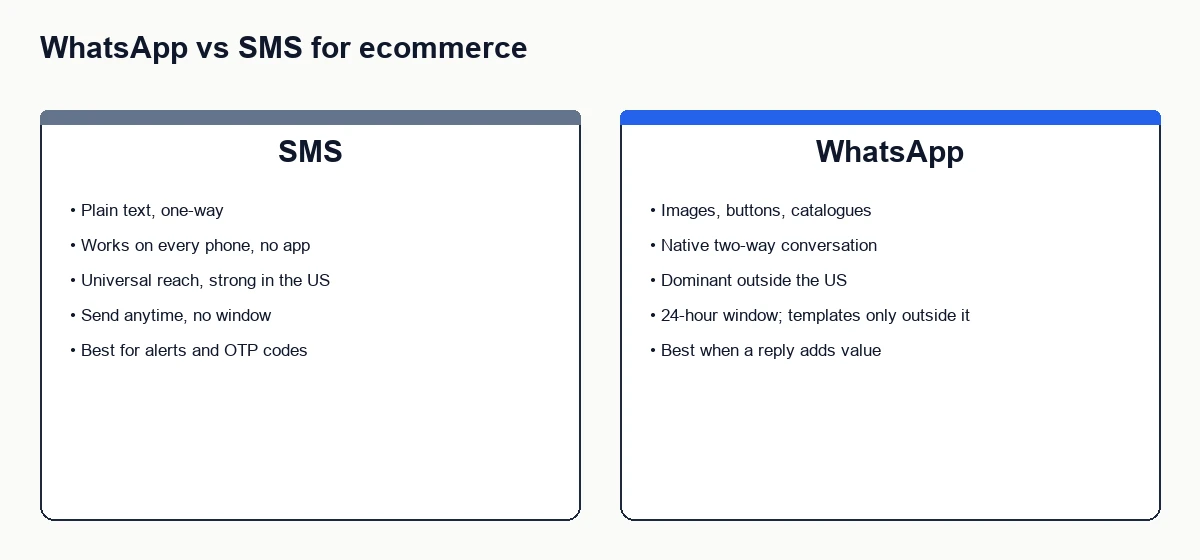
Side by side
| SMS | ||
|---|---|---|
| Message format | Text, images, buttons, catalogues, documents | Plain text; MMS adds images but is inconsistent and pricier |
| Two-way conversation | Native. Customers reply and your team picks it up | Technically possible, but most stores treat it as send-only |
| Reach | Requires the app; dominant in most of the world, lighter in the US | Works on every phone, no app, everywhere |
| Opt-in | Explicit opt-in required to receive business messages | Consent required, but a checkout checkbox is usually enough |
| Sending freedom | Outside a 24-hour window, only pre-approved templates | Send anytime, subject to local regulations and quiet hours |
| Cost model | Priced per conversation by Meta; varies by country | Priced per message (or segment) by your SMS provider; varies by country |
| Deliverability | Delivered or not, with read receipts | Generally very high; carrier filtering can silently drop marketing sends |
| Brand presence | Verified business profile with name, logo, description | A short code or number; little brand identity |
Use SMS for the plain, universal alert
SMS is the right tool when the message is short, one-way, and needs to reach everyone regardless of which app they use:
- Shipping and delivery notifications, the classic “your order is out for delivery” text.
- OTP and verification codes, where universality and speed matter and there’s nothing to discuss.
- Short, urgent alerts to a US-heavy customer base where WhatsApp adoption is lower.
- Any store without the team to handle replies, since SMS sets no expectation of a conversation.
AeroChat isn’t an SMS tool; for the Shopify-specific side of what to send and when, see SMS marketing for Shopify.
Use WhatsApp where the conversation or the richer message earns its cost
- Order exceptions, a delay, a failed delivery, a stock issue, where the customer will have a follow-up question and you want them to be able to just ask it.
- Cart recovery and back-in-stock, where a product image and a single tap-to-buy button outperform a plain text link.
- Post-purchase check-ins that invite a reply, since a “how did it go?” on WhatsApp actually gets answered.
- International customers in markets where WhatsApp is the default messaging app and an SMS from an unknown number gets ignored.
The window difference that changes campaign design
SMS lets you send a scheduled campaign to your whole list whenever you like. WhatsApp doesn’t, outside the 24-hour window after a customer’s last message, you’re limited to pre-approved templates, and approval takes time. This means WhatsApp campaigns have to be planned around template approval and the window, while SMS campaigns can be far more spontaneous. The mechanics of working within that window are covered in how can I automate follow-ups after a customer conversation.
Running both
Plenty of stores use SMS as the baseline, delivery alerts and OTPs to everyone, and layer WhatsApp on top for opted-in customers who get the richer experience: order updates they can reply to, restock alerts with a buy button, a real conversation when something goes wrong. The customer who opted into WhatsApp gets more; the customer who didn’t still gets the essential text.
Your next step
Check where your customers actually are. A US-heavy base leans SMS-first, with WhatsApp as an opt-in upgrade. An international or non-US base often makes WhatsApp the primary channel worth investing in. Then split your messages: pure alerts and codes on SMS, anything that benefits from an image, a button, or a reply on WhatsApp for the customers who opted in. For the WhatsApp side, AeroChat’s broadcast campaigns (Growth plan and above) handle the sending and let your team catch the replies.
Frequently asked questions
Which is cheaper, WhatsApp or SMS?
It depends heavily on the country. In some markets SMS is cheaper per message; in others WhatsApp’s per-conversation pricing works out lower, especially when a single conversation covers several back-and-forth messages. Check both against your actual customer geography rather than assuming.
Do customers prefer one over the other?
It’s regional. In much of Europe, Latin America, the Middle East, and Asia, WhatsApp is the expected channel and an SMS feels dated. In the US, SMS is normal and WhatsApp business messaging is less established. Preference follows whatever app people already use for personal messaging.
Can I just use WhatsApp for everything and drop SMS?
Only if essentially all your customers use WhatsApp and have opted in. For most stores, dropping SMS means losing the ability to reliably reach customers who never installed the app or never opted in, which is why the two usually run together.