
How Can I Turn Customer Conversations Into Qualified Leads?

Ask a handful of specific questions before you call something a lead, not the moment a name and email show up in the chat. The framework worth building this around is BANT, budget, authority, need, and timeline, which has been the standard way to separate a real opportunity from a browsing visitor since long before chatbots existed. Adapted for chat, it takes about three questions, not a form.
Captured is not the same as qualified
Your chatbot can pull a name and email out of almost any conversation, including someone asking a single unrelated question. That’s a captured contact, not a qualified lead. Send your sales team a flood of those and they’ll learn to ignore anything with “chatbot” in the source field, which quietly kills the whole point of automating this. Qualification is the filter that decides who’s actually worth a rep’s time before it ever reaches them.
BANT, adapted for a chat conversation
BANT stands for budget, authority, need, and timeline, and it’s the default lead-qualification model for a reason: those four signals predict fit better than almost anything else you could ask. In a form, you’d ask all four in whatever order the fields happen to sit in. In a chat, order matters, because you’re one abandoned conversation away from getting no answers at all.
| Order | Signal | Why it goes here | Example question |
|---|---|---|---|
| 1st | Need | The most natural thing to ask early, it’s what the conversation is already about | “What are you hoping to solve with this?” |
| 2nd | Timeline | Low-friction, and it tells you how urgently this is worth a rep’s attention | “Are you looking to get this running soon, or still exploring?” |
| 3rd | Budget | The most sensitive ask, so it goes after trust is already building, not first | “Roughly what range are you working with for this?” |
| 4th | Authority | Often inferable from what’s already been said; ask directly only if it’s still unclear | “Would you be the one making this decision, or is someone else involved too?” |
You don’t need all four for every business. A high-volume ecommerce store can often stop at need and timeline. A considered B2B purchase usually wants all four before a rep spends real time on a call.
Write the question like a person, not a form field
A static form asks for information regardless of context. A chat conversation can ask the same BANT question only when it’s actually relevant, which changes how it lands.
Weak, form-like:
Please enter your company size.
Better, conversational and specific:
Got it, and roughly how many people would be using this day to day? That helps me point you to the right plan.
Same information, but the second version explains why it’s being asked. That single sentence of context is usually the difference between a real answer and someone dropping out of the conversation.
Building this in AeroChat
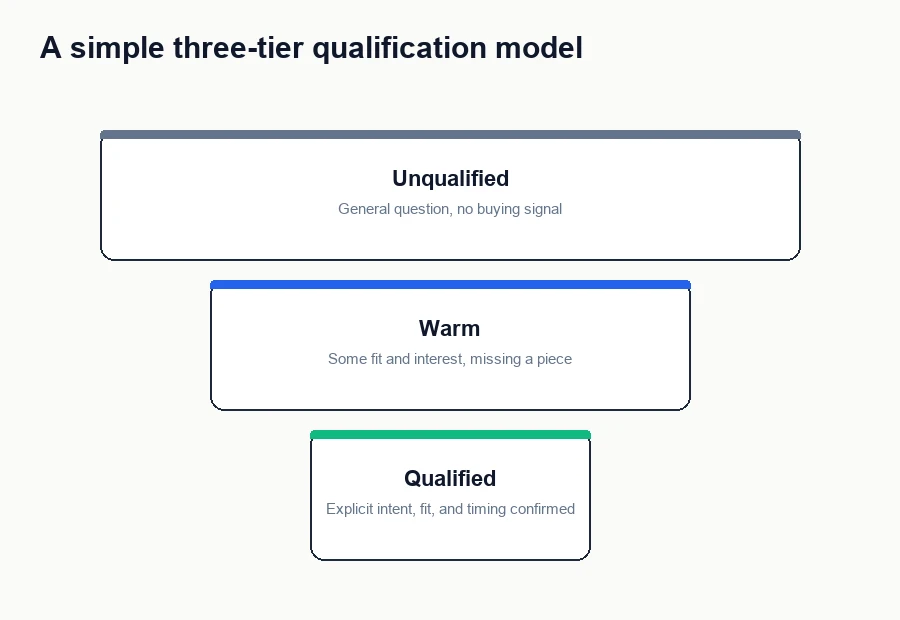
Set up your chatbot’s script to ask the BANT questions that matter for your business, in the need-timeline-budget-authority order above, then tag the outcome as soon as it’s clear using AeroChat’s conversation tagging. Three tags cover most stores: unqualified (no real signal), warm (some fit, missing a piece), and qualified (need, timeline, and either budget or authority confirmed). Tag it the moment it’s answered, not after the fact from memory, so a rep can filter your contact list by tag and immediately see who’s actually worth a call today.
What happens after a lead is qualified
Qualification is the filter. What comes next is a separate set of steps: getting the AI to actually recognise and capture those details as they’re said (can an AI chatbot automatically capture lead details), getting that record into your CRM if you run one (can a chatbot add new leads to my CRM automatically), and making sure a rep actually follows up on it well (how can a chatbot help my sales team follow up with interested customers). Qualification decides who enters that pipeline in the first place.
Common mistakes to avoid
The biggest one is front-loading every BANT question before the visitor has any reason to trust the conversation is going somewhere. Answer the actual question they came in with first, then qualify once there’s a genuine signal of interest. The second is treating every captured contact as equally qualified regardless of what was actually said in the chat, which is the fastest way to train your own sales team to stop trusting anything with “chatbot” as the source.
Your next step
Pick your three BANT questions for your business today, need first, then timeline, then budget or authority depending on which matters more for you. Set up the three conversation tags in AeroChat. Run it for a week, then check with your sales team whether “qualified”-tagged contacts are actually converting better than the rest. Adjust the questions from there, not from a guess.
Frequently asked questions
Does BANT work for ecommerce, not just B2B sales?
Yes, though “budget” and “authority” carry less weight. For ecommerce, need and timeline usually do most of the work. A shopper asking specifically about one product with a clear “when can I get it” question is a qualified lead even without a formal budget or decision-maker discussion.
How many qualifying questions is too many?
Past three or four, you’re interrogating, not chatting. If someone answers your need question and then goes quiet, that’s your signal to stop asking and let a human take it from there rather than pushing for the rest of BANT.
Can qualification happen automatically without someone defining the rules first?
The questions and what counts as a good answer are business decisions your sales team should make deliberately. The chatbot executes the BANT conversation and applies the tag, but the criteria for what “qualified” actually means should come from the people who have to act on the result.