
7 Best Shopify Voice Chatbots and AI Voice Agents in 2026
If customers call your Shopify store and nobody picks up, you lose the sale. Voice AI for Shopify routes those calls to an AI agent that can answer product questions, check order status and handle common support requests around the clock.
This guide covers the seven most relevant tools available in 2026, who each one is built for, and how to decide whether a voice-first approach is actually right for your store or whether a text-channel AI agent will serve you better.
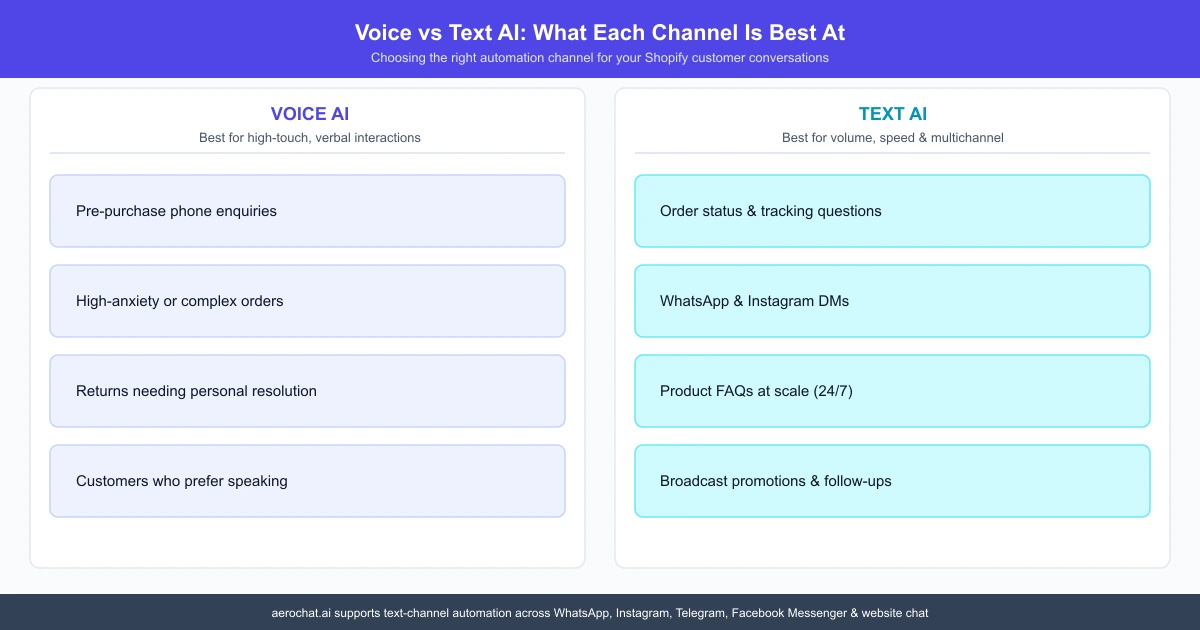
Voice chat vs normal chatbot: why some customers prefer to speak
Some customers will always choose to call rather than type, and this is not a technology preference but a practical one. A customer trying to resolve an order issue while commuting, cooking or carrying shopping bags finds a phone call easier than composing a written message. Typing requires both hands, a moment of focus and a degree of effort that speaking does not.
For customers asking complex or detailed questions, voice is also faster. A pre-purchase question that would take two minutes to type out and read back can be asked verbally in ten seconds. For customers close to a buying decision, that friction difference matters. Some studies suggest a meaningful proportion of abandoned support conversations happen not because the customer lost interest in the product but because the effort of writing out the question was too high relative to the value of the answer.
There is also an element of awkwardness for some customers when writing. Explaining a complaint, a return for a personal reason, or a complicated custom request in text requires deliberate effort and can feel more formal or confrontational than the same exchange spoken aloud. Voice lowers that barrier, particularly for customers who are not confident writers or who find typing in a second language harder than speaking it.
This is why voice AI tends to perform better on stores selling high-consideration products, for customer segments where calling is culturally preferred over messaging, and for stores where enquiries are genuinely complex. Where questions are simple and repeatable, text channels handle more volume at a lower cost. Where they are not, voice has a real advantage.
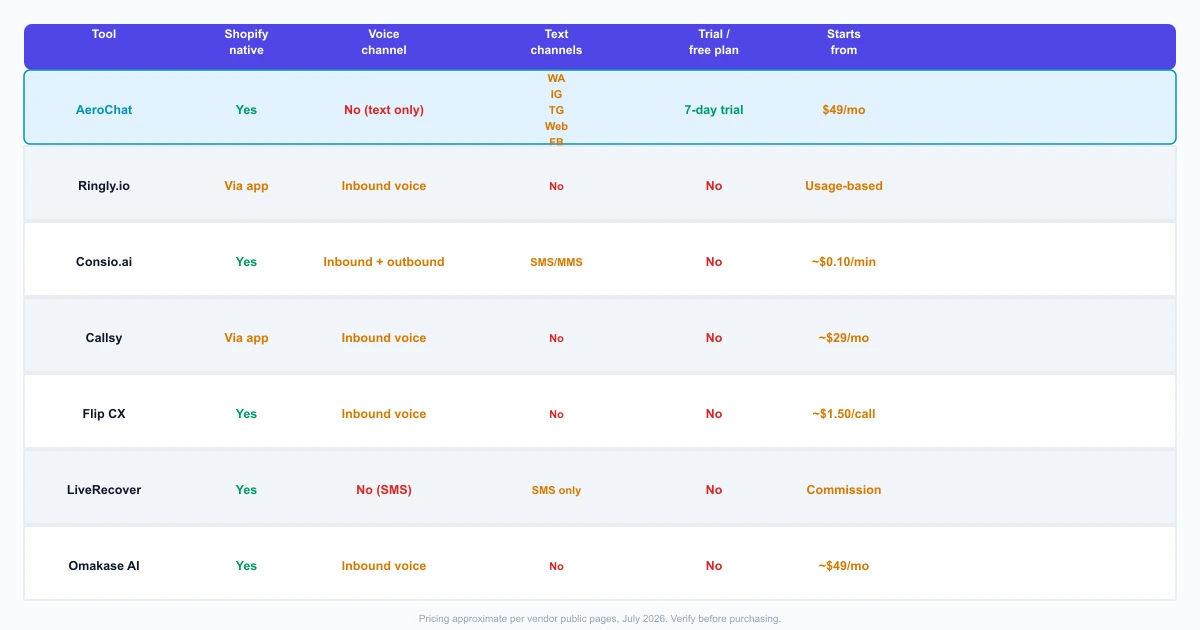
Quick comparison: Shopify voice chatbots and AI agent options
| Tool | Shopify native | Voice channel | Text channels | Trial / free plan | Starting price |
|---|---|---|---|---|---|
| AeroChat | Yes | No (text only) | WA, IG, TG, Web, FB | 7-day trial | From $49/mo |
| Ringly.io | Via app | Inbound voice | No | No | Usage-based |
| Consio.ai | Yes | Inbound + outbound | SMS/MMS | No | ~$0.10/min |
| Callsy | Via app | Inbound voice | No | No | ~$29/mo |
| Flip CX | Yes | Inbound voice | No | No | ~$1.50/call |
| LiveRecover | Yes | No | SMS only | No | Commission |
| Omakase AI | Yes | Inbound voice | No | No | ~$49/mo |
Pricing is approximate and sourced from each vendor’s public pricing pages as of July 2026. Verify current rates before purchasing.
1. AeroChat
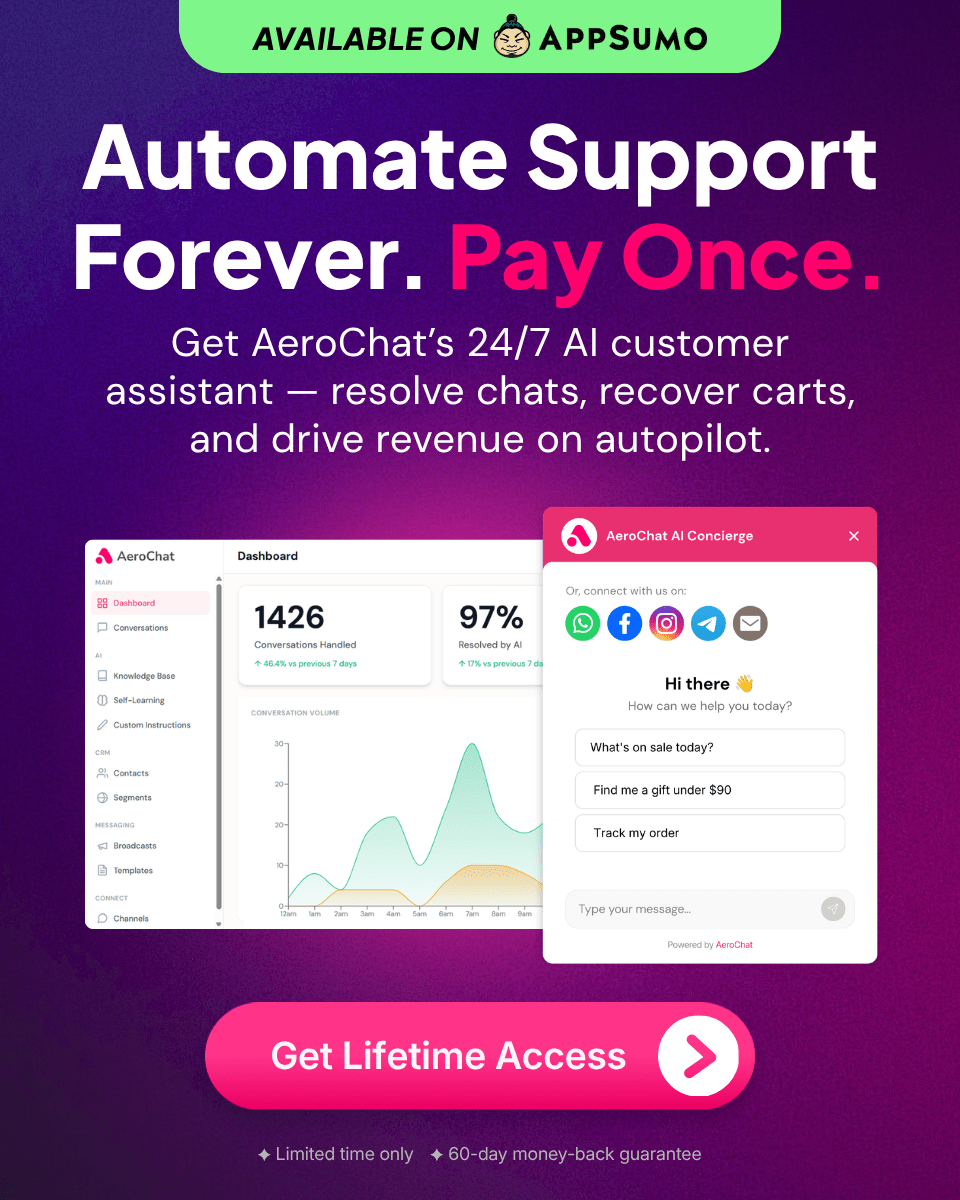
AeroChat is an AI agent platform that helps Shopify merchants run customer service on autopilot. It does not handle phone calls, but for most Shopify stores the larger volume of support enquiries arrives through messaging channels rather than inbound calls.
AeroChat connects to Shopify for live order data and handles customer conversations across WhatsApp, Instagram, Telegram, Facebook Messenger, website chat and email from a single inbox. If a customer sends a voice note in WhatsApp, AeroChat’s voice-message handling transcribes and responds to it automatically, so spoken queries in messaging apps are covered without a separate phone integration.
When a conversation needs personal attention, it passes to a human agent. The AI learns from unanswered questions over time, building a deeper knowledge base from your actual product and order information. You can start with a 7-day trial before committing to a paid plan.
See the AeroChat for Shopify page for the full integration details.
Best for: Shopify merchants whose customers primarily contact them through WhatsApp, Instagram or website chat rather than phone calls.
Pricing: Plans start from $49/month. Verify current pricing at aerochat.ai.
Channels: WhatsApp, Instagram, Telegram, Facebook Messenger, website chat, email and other supported channels.
2. Ringly.io
Ringly is a voice AI built for ecommerce stores. It connects to Shopify to pull live product and order data, answers inbound calls and handles a defined set of support scenarios without human involvement. The company reports a 73% autonomous resolution rate on qualifying stores, though results vary based on enquiry complexity and product type.
Ringly focuses specifically on inbound call handling. It does not include outbound campaigns or text-channel coverage, so merchants using it for voice will need a separate solution for WhatsApp or Instagram enquiries.
Best for: Shopify merchants receiving regular inbound calls who want a dedicated voice AI with ecommerce context.
Pricing: Usage-based. Verify current pricing at ringly.io.
3. Consio.ai
Consio takes a Shopify-first, revenue-first approach to voice AI. It covers both inbound call handling and outbound campaigns, supports SMS and MMS alongside voice, and includes revenue attribution at the order level so you can measure whether resolved calls lead to completed purchases.
The order-level attribution is useful for merchants who want to measure customer-service ROI rather than call volume alone. Setup complexity is higher than simpler options, and usage-based pricing makes costs harder to predict at the outset.
Best for: Shopify stores wanting both inbound voice and outbound SMS campaigns with sales attribution.
Pricing: Approximately $0.10/minute for overages. Verify current rates at consio.ai.
4. Callsy
Callsy is a lower-commitment entry point for stores that want to test voice AI without a high monthly outlay. It handles inbound calls with AI, escalates to human agents when needed and provides call transcriptions. Shopify integration is available via app rather than native API.
Best for: Smaller Shopify stores testing voice AI for the first time.
Pricing: From approximately $29/month including 50 calls. Verify current terms at callsy.ai.
5. Flip CX
Flip CX integrates directly with Shopify for order and product data and handles inbound voice with per-resolved-call pricing. The pricing model means costs scale with outcomes rather than volume, which works well when the AI resolves a high proportion of calls but can become expensive when many calls escalate.
Best for: Higher-volume Shopify merchants who want pay-per-outcome pricing.
Pricing: Approximately $1.50 per resolved call. Verify current pricing at flipcx.com.
6. LiveRecover
LiveRecover focuses on abandoned-cart recovery through SMS conversations handled by a mix of AI and human agents. Pricing is commission-based on recovered revenue with no upfront subscription. Worth calculating whether this competes favourably with email-based recovery sequences before committing.
Best for: Shopify stores with meaningful cart abandonment rates looking for an automated SMS recovery option.
Pricing: Commission on recovered sales. Verify current rates at livercover.com.
7. Omakase AI
Omakase AI handles inbound voice calls with Shopify integration and places an emphasis on natural-sounding conversation quality, which can matter for high-consideration products where the quality of an automated call reflects on the brand.
Best for: Stores prioritising natural-sounding AI voice responses.
Pricing: From approximately $49/month for 50 conversations. Verify current pricing at omakaseai.com.
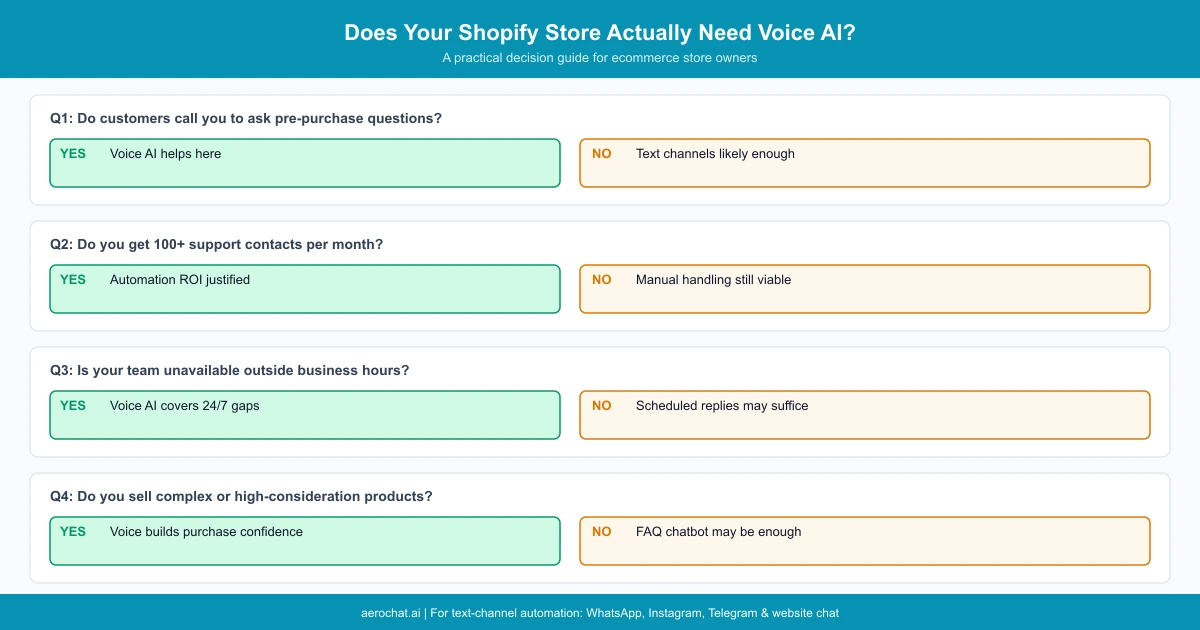
Do you actually need voice AI for your Shopify store?
Voice AI makes a strong case when your store receives a meaningful volume of inbound calls, when calls arrive outside business hours and go unanswered, or when customers call to ask detailed pre-purchase questions about complex or high-value products. In those situations, an AI that can answer the call, pull your Shopify order and product data, and resolve common queries is a practical improvement over a missed call or voicemail.
In many Shopify stores, however, the larger support volume arrives through messaging. Customers send WhatsApp messages about orders, DM on Instagram about product availability, or use website chat to ask questions during the purchase process. If that describes your store, a text-channel AI agent covers more ground than a voice tool that handles a channel most of your customers are not using.
Some stores need both. A merchant selling high-consideration products such as custom furniture, professional equipment or made-to-order jewellery may receive phone enquiries about complex decisions, while managing a separate stream of order and delivery questions through WhatsApp. In that scenario, pairing a voice agent for calls with a text-channel AI for messaging is worth the added cost.
What to check before choosing a voice AI tool
Shopify data access matters more than the headline feature set. Ask whether the AI can pull live order status, product stock and customer records directly from your store, or whether it only works from a static FAQ. An AI that cannot check your real Shopify data cannot answer the questions customers most commonly call about.
Escalation handling is equally important. When the AI cannot resolve a call, what happens? A smooth transfer to a human agent or a clear next step preserves the customer experience. A call that drops or loops through menus is worse than no AI at all.
Resolution rate definitions vary between vendors. One tool might count a call as resolved if the caller did not press zero for an agent. Another requires the customer to confirm their issue was handled. Ask for a specific definition and, if possible, trial data from stores in a similar category to yours before committing.
Frequently asked questions
What is the best voice chatbot for Shopify?
There is no single best answer because the right tool depends on your call volume, the type of enquiries you receive and your budget. Ringly.io is a strong starting point for ecommerce-specific inbound voice, while Consio adds outbound and SMS capabilities. If your customers primarily use messaging rather than phone, AeroChat covers WhatsApp, Instagram and other text channels and is a more practical fit for most stores.
Do I need a voice chatbot for my Shopify store?
Only if your customers regularly contact you by phone. If support enquiries arrive mostly through WhatsApp, Instagram, website chat or email, a text-channel AI agent will cover more of your actual support volume at a lower cost. Check where your customers are currently contacting you before investing in voice automation.
How much does a Shopify AI voice agent cost?
Costs range from approximately $29 per month for entry-level inbound tools to $1.50 per resolved call for usage-based pricing. Some tools charge per minute rather than per call. Verify current pricing with each vendor before purchasing, as rates change and most include minimum commitments or per-call overages.
Can an AI voice agent access Shopify order data?
The tools in this list with native Shopify integration can pull order status, product information and customer data directly from your store. Tools that connect via a third-party app may have more limited data access. Confirm what data the AI can access before purchasing, particularly if order enquiries are a common call type for your store.
Does AeroChat support voice calls?
AeroChat does not handle inbound or outbound phone calls. It is a text-channel AI agent covering WhatsApp, Instagram, Telegram, Facebook Messenger, website chat and email. It does support voice messages within chat channels, such as WhatsApp voice notes, which are transcribed and handled automatically. For phone call automation, the voice-specific tools in this list are the relevant options.
What is the difference between a voice chatbot and a text chatbot?
A voice chatbot handles spoken phone conversations using AI speech recognition and natural-language processing. A text chatbot handles written messages in channels such as WhatsApp, Instagram or website widgets. Most tools in this market specialise in one or the other. The right choice depends on which channel your customers use to contact you.