

Southeast Asia Already Buys in Chat. The New Part Is Who Answers

Two days ago Google, Temasek and Bain & Company published the eleventh e-Conomy SEA
report. The headline most outlets ran was the digital economy growing 17% this year. The
number that matters more if you sell to people in this region is further down.
243 million people across the six main Southeast Asian markets have started using
generative AI in under three years. That is 58% of the working population. Half consult it
weekly and almost a fifth use it daily (e-Conomy SEA 2026, Google, Temasek and Bain & Company).
Set that beside how those people shop. The same report finds 69% of consumers in those
markets now use AI to compare product options, and 93% trust the recommendations they get
from it.
So the customer side has already moved. The question for anyone selling here is whether
the business side has.
The part that is not new
Buying in a chat is not a 2026 development in Southeast Asia. A Facebook and Boston
Consulting Group study published in 2019 found the share of online
shoppers who had bought through a chat conversation was 40% in Thailand, 36% in Vietnam,
29% in Indonesia, 26% in Malaysia and 23% in the Philippines (reported via KrASIA). The same study found
57% of chat shoppers were chatting to get product or price information and 35% to
negotiate price.
That study is seven years old and should always be dated when quoted. No recent public
figure isolates chat purchases by country in the region, and we have looked. Treat it as
evidence about a long-standing habit rather than a current measurement.
The 2019 study also measured something that reads differently now. Comfort with
automated chatbots was 62% in Vietnam, 60% in Malaysia, 55% in the Philippines, 53% in
Indonesia and 47% in Thailand. Those were majorities in most markets before current
tooling existed.
The gap
Put the two sets of numbers next to each other and a gap appears.
Customers in this region have been buying through conversations for years, now use AI
to decide what to buy, and largely trust what it tells them. Meanwhile the typical seller
they are messaging is one person with a phone, answering during the hours they are awake,
with a price list in their head.
That is not a technology gap. The tooling exists and most of it is cheap. It is a gap
between how fast customer behaviour moved and how fast the businesses serving them
re-tooled. The report makes the same point from the other direction: only around 1 to 2%
of the population pays to use generative AI, so almost all of this adoption is happening
on free consumer tools, with no corresponding business investment underneath it.
What that means for a seller here, specifically
Your product information is being read by something other than a human.
If 69% of shoppers are using AI to compare options, then what your product pages and your
chat replies say is being summarised before a person sees it. Vague, inconsistent or
missing information does not just confuse customers now. It produces a wrong summary.
Trust in AI recommendations cuts both ways. 93% trusting what AI tells
them means a confident wrong answer about your return policy or your delivery time gets
believed. If you run automation, that is an argument for tying its answers to your real
data rather than letting it generalise. See AI hallucination.
Response time is now the differentiator, not price. In a market where
customers compare options with AI in seconds, the seller who answers the final question at
11pm gets the order. A Kantar survey of 11,056 adults in 22 markets commissioned by Meta,
fieldwork April to September 2025, found 73.3% of consumers prefer messaging when
contacting a business and 66.8% get frustrated when messaging is not offered. Meta sells
business messaging, so read it as vendor research with a plausible direction.
Local payment and delivery are the hard part, not the AI. At the chat
application level every AI chatbot is close to identical technically. What differs is what
each one connects to. In this region that means the payment processors and logistics
providers people actually use. A global tool with no local payment or courier connection
can hold a conversation and cannot finish a sale.
The region is not one market
Treating Southeast Asia as a single market is the fastest way to build the wrong thing.
Three differences matter operationally.
The channel differs by country. WhatsApp dominates in Malaysia,
Singapore and Indonesia. The Philippines leans to Messenger. Vietnam has Zalo. Thailand
has LINE. A plan built entirely on WhatsApp covers some of the region and misses the rest,
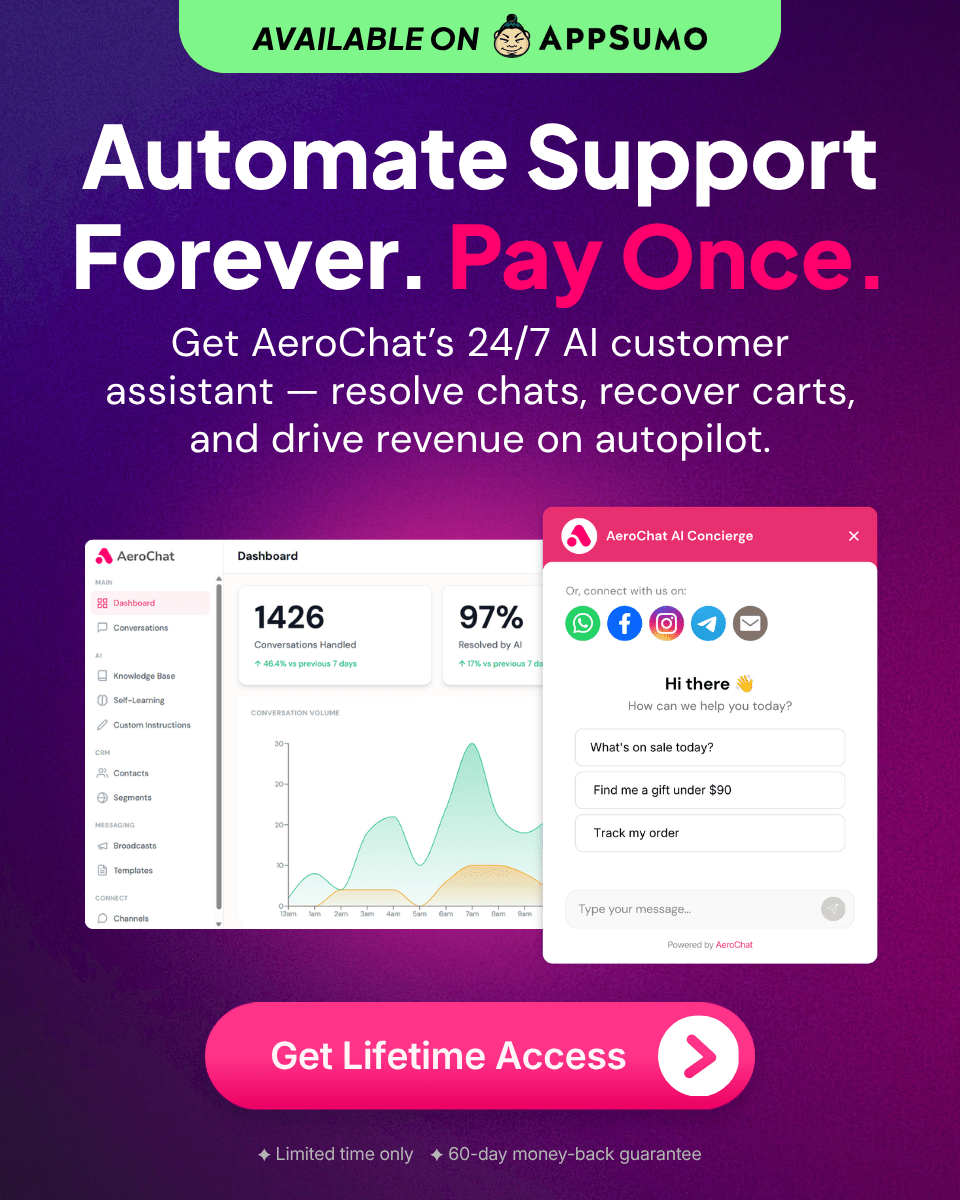
and the gap is not small. AeroChat’s current channel list is WhatsApp, Instagram,
Messenger, Telegram, email and web chat, with TikTok covering both TikTok direct messages
and TikTok Shop buyer chat in one inbox. Zalo and Viber are coming next.
The payment habit differs. Card penetration, bank transfer culture,
e-wallet share and cash on delivery expectations all vary by country. A payment link is
only useful if it offers the method that country’s customers actually use, which is a
question about your payment provider rather than about your chat tool.
The language is mixed, not translated. Real messages in Singapore and
Malaysia switch between English, Malay, Mandarin and dialect inside one sentence. This is
not a translation problem, it is a comprehension problem, and it is the thing older
keyword-matching tools broke on. Anything you evaluate should be tested on your own
customers’ actual phrasing, not on clean English.
What to do about it
Three things, in order of how quickly they pay back.
- Make one correct price list that software can read. A Google Sheet is
enough to start. Inconsistent data is the single biggest cause of bad automated answers,
and it costs nothing to fix. - Cover the hours you are closed. Not with a holding message. With
answers to price, availability, delivery and order status, which is most of what arrives
after 7pm. See first response time. - Connect payment and delivery to the conversation. This is what turns
an answered question into an order. See the four pieces a chat sale needs.
One caution about the numbers
The e-Conomy report also says AI could be used up to 60 times as much across the region
by 2030, and that AI is already delivering order volume uplifts “as large as 75%” for some
commerce players. Both are worth knowing and neither is a plan. “As large as” describes a
ceiling observed somewhere, and a 2030 projection in a market moving this fast is a
direction, not a forecast.
What the report establishes solidly is adoption, and adoption is the actionable part.
Your customers changed how they shop inside three years. The 17% growth figure describes
the market. The 58% figure describes your customers.
Read next
- Conversational commerce
- AI hallucination
- First response time
- Payment link
- The four pieces a chat sale needs
- What chat selling does to sales and support costs
Start for free
AeroChat runs customer service and sales workflows you describe in plain English. There is a free plan, so there is nothing to decide today.
Start for free on the Shopify App Store
Not on Shopify? Create an AeroChat account here.