
10 Best AI Sales Chatbots in 2026 (Compared for Ecommerce and B2B)

The best AI sales chatbot for most ecommerce stores is AeroChat, which combines multichannel automation with Shopify and WooCommerce integration. For B2B teams, Intercom Fin and HubSpot Chatbot handle lead qualification and meeting booking within existing CRM workflows. The right choice depends on whether you need proactive ecommerce sales support, social commerce automation, or structured pipeline management.
This guide covers ten actively maintained platforms, explains what each is genuinely best suited for, and flags the trade-offs worth knowing before you commit. It works as both a shortlist of the best AI sales chatbots and a buyer’s guide to sales chatbot software for ecommerce, since the two searches lead to the same decision: which tool converts more of your traffic without adding support headcount.
What makes a good AI sales chatbot in 2026?
A sales chatbot does something a support chatbot does not: it initiates conversations, qualifies intent, and nudges buyers towards a decision — rather than waiting to answer a question after the fact.
The most capable platforms in 2026 can:
- detect on-site behaviour and trigger proactive conversations at the right moment
- qualify leads by asking structured questions and scoring responses
- recommend products or services based on what the visitor is browsing
- book meetings or escalate to a human agent when appropriate
- operate across multiple channels simultaneously — website, WhatsApp, Instagram, and Messenger
Sales chatbot vs support chatbot: the key difference
Support chatbots answer questions. Sales chatbots create opportunities.
A support chatbot handles "Where is my order?" A sales chatbot handles "You've been on this product page for 90 seconds — can I help you decide?" The distinction matters when selecting a platform, because many tools marketed as sales chatbots are primarily support tools with a lead-capture form attached.
If your primary goal is reducing inbound support tickets, a support-first platform is fine. If your goal is converting more visitors into buyers, look specifically for proactive engagement and intent-detection capabilities.
Why ecommerce stores use sales chatbots
Ecommerce brands face problems that chatbots address well: high traffic with lower-than-expected conversion rates, customers who abandon carts without explanation, and support teams stretched by repetitive pre-purchase questions.
The most common use cases are:
- converting product-page visitors who are hesitating before buying
- recovering abandoned carts with timely, relevant follow-up messages
- cross-selling or upselling during or after the checkout process
- answering stock, shipping, and returns questions at the moment they arise
- handling after-hours enquiries without additional staffing costs
B2B teams use sales chatbots differently — primarily for lead qualification, meeting booking, and routing inbound enquiries to the right sales representative.
The 10 best AI sales chatbots for 2026
One significant change from previous roundups: Drift has been excluded. Following its acquisition by Salesloft in February 2024 and the subsequent Clari merger in December 2025, Drift's standalone product was sunset in March 2026, with 1mind named as the recommended successor for existing customers. Recommending a product being wound down does not serve readers making purchasing decisions today. (Source: Warmly, 2026)
| Tool | Best for | Shopify | Starting price | Channels | Human handoff |
|---|---|---|---|---|---|
| AeroChat | Ecommerce & multichannel customer service | Native integration | From $49/month | Website chat, WhatsApp, Instagram, Telegram, Messenger, email | Yes |
| Tidio | Small ecommerce stores | Native app | Free; paid from ~£25/month | Website, email, Messenger | Yes |
| Gorgias | Shopify helpdesk with conversion tracking | Native integration | From ~£8/month | Website, email, social | Yes |
| ManyChat | Instagram & Messenger DM automation | Integration | Free; paid from ~£12/month | Instagram, Messenger, WhatsApp, SMS | Yes |
| Intercom Fin | SaaS & product-led B2B | Integration | From ~£60/month | Website, email, in-app | Yes |
| Chatfuel | Facebook & Instagram automation | Integration | Free; paid from ~£12/month | Facebook Messenger, Instagram | Limited |
| LivePerson | Enterprise ecommerce | Integration | Enterprise — contact for pricing | Web, SMS, WhatsApp, social | Yes |
| Zendesk AI | Teams already using Zendesk | Integration | Suite from ~£45/agent/month | Omnichannel | Yes |
| Freshchat | Omnichannel lead qualification | Integration | Free; paid from ~£15/agent/month | Web, email, WhatsApp, Messenger | Yes |
| HubSpot Chatbot | B2B teams with CRM needs | Integration | Free with HubSpot CRM | Website, Messenger | Yes |
Pricing figures are indicative and converted to GBP for reference. Verify current plans directly with each provider before purchasing.
1. AeroChat — best for ecommerce and multichannel customer service
Best for: Ecommerce and subscription businesses that want to automate and scale customer service without extra manpower and costs.
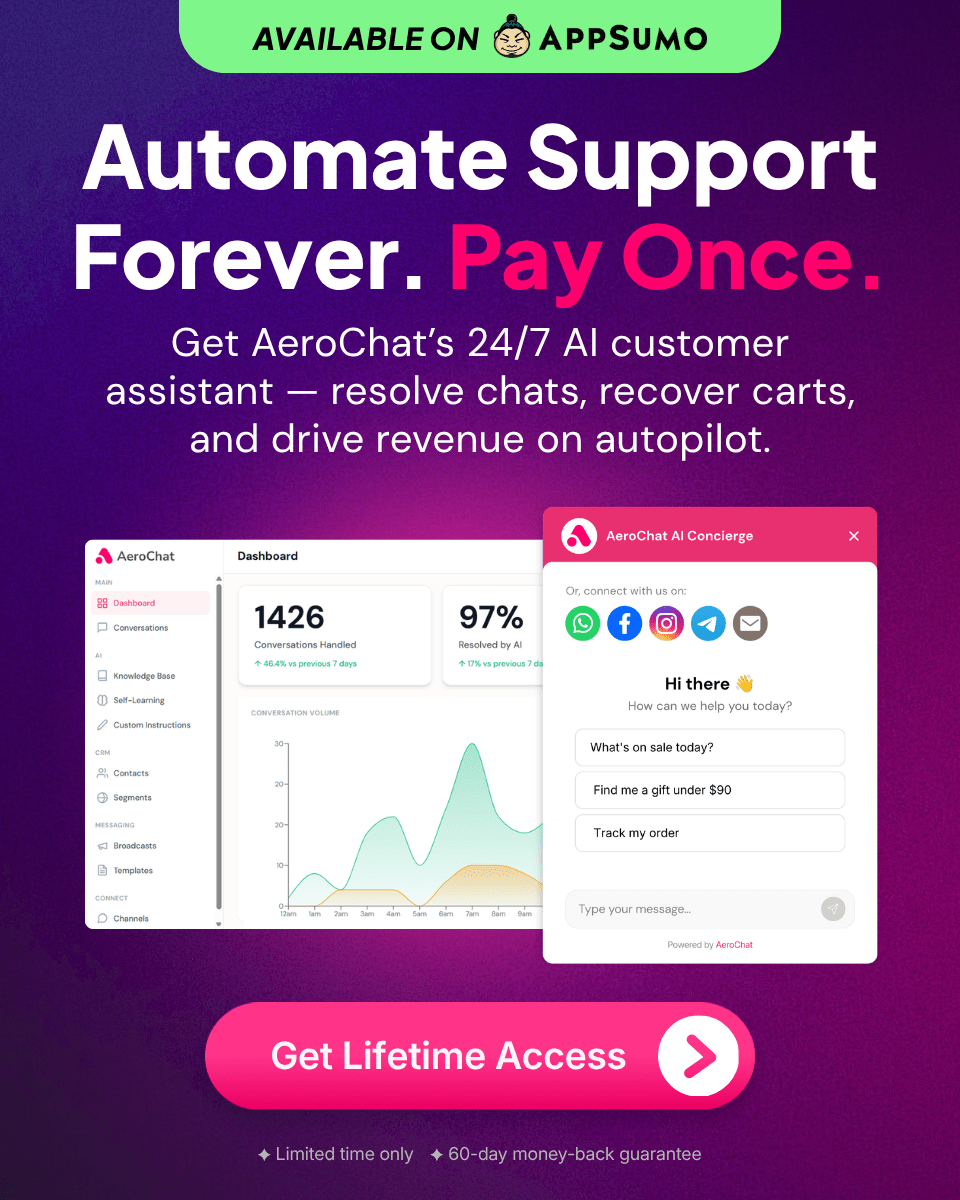
AeroChat is an AI agent platform that helps ecommerce brands run customer service on autopilot. It can answer product, delivery, return and order-related questions across website chat, WhatsApp, Instagram DMs and comments, Facebook Messenger, Telegram, Facebook comments and email — from a single platform, without building separate automations for each channel.
For Shopify stores, AeroChat syncs automatically with your product and order data, so the AI can handle order tracking enquiries, explain delivery timelines and surface relevant product recommendations without manual configuration. Its self-learning AI updates the knowledge base from every unanswered question over time, which means the gap between what customers ask and what the bot can reliably handle narrows as the platform is used.
Key capabilities relevant to ecommerce:
- Smart product recommendations based on customer intent during the conversation
- Discount and promotion suggestions surfaced at appropriate moments to support conversion
- Order tracking and status — customers can check their order without contacting a human agent
- Conversion tracking from chat interaction to completed sale
- WhatsApp Broadcasts to targeted customer segments
- Multilingual conversations with real-time translation for human agents
- Smart human handover when a conversation needs a live agent rather than an automated response
- Contact management and segmentation
- GDPR/PDPA-compliant encryption
Setup uses natural language rather than flowcharts or workflow builders, which reduces the time from sign-up to a working AI agent. Plans start from $49/month. If you are comparing options specifically for Shopify, the best Shopify chatbot guide covers the Shopify-native options in more detail. For stores where WhatsApp is a primary sales channel, the WhatsApp AI chatbot comparison is worth reading alongside this article.
Limitation: AeroChat is designed for ecommerce customer service and multichannel automation rather than B2B pipeline management. It does not currently offer a white-label solution — the brand-removal option removes AeroChat branding from the chat widget only. It is less suited to businesses with long, complex sales cycles that require deep CRM integration at every stage.
2. Tidio — best for small ecommerce stores
Best for: Small businesses and early-stage Shopify stores that want to test chatbot automation without significant upfront cost or configuration time.
Tidio combines live chat, a visual workflow builder, and its Lyro AI assistant. It has a direct Shopify app and is one of the faster platforms to get running without developer involvement.
The free tier covers basic live chat and a limited number of AI-handled conversations each month, making it a sensible starting point. As conversation volumes grow, costs increase — the Lyro AI tier uses per-conversation pricing that can become substantial at scale.
Limitation: Lyro performs well on FAQ-level questions but can struggle on nuanced, multi-turn product conversations. For stores with complex catalogues or detailed pre-purchase enquiries, it may require significant flow-building to cover common scenarios adequately.
3. Gorgias — best Shopify-native option for conversion-aware support
Best for: Shopify stores that want to automate customer service conversations — particularly order status, returns, and pre-purchase questions — with direct access to Shopify order data.
Gorgias is a Shopify-native helpdesk that includes chat automation, rather than a traditional proactive sales chatbot. It is worth including here because it integrates directly with Shopify order and customer records, allowing it to resolve queries automatically while freeing agents to focus on converting undecided buyers.
Its automation rules trigger based on customer actions, tags, and order history. A revenue statistics feature connects support interactions to actual purchases, which is useful for measuring ROI on customer service investment.
Limitation: Gorgias is primarily reactive — it handles inbound queries well but does not proactively initiate conversations with browsing visitors. For proactive engagement, AeroChat or Tidio are stronger choices.
4. ManyChat — best for Instagram and Messenger sales automation
Best for: Ecommerce brands running paid social campaigns on Instagram or Facebook, where DM-based conversion is part of the sales strategy.
ManyChat automates conversations in Instagram DMs and Facebook Messenger, making it particularly useful for brands that generate traffic through social content or ads. It can handle comment replies, story responses, and DM flows — converting social engagement into qualified leads or direct purchases.
It integrates with Shopify to share product links, discount codes, and order updates within Messenger conversations. Its keyword-trigger system means specific words or phrases can open automated sales sequences automatically.
If Instagram is your primary social sales channel, the best Instagram AI chatbots guide covers the dedicated Instagram options in more depth. For automating Instagram DM campaigns specifically, Instagram DM automation for ecommerce is a useful companion read.
Limitation: ManyChat's strength is social commerce. For WhatsApp Business automation at scale, platforms built specifically for that channel deliver better results — see the WhatsApp AI chatbot comparison for a direct comparison.
5. Intercom Fin — best for product-led B2B businesses
Best for: SaaS companies and B2B businesses that need an AI agent capable of handling complex, detailed product questions without constant human intervention.
Intercom's Fin AI agent is trained on your company's documentation and support content, and can manage detailed product enquiries across multi-turn conversations. It is widely used in B2B SaaS contexts for pre-sales qualification, trial-user support, and inbound lead routing.
Fin supports human handoff and integrates with Intercom's full platform, including CRM contacts, ticketing, and outbound messaging.
Limitation: Intercom is priced for growth-stage and enterprise businesses. The cost is difficult to justify for smaller ecommerce stores with straightforward support needs. It is also better suited to B2B product contexts than to high-SKU ecommerce environments where product-catalogue depth matters more than documentation-based answers.
6. Chatfuel — best for Facebook and Instagram automation
Best for: Businesses running lead generation or sales funnels through Facebook Messenger or Instagram, particularly those already familiar with flow-based chatbot builders.
Chatfuel allows businesses to build automated conversation flows for Messenger and Instagram without coding. Its Shopify integration enables product browsing and basic order support within the chat interface.
It is a simpler platform than ManyChat, with a focus on predictable scripted flows rather than AI-driven open conversation. That makes it more consistent but less adaptable when customers deviate from expected paths. For a broader look at Instagram automation tools, the best Instagram AI chatbots comparison includes Chatfuel alongside newer alternatives.
Limitation: Chatfuel's AI capabilities are limited compared to newer platforms. It performs reliably for structured flows and campaigns but can produce poor experiences when conversations move outside the scripted structure.
7. LivePerson — best for enterprise ecommerce
Best for: Large-scale retailers and enterprise ecommerce brands managing high conversation volumes across multiple channels simultaneously.
LivePerson combines AI automation with a human-agent collaboration model, allowing complex queries to escalate smoothly from bot to agent. It supports web, SMS, WhatsApp, email, and social — making it a strong option for brands that require consistent experiences across every channel at volume.
Its analytics suite reports on bot performance, resolution rates, and revenue impact, which makes it easier to justify the investment internally.
Limitation: LivePerson's pricing and implementation complexity put it well beyond the reach of most small and mid-sized ecommerce businesses. It requires a meaningful onboarding investment and performs best for teams with dedicated customer experience operations.
8. Zendesk AI — best for teams already using Zendesk
Best for: Businesses running customer service on Zendesk who want to add AI automation without migrating to a new platform.
Zendesk's AI agent layer — built into Zendesk Suite — handles inbound queries, classifies intent, and resolves issues using your existing knowledge base and macros. For teams that have already invested in Zendesk workflows, adding AI automation involves less disruption than switching platforms.
Limitation: If you are not already a Zendesk customer, it is an expensive starting point for chatbot automation alone. The AI capabilities are broadly comparable to more affordable alternatives — the value proposition is integration with existing Zendesk infrastructure, not AI superiority.
9. Freshchat — best for omnichannel lead qualification at mid-range cost
Best for: Growing ecommerce and service businesses that need omnichannel messaging with behavioural triggers, without enterprise-level pricing.
Freshchat (part of the Freshworks suite) handles web, email, WhatsApp, and Messenger conversations from a single inbox. Its bot can qualify leads through structured question sequences, route conversations to the appropriate team, and trigger automated messages based on visitor behaviour — such as time spent on a page or the value of items in the cart.
It is more affordable than Zendesk at a comparable feature level, which makes it practical for businesses scaling their support function without a large team.
Limitation: Freshchat's AI is capable on structured qualification flows but less suited to open-ended or complex product conversations. For detailed catalogue questions, expect to supplement automated responses with human review.
10. HubSpot Chatbot — best for B2B teams with CRM needs
Best for: B2B sales teams that want lead qualification and meeting booking integrated directly into their CRM pipeline, with minimal additional cost.
HubSpot's chatbot builder is included in the free HubSpot CRM tier, making it accessible to businesses not yet ready to invest in a standalone chatbot platform. It qualifies leads, books meetings via calendar integration, and logs every conversation directly into HubSpot contact records.
For B2B teams already using HubSpot for sales and marketing, the chatbot is an extension of existing infrastructure rather than a separate tool to manage and maintain.
Limitation: HubSpot Chatbot is designed for lead capture and qualification in B2B contexts, not for ecommerce product recommendation or Shopify-native workflows. For ecommerce use cases, purpose-built platforms deliver significantly better results.
How AI sales chatbots increase ecommerce revenue
Convert visitors into buyers
A chatbot can detect when a visitor is hesitating on a product page — spending time, scrolling without adding to cart, or returning after leaving — and open a conversation at that point. Addressing a buyer's question in real time, rather than leaving them to search elsewhere for an answer, is one of the clearest conversion levers available to ecommerce stores.
Reduce abandoned carts
Cart abandonment is a persistent ecommerce problem. Baymard Institute reports an average cart abandonment rate of approximately 70% across industries. (Source: Baymard Institute) AI chatbots can trigger a follow-up message when a visitor stalls after adding items, addressing the most common reasons for not completing a purchase — delivery costs, returns questions, and sizing uncertainty.
Recommend the right products
AI chatbots connected to a product catalogue can suggest relevant alternatives, higher-value items, or complementary products based on what a customer is viewing. This is different from a static recommendation widget — it is a responsive suggestion made in the context of a live conversation.
Provide answers at the moment they matter
Most buying decisions happen outside standard business hours. A sales chatbot handles the questions that would otherwise go unanswered until the next working day, by which point the customer may have purchased elsewhere.
See also: How to reduce customer waiting time with automation
Lower customer service costs
Automating responses to repetitive pre-purchase questions — shipping times, return policies, sizing guidance — reduces the volume of queries reaching human agents. The same staff capacity can then focus on conversations that genuinely require human judgement.
How to choose the right AI sales chatbot
Ecommerce vs B2B — different needs, different tools
Ecommerce chatbots need to handle product-level questions, order lookups, and cart scenarios in real time. B2B sales chatbots need to qualify company size, role, and buying intent, then connect qualified prospects to a human sales representative.
Many platforms are built primarily for one context. AeroChat and Gorgias are designed around ecommerce workflows. Intercom Fin and HubSpot Chatbot are better suited to B2B pipeline management. ManyChat and Chatfuel work in both contexts for social commerce.
Shopify-native vs API integration — what to check
A Shopify-native chatbot accesses your product catalogue, order data, and customer records directly within Shopify. An API-integrated chatbot connects via Shopify's API, which usually works reliably but adds a layer of dependency and can introduce data latency on order lookups.
Gorgias and AeroChat are both designed with Shopify workflows in mind. For a full breakdown of how the AI chatbot for Shopify landscape looks, including Shopify-native options and their trade-offs, the Shopify AI chatbot guide covers this in detail.
Before committing to any platform, ask: can the bot look up a specific order by name or email address? Can it surface product variants, stock levels, and delivery estimates in real time? If the answers are unclear, test with a live product catalogue before purchasing.
Who should use a sales chatbot?
A sales chatbot is well suited to:
- Ecommerce stores with consistent traffic but lower-than-expected conversion rates
- Shopify or WooCommerce merchants receiving repeated pre-purchase questions
- Brands running paid social campaigns that generate high volumes of DM enquiries
- B2B businesses with a defined sales process and consistent inbound lead flow
- Any business where customers regularly contact support outside standard hours
It is less immediately valuable for businesses with very low traffic volumes, highly bespoke configurations that require expert human input at every stage, or long-cycle sales processes with no standard qualification path.
Choosing AeroChat for ecommerce
AeroChat is built specifically for ecommerce customer service and multichannel automation, rather than adapted from a B2B or enterprise tool. If your business handles frequent enquiries about products, orders, delivery and returns across multiple channels — and your team is spending significant time on questions that follow predictable patterns — it is a practical option to evaluate.
Plans start from $49/month. Explore the Shopify chatbot guide for the Shopify-specific comparison, or visit aerochat.ai to see current plans and features.
Frequently asked questions
What is the difference between an AI sales chatbot and a live chat tool?
A live chat tool connects a visitor directly to a human agent. An AI sales chatbot handles the conversation automatically, without a human present, using trained responses and workflow logic. Most platforms now combine both — the bot handles initial contact and common questions, then hands off to an agent when the query requires human input.
Do I need coding skills to set up a sales chatbot?
Not for most platforms on this list. Tidio, ManyChat, Chatfuel, Freshchat, and HubSpot all provide visual builders designed for non-technical users. AeroChat uses natural-language setup without flowcharts or workflow builders, which means most ecommerce merchants can configure it without developer involvement. Enterprise platforms such as LivePerson and Zendesk typically involve more configuration and may benefit from implementation support.