
How to Reduce Customer Support Costs With AI Chat in 2026

AI chat reduces customer support costs by 30 to 60 percent for most businesses, mainly by deflecting the Tier-1 questions that never needed a human in the first place. The mechanism is simple: a human-handled query costs roughly $13 while a self-service or AI-handled query costs under $1, and 40 to 60 percent of support volume is repetitive enough for AI to handle. For a small business, that often means $2,000 to $5,000 in monthly savings against a chatbot cost of $29 to a few hundred dollars. The catch is that cutting costs the wrong way damages customer experience and raises churn, which costs more than you saved. This guide shows where support costs actually come from, how AI cuts them, the real ROI math at small-business scale, and how to do it without hurting CX.
Most articles on this topic cite Klarna saving $40 million and Alibaba saving $150 million. Those numbers are real, but they are useless if you run a business with five support staff. This guide is about the math that applies to you.
Where Support Costs Actually Come From
You cannot cut costs without knowing where they go. For most support teams, the breakdown is consistent.
Labor is the overwhelming majority of the support budget. Labor typically swallows around 70% of the total support budget, including salaries, benefits, training, and the constant churn of agents leaving and needing replacement. In contact centers specifically, the figure runs higher — labor expenses can account for as much as 95% of a contact center’s total costs.
The rest is software, infrastructure, and the hidden cost most teams ignore: agent turnover. Replacing a trained agent is expensive, and the most common reason agents quit is burnout from repetitive, low-value work — exactly the work AI is best at handling.
This matters because it tells you where AI can and cannot help. AI cuts labor cost on repetitive queries. It does not cut your software bill or your office rent. The savings come almost entirely from handling volume that would otherwise need a paid human.
The 6 Ways AI Chat Reduces Support Costs
Each of these maps to a real line item in your support budget.
1. Ticket deflection. The biggest lever. AI answers repetitive questions before they ever become a ticket a human has to handle. Done well, self-service can head off 30 to 60 percent of potential support tickets. Every deflected ticket is labor cost you don’t pay. For more on measuring this, see our guide on deflection rate vs containment rate.
2. After-hours automation. Customers message at night and on weekends. Without AI, you either pay for overnight staff or lose those customers. AI handles after-hours volume at near-zero marginal cost, which directly attacks one of the biggest expense drivers.
3. Faster handling time. Even when a human is involved, AI pre-populates information and suggests answers, cutting the time per ticket. Shorter handle time means each agent handles more volume, so you need fewer agents for the same load.
4. Reduced agent turnover. This one is counterintuitive but real. Agents burn out on repetitive work. Hand that work to AI, give humans the interesting problems, and turnover drops. Since replacing an agent costs a large fraction of their annual salary, lower turnover is a genuine saving most cost analyses miss.
5. Lower training and onboarding cost. Fewer agents and lower turnover mean less money spent training new hires. AI also assists new agents with suggested answers, shortening their ramp-up time.
6. Scaling without hiring. The clearest saving. When volume spikes — Black Friday, a product launch, a viral moment — AI absorbs the surge instead of you hiring and training temporary staff. You scale support without scaling headcount.
The Real Numbers (With Sources)
This is where most cost articles get vague. Here is the actual data, cited.
Per-contact cost. The gap between human and AI handling is large. A contact resolved through self-service costs $1.84, versus $13.50 for a human agent — a 7x cost difference per interaction. Other analyses put the AI cost even lower, with each chatbot interaction saving $0.50 to $0.70 compared to a human-handled query.
Overall cost reduction. The data suggests companies can reduce support costs by 30% or more with the right AI implementation. Enterprise figures run higher: chatbots reduce customer service costs by 40 to 60 percent for enterprises.
The macro picture. Conversational AI is projected to save companies $80 billion in contact center labor costs by 2026. Gartner’s research adds a forward view: agentic AI will autonomously resolve 80% of common customer service issues by 2029, with a corresponding 30% reduction in operational costs.
Named results. The large-scale case studies are real. Klarna’s AI assistant handled 2.3 million conversations in 2024, work that would have required 700 full-time agents, saving an estimated $40 million. Vodafone reduced cost-per-chat by 70%, and NIB Health Insurance saved $22 million while cutting costs by 60%.
These are enterprise numbers. The next section translates them to a scale that actually applies to most businesses.
ROI Calculation at Small-Business Scale
Klarna’s $40 million means nothing to a business with a few support staff. Here is the same math at a realistic small-business scale.
Say your business handles 4,000 customer conversations a month, and a human-handled interaction costs you about $10 all-in (wage, benefits, overhead).
-
Cost saving per interaction: $10.00 human cost minus roughly $0.60 AI cost = $9.40 saved per interaction
-
If AI handles 70% of those 4,000 conversations: 2,800 interactions × $9.40 = $26,320 gross monthly saving
-
Minus the chatbot cost (say $200/month for a mid-tier tool): $26,320 − $200 = $26,120 net monthly saving
Even if you halve every assumption to be conservative — fewer conversations, lower human cost, lower deflection — the savings still dwarf the tool cost. This is why the method shows the potential for very high returns, with worked examples reaching well over 1,000% ROI.
For a smaller business handling 500 conversations a month, the gross saving is smaller but the ratio is the same: a $29/month tool that deflects even 350 interactions pays for itself many times over. The point isn’t the exact figure — it’s that the saving scales with your volume while the tool cost stays roughly flat. For a deeper ROI breakdown, see our guide on measuring chatbot ROI.
What AI Can and Cannot Cut
Honest cost planning means knowing the limits.
AI can cut:
-
Labor cost on repetitive Tier-1 queries (order status, hours, returns, FAQs)
-
After-hours staffing cost
-
Temporary seasonal hiring cost
-
Agent training and onboarding cost
-
Cost of slow resolution (repeat contacts, escalations)
AI cannot cut:
-
The cost of genuinely complex problems that need human judgment
-
The cost of sensitive conversations (complaints, cancellations, emotional situations)
-
Your core software and infrastructure spend
-
The cost of a bad knowledge base — if your content is wrong, AI gives wrong answers faster
The businesses that achieve real savings are clear-eyed about this split. They automate the repetitive 70 to 80 percent and keep humans on the rest. They don’t try to automate everything, because the last 20 percent is where automation backfires.
What Breaks If You Cut Costs the Wrong Way
This is the section most vendor articles skip, and it’s the one that matters most.
Cutting support costs with AI is easy. Cutting them without hurting customer experience is the hard part. Here’s what goes wrong when businesses cut wrong:
They automate complaints. A bot that auto-responds to an angry customer makes them angrier. Complaints must route to a human, fast. Automate them to save money and you lose the customer.
They remove the human escape hatch. Cost-cutters sometimes hide the “talk to a human” option to force AI usage. Customers hate it. They leave. Churn rises, and a lost customer costs far more than the support interaction you saved.
They deploy and forget. Static deployments degrade as your product and policies change; the implementations that achieve sustained 30 to 40 percent cost reduction are the ones that review AI performance weekly and fix knowledge base gaps monthly. A neglected bot gives stale answers, frustrates customers, and quietly raises costs through repeat contacts.
They cut headcount before proving the AI works. Fire your support team in month one and you’ll be rehiring in month three when the bot can’t handle the complex 20 percent. Reduce headcount through natural attrition after the AI proves itself, not before.
The rule: cut waste, not quality. The savings come from handling the volume that never needed a human, not from giving customers worse service. For the human side of this balance, see our take on AI vs human support.
How to Roll It Out Without Hurting CX
A practical sequence that captures savings without breaking customer experience.
-
Measure your baseline. Know your current cost per ticket, ticket volume, and what percentage is repetitive. You can’t prove savings without a starting point.
-
Automate the clear wins first. Start with the most repetitive, lowest-risk questions (hours, order status, returns). Leave complaints and complex issues with humans.
-
Keep the human handoff obvious. Never hide it. A visible “talk to a person” option actually increases trust in the bot.
-
Review weekly. Read the conversation logs. Fix what the bot got wrong. This is non-negotiable for sustained savings.
-
Expand scope only as accuracy proves out. Add more question types to the bot only once it’s handling the current set well.
-
Adjust headcount through attrition, not layoffs. Let the AI prove itself, then let natural turnover reduce the team rather than cutting before you have data.
Frequently Asked Questions
How much can AI chat actually reduce support costs?
Most businesses see 30 to 60 percent reduction in support costs with a well-run AI implementation. The savings come almost entirely from deflecting repetitive Tier-1 queries that would otherwise need a paid human. A human-handled query costs around $13 versus under $1 for AI, and 40 to 60 percent of volume is typically repetitive enough to automate.
Does cutting support costs with AI hurt customer experience?
It can if done wrong. The businesses that cut costs without hurting CX automate only the repetitive, low-risk questions and keep humans on complaints, cancellations, and complex issues. The ones that hurt CX automate everything, hide the human handoff, or deploy and forget. Cut waste, not quality.
What’s the ROI of an AI support chatbot for a small business?
For a business handling 500 to 4,000 monthly conversations, the chatbot typically pays for itself within the first month. A tool costing $29 to a few hundred dollars per month can deflect hundreds or thousands of interactions, each saving several dollars in labor. The savings scale with volume while the tool cost stays roughly flat, producing returns often exceeding 1,000 percent. See our chatbot cost guide for pricing detail.
Which support costs can AI not reduce?
AI cannot reduce the cost of genuinely complex problems, sensitive conversations, your core software and infrastructure spend, or the cost of a bad knowledge base. AI cuts labor on repetitive queries, not the cost of work that genuinely needs human judgment.
How long before I see cost savings from AI support?
Most businesses see measurable savings within one to three months, assuming they review and tune the bot weekly. The first few weeks are about training and tuning. Real savings appear once the bot reliably handles 70 percent or more of repetitive volume.
Should I reduce my support team after adding AI?
Not immediately. Let the AI prove it can handle the repetitive volume first. Then reduce the team through natural attrition rather than layoffs. Cutting headcount before the AI is proven leads to rehiring within months when the bot can’t handle complex issues.
What percentage of support tickets can AI handle?
For most businesses, 40 to 60 percent of incoming volume is repetitive enough for AI to handle, and well-tuned implementations reach 70 to 85 percent resolution on the questions they’re designed for. The remaining 15 to 30 percent — complex, sensitive, or judgment-heavy issues — should stay with humans.
Is AI support cost reduction only for big companies?
No. The case studies you see (Klarna, Vodafone, Alibaba) are enterprise, but the per-interaction math works at any scale. A small business handling 500 monthly conversations saves proportionally as much as an enterprise handling millions. The ratio of savings to tool cost is often better for small businesses because modern tools start at $29 per month.
The Bottom Line
AI chat reduces customer support costs by 30 to 60 percent, almost entirely by deflecting the repetitive volume that never needed a human. A human query costs around $13; an AI query costs under $1. For most businesses, the chatbot pays for itself within the first month.
The savings are real, but so is the risk. Cut waste, not quality. Automate the repetitive questions, keep humans on the complex and sensitive ones, keep the human handoff obvious, and review the bot weekly. Businesses that follow this approach capture the savings and keep their customers. Businesses that automate everything and hide the human option save money on support and lose it on churn.
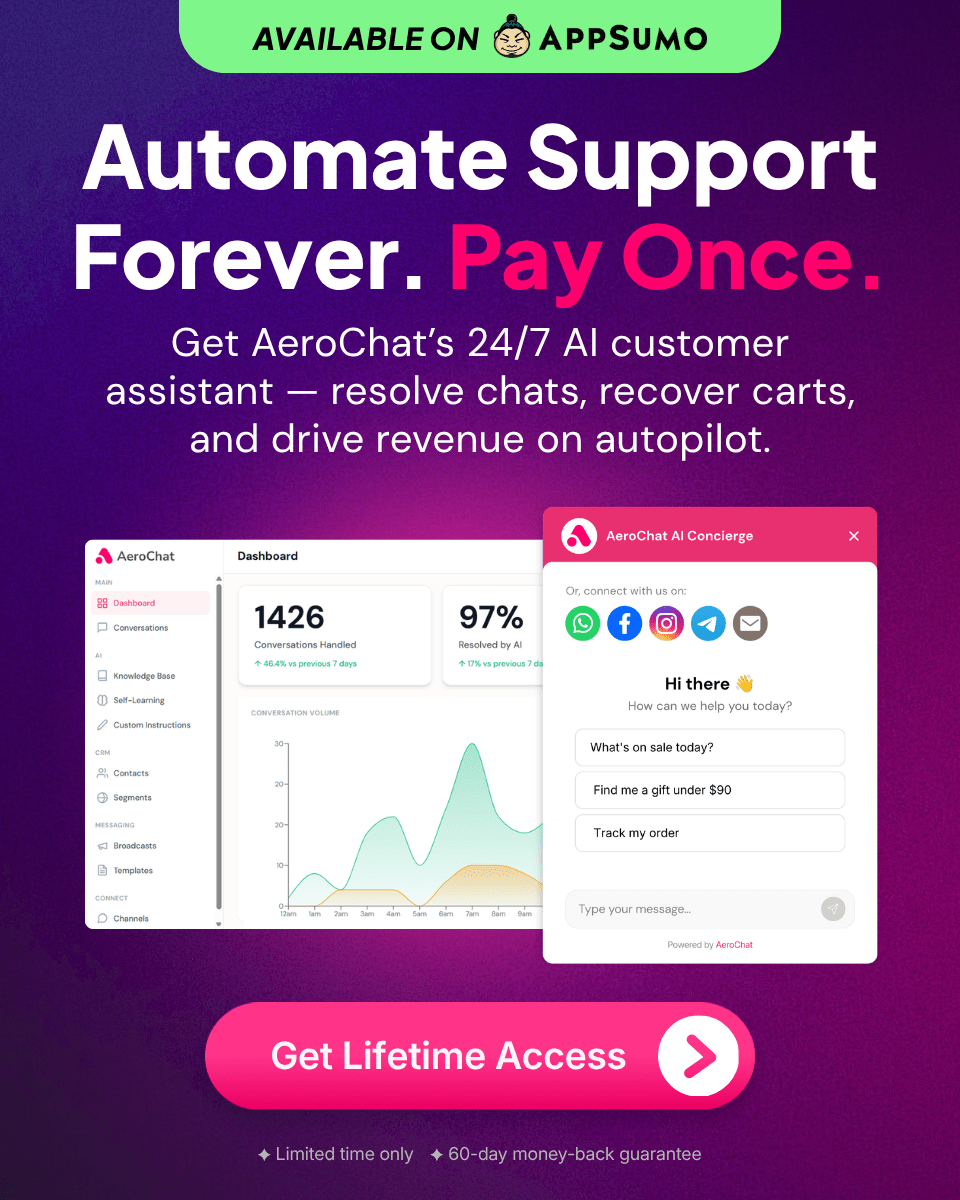
If you want to reduce support costs across your website, WhatsApp, Instagram, and email from one tool, AeroChat starts at $49 per month and handles the repetitive volume so your team can focus on the conversations that need a human. For Shopify stores specifically, see our guide on reducing support costs on Shopify.
Support cost reduction through AI chat is primarily driven by reducing the volume of conversations that require human time. The most common pre-purchase questions covers what the AI needs to answer to have the most impact, and the automation maturity framework shows how cost reduction typically progresses as automation matures. For a tool-level view of the cost comparison, the chatbot ROI calculator provides a framework for estimating the saving.