
AI Agent vs Chatbot: Real Difference, Examples & Cost (2026
A chatbot answers questions. An AI agent finishes tasks. That’s the real difference.
Ask a chatbot “where is my order?” and it sends a tracking link. Ask an AI agent the same question — it checks the order, sees the delivery is late, offers a refund or a replacement, and processes the one you pick. Same question. Very different work.
A chatbot reads and replies. An AI agent reads, decides, and acts. Most tools sold as “AI agents” in 2026 are still chatbots with better marketing.
This guide shows you the real difference, which one your business actually needs, and what each one costs.
What Is a Chatbot?
A chatbot is software that holds a text or voice conversation using rules, scripts, or a language model. It reads what you type, finds the closest match in its knowledge, and replies. That’s the full job.
Chatbots are good at:
-
Answering FAQs like hours, pricing, and return policy
-
Capturing leads with a few questions
-
Pointing people to help articles
-
Booking simple meetings when connected to a calendar
What they don’t do well:
-
Take actions across different tools
-
Handle anything outside what they’ve been trained on
-
Remember past conversations long-term
-
Make decisions without someone reviewing them
Think of the help widget on most websites in 2022, basic Facebook Messenger bots, or simple WhatsApp auto-replies. If you want a deeper look at how chatbots compare to broader AI categories, read our chatbot versus conversational AI breakdown.
What Is an AI Agent?
An AI agent is software that uses a large language model (like GPT, Claude, or Gemini) to understand a goal, plan steps to reach it, and take actions across connected tools. It doesn’t just talk. It does the work.
AI agents can:
-
Read a customer message, check the order, process a refund, and send a confirmation — all in one chat
-
Pull data from multiple systems (CRM, inventory, calendar, payments)
-
Remember context across conversations
-
Adjust their approach based on what worked before
-
Hand off to a human only when they should
What they still can’t do well:
-
Replace doctors, lawyers, or anyone making high-stakes calls
-
Work without good data to pull from
-
Always explain their reasoning the way humans expect
Examples include Shopify Sidekick, Intercom Fin, and Salesforce Agentforce. For a fuller look at this category, see our list of the best agentic customer service software.
Side-by-Side: Chatbot vs AI Agent
|
Dimension |
Chatbot |
AI Agent |
|---|---|---|
|
Core function |
Responds to messages |
Completes tasks |
|
Decision-making |
Rules and scripts |
Reasoning across data |
|
Memory |
One chat at a time |
Across all chats |
|
System access |
Reads from FAQ |
Reads and writes across tools |
|
Setup time |
Under an hour |
Days to weeks |
|
Cost (entry) |
$20–$100/month |
$500–$5,000/month |
|
Cost (enterprise) |
$500–$2,000/month |
$10,000+/month |
|
Best for |
FAQ deflection, lead capture |
Bookings, refunds, multi-step support |
|
Replaces |
Phone tree, FAQ page |
Front desk staff, junior agent |
The 5 Real Differences That Matter
Most comparison articles stop at surface features. These five points are architectural — you can’t fix them with a better prompt or a new plugin. The tool either does these things or it doesn’t.
1. Understanding
A chatbot reads keywords. An AI agent reads intent.
If a customer types “I want to send back the shirt I got last week,” a chatbot scans for words like “return” or “refund” and matches them to its return script. An AI agent figures out what the customer means, looks up the order, checks if it’s still inside the return window, and starts the return — without being told step by step.
2. Action
A chatbot tells. An AI agent does.
A chatbot points the customer to your return policy page. An AI agent processes the return inside the chat. The first hands the work to a human. The second finishes the work.
3. Memory
A chatbot forgets you between sessions. An AI agent remembers.
Message a chatbot today, come back tomorrow, and you start over. An AI agent picks up where you left off — knows your past orders, your old issues, what’s already been tried.
4. Reasoning
A chatbot follows a flowchart. An AI agent thinks through a problem.
When the script doesn’t cover a question, a chatbot says “I don’t understand” or pushes the chat to a human. An AI agent breaks the problem down, tries different paths, and works out what to do.
5. Learning
A chatbot needs you to train it. An AI agent learns on the job.
To improve a chatbot, you upload new data, write new flows, and test. An AI agent improves from each conversation, though smart teams still review the work before it goes wide.
Which One Do You Need? A Simple Decision Tree
Three questions tell you the answer:
1. Do my customers mostly ask the same things?
If yes (FAQs, hours, basic product info), a chatbot is enough.
2. Do I want the system to take actions, not just answer?
If yes (book appointments, process refunds, update orders, recover carts), you need an AI agent — or a hybrid tool that takes a few key actions.
3. What’s my monthly budget?
-
Under $100 → chatbot or hybrid tool
-
$100–$500 → hybrid tool with agent-like features
-
$500+ → real AI agent
-
$10,000+ → enterprise AI agent
The honest answer most articles skip: most small and mid-size businesses don’t need a $5,000/month AI agent. They need a hybrid — a smart chatbot that takes a few key actions (booking, order lookup, lead capture, escalation) without the cost or setup of a full agent.
Real Examples by Industry
The difference is easier to see when you put it next to specific use cases.
E-commerce store
-
Chatbot job: Answers “where’s my order?” with a tracking link.
-
AI agent job: Pulls the order, sees it’s two days late, offers a replacement or refund, and processes whichever the customer picks.
Medical clinic
-
Chatbot job: Lists clinic hours, services, and location.
-
AI agent job: Books the appointment, checks the doctor’s calendar, sends an invite, and texts a reminder a day before.
SaaS company
-
Chatbot job: Points users to docs when they ask “how do I reset my password?”
-
AI agent job: Resets the password, sends the reset link, and logs the support ticket.
Real estate agency
-
Chatbot job: Captures lead info and pushes it to a CRM.
-
AI agent job: Qualifies the lead, books a viewing, syncs with the agent’s calendar, and sends the property details.
Restaurant or food service
-
Chatbot job: Shares the menu and hours.
-
AI agent job: Takes the order, confirms the delivery address, processes payment, and sends the receipt.
Cost Reality Check
Most comparison articles avoid the money question. Here it is, plain.
Basic chatbot ($20–$100/month): Tools like Tidio, Crisp, or AeroChat’s entry plan. Good for FAQs and lead capture. Not built to take actions across systems. If you want a full breakdown, read how much a chatbot actually costs by tier.
Hybrid tier ($49–$500/month): Tools like AeroChat (starting at $49/month), Intercom Fin, or Drift’s lower tiers. They look like chatbots but take some agent-like actions — pulling order data, recommending products, escalating intelligently. This is where most small and mid-size businesses should start.
Mid-market AI agent ($500–$5,000/month): Tools like Ada or Forethought. Real reasoning, real action-taking, real cost. Worth it once you handle thousands of monthly conversations.
Enterprise AI agent ($10,000+/month): AeroChat, Salesforce Agentforce, ServiceNow AI Agent, Hyro. Custom integrations, dedicated support, deep workflows. Built for companies with complex stacks and high volumes.
A common mistake: businesses paying enterprise prices for chatbot-level results because the sales deck used “AI agent” three dozen times.
Where AeroChat Sits on This Spectrum
Honestly? AeroChat is a hybrid.
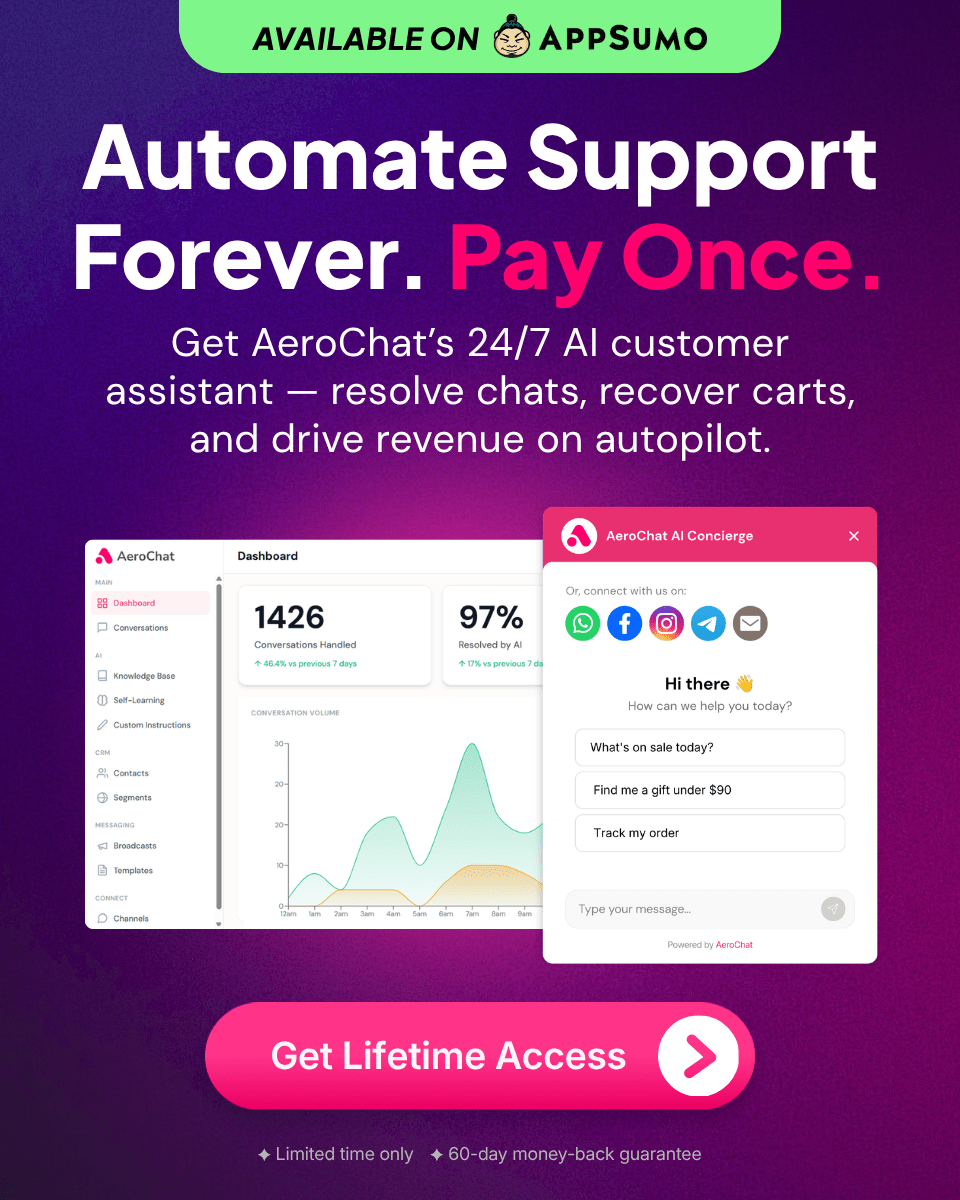
It looks like a chatbot, but it takes agent-like actions — syncs your product catalog, pulls order data, recommends products in conversation, and hands off to a human at the right moment. It resolves 87–94% of customer inquiries without a human touching them, which is closer to AI agent performance than basic chatbot performance.
AeroChat isn’t a $10,000/month enterprise AI agent. It’s a $49/month tool that handles the 80% of agent work most small and mid-size businesses actually need. For e-commerce stores, clinics, and service businesses, that gap matters more than the label.
If you want a full enterprise AI agent with custom integrations and deep workflows, look at Salesforce or ServiceNow. If you want most of that value at a fraction of the cost, a hybrid is the smarter starting point. Read more on the conversational AI versus agentic AI question to see where most modern tools actually land.
Frequently Asked Questions
Is ChatGPT a chatbot or an AI agent?
ChatGPT is a chatbot in its basic form. With Custom GPTs and the agent mode released in 2025, it can act as a basic AI agent for some tasks. Out of the box, it answers questions. With tools and integrations connected, it can take actions.
Is Siri an AI agent?
Siri sits in between. It’s more than a chatbot because it takes actions like setting reminders, sending texts, and playing music. But it’s not a full AI agent — it can’t reason through multi-step tasks or learn from past use the way modern agents do.
Can a chatbot replace an AI agent?
Only for simple, repetitive work. For anything that needs decisions, actions across systems, or memory between chats, a chatbot will hit a wall.
Are AI agents more expensive than chatbots?
Yes — usually 5 to 50 times more. A basic chatbot starts around $20/month. A real AI agent starts at $500/month and goes up. Hybrid tools sit in between.
Do small businesses need an AI agent?
Most don’t. A hybrid tool that handles FAQs and a few key actions (booking, order lookup, lead routing) covers most needs. Full AI agents start to pay off once monthly conversation volume crosses a few thousand.
Is conversational AI the same as an AI agent?
No. Conversational AI is the bigger category that includes chatbots, voice assistants, and AI agents. An AI agent is one type of conversational AI — the type that can take actions, not just hold a conversation.
Can chatbots learn over time?
Old chatbots can’t. Modern AI chatbots can learn from past conversations to some degree, but they don’t plan or take actions across tools the way AI agents do.
Which is better for customer service: chatbot or AI agent?
It depends on volume and complexity. For under 500 inquiries a month that are mostly FAQs, a chatbot is enough. For higher volumes and inquiries that need actions (refunds, bookings, account changes), an AI agent earns its cost. To go deeper, see our AI versus human support comparison.
What is an agentic AI?
Agentic AI is another name for AI agents. It refers to AI systems that can plan, decide, and act on their own rather than just respond to prompts. The “agentic” part means having agency — the ability to take action.
Are AI agents replacing customer service jobs?
They’re replacing the simple, repetitive part of those jobs. The complex part — judgment calls, sensitive conversations, anything that needs empathy or trust — still needs humans. The smart move is to use AI agents to handle the routine 70–80% so your team can focus on the rest.
The Bottom Line
A chatbot is a smart FAQ that types back. An AI agent is software that does the work. The difference is action, not language.
For most small and mid-size businesses, a hybrid tool gives you 80% of the value of an AI agent for 10% of the cost. Save the full agent budget for when your volume actually justifies it.
If you want to see what a hybrid looks like in practice, try AeroChat free. Connect your store, your calendar, your inbox — and see how much it handles without you.