
9 Best Shopify AI Assistants in 2026 (Support, Sales, AI)
The best Shopify AI assistant for customer-facing support and sales in 2026 is AeroChat — the only platform combining live Shopify and WooCommerce order data, WhatsApp and Telegram in one inbox, at a flat fee of $49 per month with a 90 percent-plus AI resolution rate. For stores wanting the most proven platform with the largest review base, Tidio’s Lyro AI achieves a verified 67 percent resolution rate across 1,700-plus Shopify App Store reviews. For merchant-facing store management, Shopify Sidekick is the native assistant built directly into the Shopify admin.
This guide covers the 9 best Shopify AI assistants in 2026, the important distinction between customer-facing and merchant-facing assistants, what features actually matter for ecommerce revenue, and how to choose the right platform for your store’s specific situation.
The Most Important Distinction Nobody Else Explains
Before comparing any tools, you need to understand one thing that every other guide on this topic glosses over.
There are two completely different types of Shopify AI assistant, and they serve completely different audiences.
Merchant-facing AI assistants help you — the store owner — manage your Shopify store. Shopify Sidekick and Shopify Magic fall into this category. They generate product descriptions, answer admin questions, and help you navigate your dashboard. They do not talk to your customers.
Customer-facing AI assistants talk to your shoppers — answering product questions, tracking orders, recovering abandoned carts, and guiding people through checkout. AeroChat, Tidio, Gorgias, and Alhena AI fall into this category. These are the tools that directly drive revenue and reduce support costs.
Most searches for “best Shopify AI assistant” are looking for customer-facing tools. This guide covers both types, clearly labelled, so you can make the right decision for what you actually need.
The revenue impact of each type is also very different. A merchant-facing assistant saves you time writing product descriptions. A customer-facing assistant converts a hesitating shopper at midnight on a Sunday who would otherwise have abandoned their cart and bought from a competitor. The impact of slow or absent replies on Shopify store revenue is direct and measurable — customer-facing AI addresses this at scale.
Shopify AI assistants Comparison Table
|
Assistant |
Type |
Best For |
Shopify + WooCommerce |
WhatsApp Native |
Starting Price |
Shopify Reviews |
|---|---|---|---|---|---|---|
|
AeroChat |
Customer-facing |
Omnichannel ecommerce, WhatsApp, flat pricing |
Both native |
Yes |
$49/mo flat |
5.0 (1 review) |
|
Tidio |
Customer-facing |
Proven AI, largest review base |
Shopify native |
Via integration |
$29/mo |
4.7 / 1,700+ |
|
Gorgias |
Customer-facing |
Scaling stores with support teams |
Shopify native |
Via integration |
$60/mo |
4.4 / 700+ |
|
Alhena AI |
Customer-facing |
Revenue-focused AI with product discovery |
Shopify + WooCommerce |
No |
Custom |
N/A |
|
eesel AI |
Customer-facing |
Helpdesk AI that processes refunds |
Shopify native |
No |
$239/mo |
Limited |
|
Shopify Sidekick |
Merchant-facing |
Store management and admin tasks |
Shopify only |
No |
Included |
Native |
|
Shopify Inbox |
Customer-facing |
Free basic chat for new stores |
Shopify only |
No |
Free |
Native |
|
Tidio Lyro |
Customer-facing |
AI resolution with contractual guarantee |
Shopify native |
Via integration |
$39/mo add-on |
4.7 / 1,700+ |
|
Re:amaze |
Customer-facing |
Multi-channel helpdesk with agent inbox |
Shopify + others |
Yes |
$29/agent/mo |
4.6 |
10 Best Shopify AI assistants in 2026 to choose from
1. AeroChat — Best Customer-Facing Shopify AI Assistant for Omnichannel Ecommerce
Type: Customer-facing Shopify App Store: 5.0 stars Channels: WhatsApp, Telegram, Instagram, Messenger, Web Chat Starting price: from $49 per month
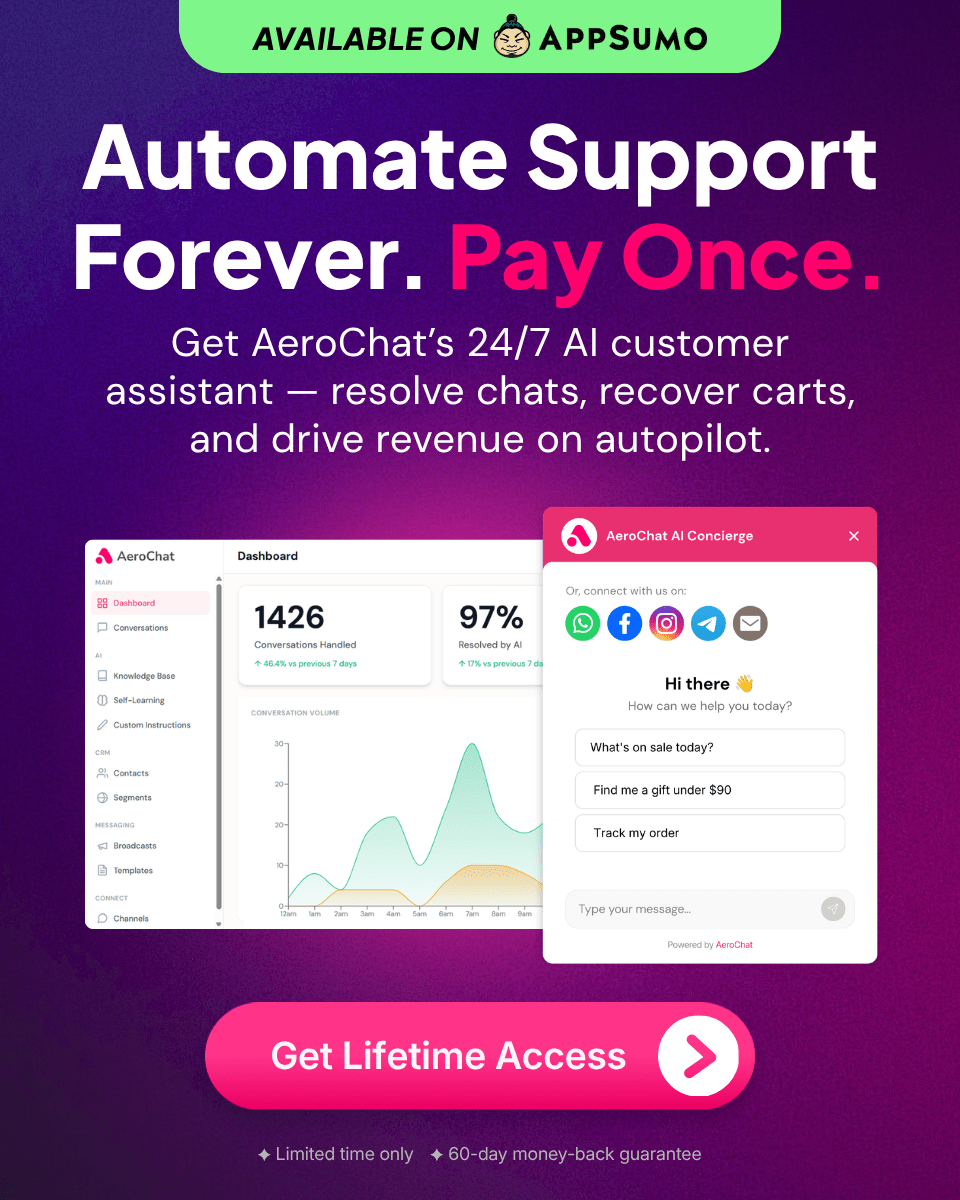
AeroChat is the customer-facing AI assistant built specifically for ecommerce stores that need their AI to take real actions using live store data — not just answer FAQs. It connects natively to both Shopify and WooCommerce, reads live order data, product inventory, and store policies in real time, and handles customer conversations across WhatsApp, Telegram, Instagram, Messenger, and web chat from a single unified inbox.
The distinction from every other platform on this list starts with two things: WooCommerce parity and flat-fee pricing.
Most Shopify AI assistants are Shopify-only. Stores that run WooCommerce alongside Shopify — common for brands with a UK or European storefront on WooCommerce and a US storefront on Shopify — have to run separate chatbot tools per platform. AeroChat unifies both. This is a genuine operational advantage that no competitor currently offers.
The flat-fee pricing is equally important for stores running advertising campaigns. When a TikTok or Instagram ad performs and message volume spikes 8 to 10 times overnight, a usage-based chatbot platform bills you proportionally more on the exact nights your marketing works. AeroChat’s pricing does not change regardless of message volume. For DTC stores that run frequent paid campaigns, this predictability is a direct operational benefit.
What makes AeroChat different from every other assistant:
The proactive model is the core difference. Most Shopify AI assistants wait for a customer to ask a question and then respond. AeroChat detects customer behaviour and acts before the question is asked. A customer who has been on the checkout page for 90 seconds and has not completed purchase is showing hesitation. AeroChat recognises this signal and opens a conversation at that moment — not to push, but to remove the last friction point. This is the mechanism behind reducing cart abandonment through instant replies, and it is a meaningful conversion driver that reactive assistants cannot replicate.
The WhatsApp and Telegram coverage matters specifically for stores selling to customers in UAE, UK, Europe, and Southeast Asia. In these markets, customers frequently send pre-purchase questions via WhatsApp before they reach a store’s website. A customer who has seen your Instagram ad and wants to ask about sizing or availability messages you on WhatsApp. Without WhatsApp automation, that conversation either goes unanswered until the next working day or requires a human agent. AeroChat handles it automatically, in the customer’s language, using live product catalog data. For the full picture of why this matters for specific markets, the best WhatsApp AI chatbots for Shopify covers country-level adoption data.
Pros: Live Shopify and WooCommerce order data, flat-fee pricing, WhatsApp and Telegram native, proactive behaviour-based triggers, omnichannel inbox, multilingual, 90-plus percent resolution rate, self-learning AI
Cons: Newer platform with limited independent third-party review history, no free plan, best suited to ecommerce stores rather than service businesses
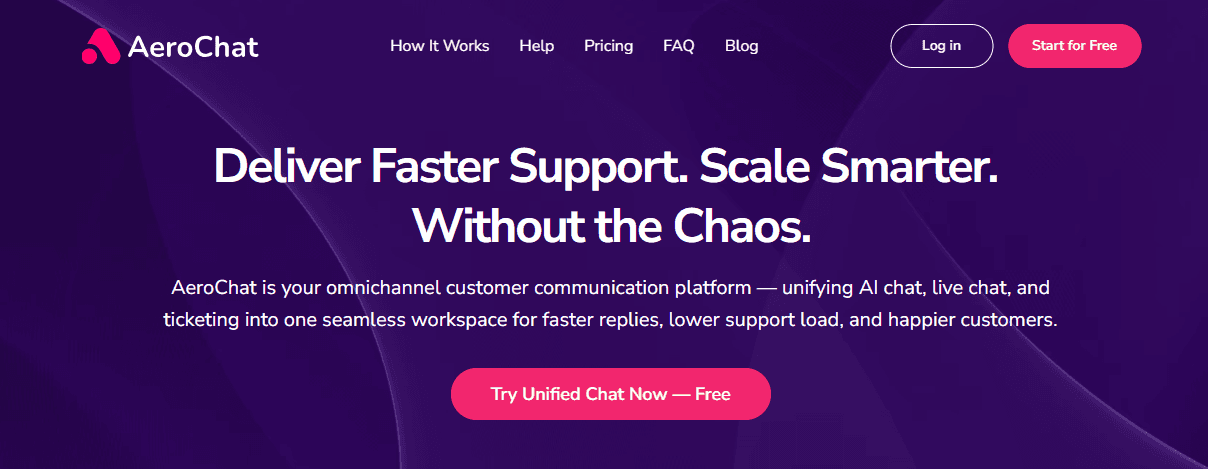
Pricing: from $49 per month, no per-conversation charges beyond Meta’s standard WhatsApp API fees
Best for: Growing Shopify and WooCommerce stores in UK, UAE, Australia, Europe, and Canada that want customer-facing AI covering WhatsApp alongside web chat, with predictable pricing during advertising campaigns
For a detailed head-to-head comparison with the other leading platforms, see the best Shopify AI chatbot comparison guide.
2. Tidio — Best for Proven AI With the Largest Shopify Review Base
Type: Customer-facing Shopify App Store: 4.7 stars / 1,700-plus reviews G2: 4.7 stars / 1,500-plus reviews Verified AI resolution rate: 67 percent (50 percent guaranteed on Premium) Starting price: $29 per month (Lyro AI: $39 per month add-on)
Tidio is the most widely reviewed customer-facing AI assistant for Shopify, used by over 300,000 businesses. Its AI agent Lyro, built on Anthropic’s Claude, achieves a publicly verified 67 percent resolution rate — the highest independently confirmed rate among entry-level Shopify chatbot platforms. For stores that want a proven platform with the largest community, the most documentation, and an established track record before committing to a newer tool, Tidio is the lowest-risk choice.
What Tidio does well for ecommerce specifically: Lyro handles order tracking using live Shopify data, manages return policy queries, answers product questions, and escalates to human agents with full context when needed. The Flows builder creates no-code automations specific to your store — for example, a trigger that detects a customer on your returns page and opens a chat offering to help.
What to know before buying: The advertised $29 per month base plan does not include Lyro AI. Full AI functionality requires $29 plus $39 for Lyro plus $29 for Flows — a realistic all-in cost of $97 to $150 per month. Lyro also has a monthly conversation cap. If you run a flash sale and hit the cap, the AI stops responding until your next billing cycle. WhatsApp support works via integration rather than natively.
Pros: Largest Shopify review base on this list, 67 percent verified AI resolution rate with contractual guarantee at Premium tier, free plan for testing, strong Shopify data integration, no-code Flows builder, large community and documentation
Cons: Realistic full-featured cost $97 to $150 per month, WhatsApp via integration not native, AI conversation caps create risk during peak trading periods, modular pricing requires separate purchases for full functionality
Pricing: $29 per month base plus $39 per month Lyro AI plus $29 per month Flows
Best for: Shopify stores wanting the most proven customer-facing AI assistant with the largest independent review base, comfortable with modular pricing
For a full comparison, the Tidio vs AeroChat guide covers both platforms side by side for Shopify ecommerce specifically.
3. Gorgias — Best for Scaling Shopify Stores With Established Support Teams
Type: Customer-facing helpdesk with AI Shopify App Store: 4.4 stars / 700-plus reviews Shopify Premier CX Partner AI deflection rate: 60 percent Starting price: $60 per month
Gorgias is the most deeply integrated Shopify helpdesk on the market and a Shopify Premier CX Partner. Its AI handles 60 percent of routine queries and agents can take order actions — processing refunds, cancelling orders, applying discount codes — directly within the support conversation without switching to Shopify admin. For stores with 3 or more support agents handling complex tickets alongside AI automation, Gorgias provides the most structured workflow management.
The critical difference from AeroChat: Gorgias is built around agents supported by AI. AeroChat is built around AI with human escalation when needed. If your business model requires human agents reviewing and approving most customer interactions, Gorgias is well suited. If you want the AI to resolve 80 to 90 percent of queries without agent involvement, AeroChat or Tidio is more appropriate.
What to know before buying: Gorgias uses ticket-based pricing. During flash sales or high-volume periods, costs can spike significantly — one verified store reported going from $300 to $1,200 per month during Black Friday. The AI Agent charges $0.90 per resolved conversation on top of the base plan. These variable costs are important to model when comparing against flat-fee alternatives. A full cost comparison is in the Gorgias vs AeroChat guide.
Pros: Deepest Shopify action integration on the market, Shopify Premier CX Partner, strong team management and reporting, 60 percent automation rate, revenue attribution tracking
Cons: Ticket-based pricing spikes during ad campaigns, AI Agent charged per resolution, better suited to agent-heavy teams than solo operators or small stores
Pricing: From $60 per month for 300 tickets, AI Agent at $0.90 per resolved conversation
Best for: DTC Shopify stores with established support teams of 3 or more agents needing structured helpdesk management and the deepest possible Shopify order action capabilities
4. Alhena AI — Best for Revenue-Focused AI With Product Discovery
Type: Customer-facing Verified results: 86 percent deflection rate (Crocus), 3x conversion uplift (Tatcha), 38 percent AOV increase Starting price: Custom
Alhena AI is the customer-facing assistant most focused on converting browsers into buyers rather than purely handling support. It combines support automation with guided product discovery, personalised cross-sells, and agentic checkout — meaning the AI can populate a cart and guide a customer to checkout completion within the conversation.
Verified results give it credibility that newer platforms cannot match: Crocus achieved an 86 percent ticket deflection rate with an 84 percent CSAT score simultaneously, demonstrating that high deflection does not require sacrificing satisfaction. Tatcha achieved 3x conversion uplift with 38 percent AOV increase using Alhena’s product recommendation engine.
For Shopify stores where the primary goal is revenue growth through AI-assisted product discovery — particularly fashion, beauty, and lifestyle brands — Alhena AI is the strongest purpose-built option on this list.
What to know before buying: Alhena AI does not publish pricing publicly and requires a sales conversation. For stores on tighter budgets or those wanting transparent flat-fee pricing, AeroChat or Tidio are more accessible starting points.
Pros: Highest verified revenue impact results on this list, agentic checkout capability, revenue attribution showing which AI conversations drove purchases, hallucination-free responses grounded in product data
Cons: No public pricing, requires custom onboarding, not the right entry point for stores under $1 million annual revenue, no WhatsApp or Telegram support
Best for: Mid-market and enterprise Shopify stores in fashion, beauty, and lifestyle whose primary goal is AI-driven revenue growth and personalised product discovery
5. eesel AI — Best for Stores Wanting AI That Takes Order Actions
Type: Customer-facing with helpdesk integration Starting price: $239 per month
eesel AI goes beyond answering questions to taking actions inside Shopify — processing refunds, creating replacement orders, and handling returns directly. Most customer-facing AI assistants can tell a customer their order status. eesel AI can actually resolve the issue if the order was wrong, damaged, or lost.
It also integrates with existing helpdesks like Zendesk and Freshdesk rather than replacing them, meaning stores that already have a helpdesk infrastructure can add eesel as an intelligent AI layer without switching vendors.
Pros: AI takes actual order actions in Shopify, integrates with existing helpdesks, trains on your historical support tickets automatically, can process refunds and replacements without agents
Cons: Starting at $239 per month it is the most expensive option on this list, better suited to stores with $2 million-plus annual revenue and high ticket volumes
Pricing: $239 per month (Team plan, 1,000 interactions annually)
Best for: Established Shopify stores with existing helpdesk infrastructure wanting AI that resolves order issues end-to-end rather than just providing information
6. Shopify Sidekick — Best Merchant-Facing AI for Store Management
Type: Merchant-facing (does NOT talk to customers) Cost: Included with Shopify subscription
Shopify Sidekick is the AI assistant Shopify built directly into the admin panel. It helps store owners manage their store through conversational commands — pulling order reports, navigating admin settings, generating product descriptions, and answering operational questions about the store.
It is important to be completely clear: Sidekick does not interact with your customers. It is not a customer-facing assistant. A customer on your storefront cannot chat with Sidekick. It exists entirely within your admin dashboard to make store management faster for you.
What it does well: Sidekick has access to all of your Shopify data natively — orders, inventory, customers, analytics. You can ask “which products had the highest return rate last month” and get an immediate answer. For solo store owners navigating a growing Shopify admin, this native conversational layer reduces the time spent on operational tasks.
What it does not do: It cannot automate customer support. It cannot handle WhatsApp messages. It cannot recover abandoned carts. It cannot answer a customer asking about their order. For those jobs you need a customer-facing assistant.
Pros: Free with all Shopify plans, native access to all store data, no setup required, deeply integrated with Shopify admin workflows
Cons: Merchant-facing only — no customer interaction, Shopify-native only so no WooCommerce support, cannot replace a customer-facing support tool
Best for: Shopify store owners wanting AI help with admin tasks, reporting, and store management — not customer support automation
7. Shopify Inbox — Best Free Customer-Facing Assistant for New Stores
Type: Customer-facing Cost: Free with all Shopify subscriptions AI features: Shopify Magic suggested replies
Shopify Inbox is Shopify’s free native customer-facing chat tool. It lets customers message your store from your website and mobile apps, with Shopify Magic providing AI-suggested replies for agents to review and send. It shows agents what the customer has in their cart and which page they are viewing alongside the conversation.
It is a solid starting point for new Shopify stores receiving under 50 messages per month. As message volume grows, its limitations become operational bottlenecks: there are no proactive triggers, no WhatsApp or Instagram coverage, no autonomous AI resolution, and no order actions the AI can take independently.
Pros: Completely free, native Shopify integration, shows cart contents alongside conversations, Shopify Magic provides suggested replies for agents
Cons: No autonomous AI resolution — suggested replies still require agent review, no proactive behaviour-based triggers, no WhatsApp or Telegram, no WooCommerce support, not suitable for stores over 50 messages per month
Pricing: Free
Best for: New Shopify stores processing under 100 orders per month wanting zero-cost basic chat before investing in a dedicated AI platform
8. Re:amaze — Best Multi-Channel Helpdesk for Mixed-Platform Stores
Type: Customer-facing helpdesk G2: 4.6 stars Starting price: $29 per agent per month
Re:amaze brings email, live chat, social media, and SMS into a single inbox with Shopify order data visible alongside every conversation. Its three pre-built chatbots — Hello, FAQ, and Order — automate common queries out of the box. It supports Shopify, BigCommerce, and WooCommerce from the same platform, which makes it relevant for brands that operate across multiple ecommerce platforms.
The AI in Re:amaze is primarily agent-assist rather than autonomous. It helps human agents respond faster rather than resolving queries without them. For stores that specifically want human oversight on most customer interactions, this is a feature rather than a limitation.
Pros: Multi-platform support including Shopify, WooCommerce, and BigCommerce, unified inbox for all channels, pre-built ecommerce chatbots, strong agent collaboration tools
Cons: AI primarily assists agents rather than resolving autonomously, per-agent pricing grows with team size, AI features on higher plans only
Pricing: $29 per agent per month base, AI features from $69 per agent per month
Best for: Stores operating across multiple ecommerce platforms needing a unified helpdesk with agent-assist AI
9. Freshchat — Best for Stores Already in the Freshworks Ecosystem
Type: Customer-facing G2: 4.4 stars Starting price: $19 per agent per month
Freshchat is part of the Freshworks suite alongside Freshdesk, Freshsales, and Freshservice. For stores already paying for Freshdesk or Freshsales, Freshchat adds AI chat capability without a new vendor relationship. The Freddy AI assistant handles suggested replies and basic ticket routing, with deeper AI functionality on higher plan tiers.
WhatsApp support requires upgrading to Freshdesk Omni — a separate product — rather than being included in the standard Freshchat plan. The realistic all-in cost with full AI and WhatsApp is $234 to $350 per month, which is substantially higher than the advertised starting price. The full cost breakdown is covered in the Freshdesk vs AeroChat comparison.
Pros: Natural fit for existing Freshworks users, multi-channel inbox, solid escalation structure, per-agent pricing accessible for small teams
Cons: WhatsApp requires separate Omni upgrade, AI features are paid add-ons, realistic all-in cost $234 to $350 per month
Pricing: $19 per agent per month base, $234 to $350 per month realistic with full AI and WhatsApp
Best for: Shopify stores already using Freshdesk or Freshsales wanting to add AI chat without introducing a new vendor
What Actually Separates Good Shopify AI Assistants From Average Ones
This is the section other guides skip entirely. Listing features and pricing is easy. Understanding which features drive actual ecommerce results is what most articles do not cover.
Live store data access is non-negotiable. A customer-facing AI assistant that cannot read your live Shopify or WooCommerce order data cannot answer the most common question in ecommerce — where is my order. It can only respond with generic templates. Every platform on this list with a star rating above 4.5 has real-time order data access. Platforms without it should not be considered for ecommerce support automation. This is why reducing WISMO tickets on Shopify is fundamentally about which platform is reading live data, not which has the prettiest interface.
Proactive triggers convert hesitating customers. A reactive assistant waits for a customer to ask a question. A proactive assistant detects signals — a customer on checkout for 90 seconds, a customer viewing a product page three times, a customer arriving from a specific ad campaign — and opens a conversation at the right moment. The conversion difference between proactive and reactive assistance is measurable. Stores using proactive customer support on Shopify consistently report higher conversion rates than those using reactive-only models.
Flat-fee pricing matters more than most stores realise when they first choose a platform. The moment you run a successful advertising campaign, a usage-based chatbot starts costing more. For stores that run frequent TikTok, Instagram, or Meta campaigns, the month that generates the most revenue is also the month that generates the most customer messages — and the most chatbot costs. Flat-fee platforms like AeroChat remove this correlation entirely.
WhatsApp and Telegram coverage is essential for international stores. If your customers are in UAE, UK, Europe, or Southeast Asia, a significant portion of pre-purchase and post-purchase questions arrive via WhatsApp before a customer contacts your website. A customer-facing AI assistant that only covers your website chat is missing these conversations entirely. This is covered in depth in the best WhatsApp AI chatbots for Shopify guide for each major market.
WooCommerce parity determines your long-term platform choice. If you currently run Shopify only but plan to add a WooCommerce store for a different market or brand, choosing an AI assistant that supports both platforms from day one prevents a platform migration later. AeroChat and Re:amaze both support Shopify and WooCommerce. Most others are Shopify-only.
Setup time is a real differentiator. Most platforms claim “easy setup.” In practice, basic setup — installing, connecting to Shopify, and going live with default settings — takes under an hour for AeroChat, Tidio, Shopify Inbox, and Gorgias. Meaningful customisation — adding your return policy, shipping windows, product-specific FAQs — takes 2 to 4 hours for most platforms. eesel AI and Alhena AI require longer onboarding processes, typically several days, because they are more sophisticated. Understanding how to train a Shopify chatbot with your own store data covers what this process actually involves regardless of platform.
How to Choose the Right Shopify AI Assistant for Your Store
|
If you are… |
Best choice |
Why |
|---|---|---|
|
A Shopify or WooCommerce store needing WhatsApp + omnichannel |
AeroChat |
Only platform with both platforms native + WhatsApp + Telegram |
|
Wanting the most proven AI with largest review base |
Tidio |
1,700+ Shopify reviews, 67% verified resolution rate |
|
A store with established support team needing helpdesk |
Gorgias |
Deepest Shopify action integration, Shopify Premier Partner |
|
Focused on revenue growth through product discovery |
Alhena AI |
Highest verified AOV and conversion uplift results |
|
Already using Freshdesk or Freshsales |
Freshchat |
Natural extension without new vendor |
|
Wanting AI that processes refunds and takes order actions |
eesel AI |
Goes beyond answers to resolving issues in Shopify |
|
A new store wanting zero-cost starting point |
Shopify Inbox |
Free, native, requires no setup |
|
Needing to manage your Shopify admin with AI |
Shopify Sidekick |
Native merchant-facing assistant, free |
|
Running Shopify + WooCommerce + BigCommerce |
Re:amaze |
Multi-platform helpdesk from one inbox |
Frequently Asked Questions
What is the best Shopify AI assistant in 2026?
For customer-facing support and sales automation, AeroChat is the best overall for Shopify and WooCommerce stores needing WhatsApp, live order data, and flat-fee pricing. Tidio is the most proven with 1,700-plus Shopify reviews and a 67 percent verified AI resolution rate. For merchant-facing store management, Shopify Sidekick is included free with every Shopify plan.
What is the difference between a Shopify AI assistant and a Shopify AI chatbot?
In practical terms they refer to the same category of customer-facing tools. The term “AI assistant” is sometimes used to imply broader capability — including proactive suggestions, product recommendations, and revenue generation — while “chatbot” sometimes implies reactive FAQ automation. In 2026 the most capable platforms do both. The meaningful distinction is between customer-facing assistants (which talk to your shoppers) and merchant-facing assistants like Shopify Sidekick (which help you manage your store).
Does Shopify have a built-in AI assistant?
Yes, two. Shopify Sidekick is a merchant-facing AI assistant built into the Shopify admin that helps store owners with management tasks, reporting, and operations. It does not interact with customers. Shopify Inbox is a free customer-facing chat tool with Shopify Magic AI suggested replies, but it requires agent review of responses rather than autonomous resolution. Neither replaces a dedicated customer-facing AI platform for stores above 100 orders per month.
Which Shopify AI assistant works with WhatsApp?
AeroChat includes native WhatsApp support in its base $49 per month plan. ManyChat and Chatbase also support WhatsApp natively. Tidio, Gorgias, and Re:amaze support WhatsApp via integration. For Shopify stores selling to customers in UAE, UK, Europe, and Southeast Asia where WhatsApp is a primary channel, native support is significantly more reliable than integration-based options.
Can a Shopify AI assistant help with WooCommerce too?
AeroChat and Re:amaze both support Shopify and WooCommerce natively from one inbox. Most other platforms on this list are Shopify-only. For brands operating stores on both platforms, choosing a platform with genuine WooCommerce parity from the start prevents having to migrate tools later.
How long does it take to set up a Shopify AI assistant?
Basic setup — installing, connecting to Shopify, and going live with default settings — takes under an hour for AeroChat, Tidio, Shopify Inbox, and Gorgias. Meaningful customisation with your return policy, shipping windows, and product-specific FAQs takes 2 to 4 additional hours for most platforms. eesel AI and Alhena AI require longer onboarding.
What is the best free Shopify AI assistant?
Shopify Inbox is the best free customer-facing option — it is native to Shopify, shows cart data alongside conversations, and uses Shopify Magic for AI-suggested replies. Tidio has a free plan covering 50 live chat conversations per month. For merchant-facing store management, Shopify Sidekick is free with all Shopify plans. For stores growing beyond these free tiers, the best Shopify chatbots for small stores covers paid entry-level options.