
Shopify Customer Retention Strategies: The Complete Guide for 2026
The average Shopify store loses the majority of its first-time buyers. They purchase once, leave, and never return — not because of a bad experience, but because nothing happened to bring them back.
Most retention advice treats this as a tools problem: add a loyalty programme, send more emails, create a win-back campaign. That is not wrong, but it misses the underlying issue. Retention is a sequencing problem. There is a specific window after a customer's first order where the decision to return is made, and most stores leave that window almost entirely empty.
This guide maps that window, the strategies that fill it, and how to prioritise them based on where your store currently sits.
Why do most Shopify customers not come back after their first order?
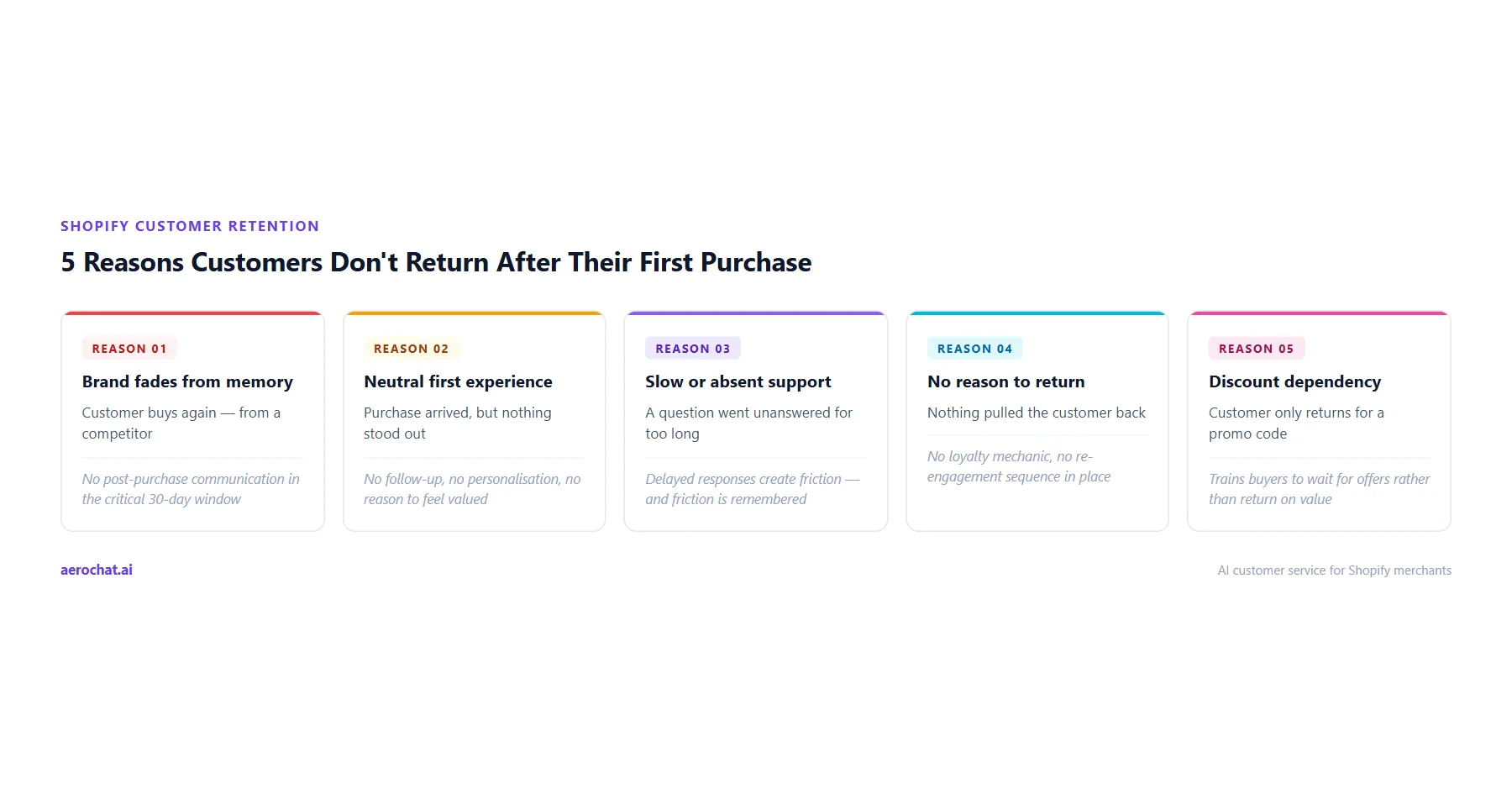
Before choosing strategies, it is worth understanding what actually drives churn. The causes are rarely what merchants assume.
| Cause | What it looks like | What drives it |
|---|---|---|
| The brand fades from memory | Customer buys again — from a competitor | No post-purchase communication in the critical window |
| Neutral first experience | Purchase arrived, but nothing stood out | No follow-up, no personalisation, no reason to feel looked after |
| Slow or absent support | Customer had a question, never got a fast answer | Delayed responses during or after the first purchase |
| No reason to return | Nothing pulled the customer back | No loyalty mechanic, no re-engagement sequence |
| Discount dependency | Customer only returns for a promotional code | Over-reliance on discounts rather than value-based retention |
The last item matters most for long-term health. Discounts recover purchases in the short term, but they train customers to wait for the next offer. A retention system built on discount codes has a ceiling: customers only return when the economics justify it, and they leave the moment a competitor runs a better promotion. The strategies below are designed to build a genuine reason to return that does not depend on reducing your margin.
The 90-day retention window: why timing matters as much as tactics
Customers who return tend to do so within the first 30 to 60 days of their initial order. After 90 days without a meaningful reason to come back, the probability of a second purchase drops considerably — not because the customer disliked the brand, but because the brand has faded.
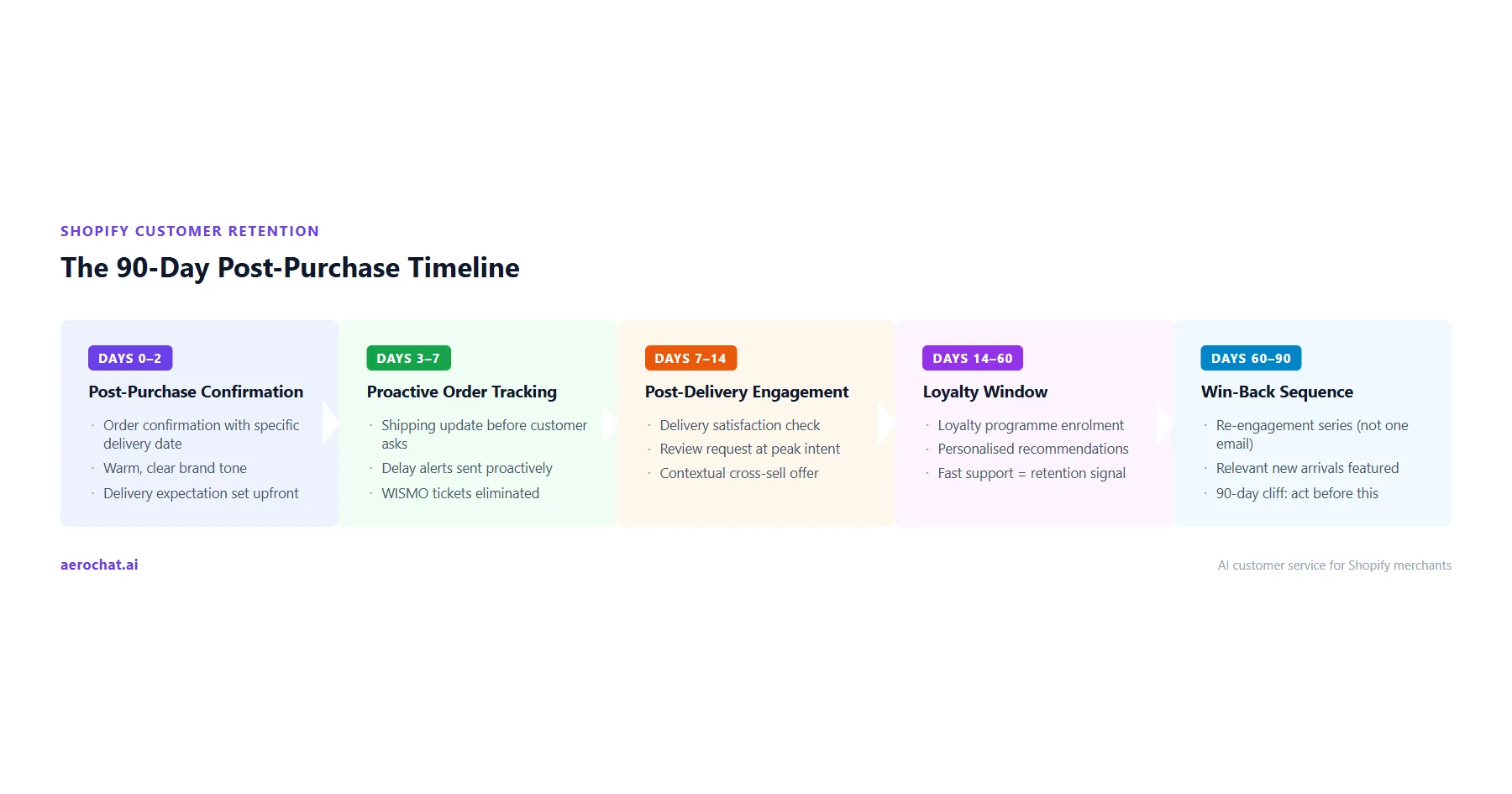
This means retention is not a background activity you run alongside everything else. It is a focused effort in a defined time window, and the effort in days 1 to 90 determines most of a customer's lifetime value. Strategies are ordered below according to when they matter.
Shopify customer retention strategies mapped to the 90-day timeline
Days 0 to 2: Does post-purchase communication affect whether customers return?
The first 48 hours after a purchase are the most underused retention window in ecommerce. The customer just spent money. The decision is fresh. Their attention is at its peak — and most stores fill that moment with an automated confirmation email that reads like a receipt.
A retention-focused Day 0 to 2 sequence does considerably more. It confirms the order, sets a specific delivery window, and makes the customer feel confident they made the right call. Warmth and clarity at this stage build the trust that brings customers back more reliably than any win-back campaign launched 60 days too late.
What to do in the first 48 hours:
- Write the confirmation as if a person sent it — not a system receipt
- Give a specific delivery date, not a range ("Arrives Thursday" beats "3–5 business days")
- Tell the customer you will send a tracking update before they need to ask
- Match the tone to the brand — warmth here is a retention investment, not a nice-to-have
For stores still setting up the foundation of their post-purchase communication, the ecommerce startup checklist covers what needs to be in place before these sequences are worth optimising.
Days 3 to 7: How does proactive order tracking reduce customer churn?
The single highest-volume support category for most Shopify stores is "Where is my order?" Most handle it reactively: the customer messages when anxious, and someone replies with a tracking link.
The retention-optimised approach inverts this entirely. A proactive tracking update sent before the customer starts worrying eliminates the anxiety before it forms. The customer feels looked after. They did not need to chase. That experience — feeling cared for without having to ask — is deeply retention-positive.
Delivery delays are a specific opportunity here, not just a problem to manage. A customer who receives an honest, proactive update handles a delay far better than one who had to contact support to find out it was happening. Stores that communicate delays before customers ask consistently retain more of those customers than stores that go quiet and wait for complaints to arrive.
What proactive tracking looks like in practice:
- Send a dispatch notification the moment the order ships — before the customer checks
- If a delay occurs, alert proactively with a revised ETA rather than waiting for a complaint
- Use WhatsApp or SMS for time-sensitive updates where possible; email gets buried
- Keep the message short — tracking link, expected date, one line of reassurance
Days 7 to 14: What should you send after a customer receives their Shopify order?
The week after delivery is the highest-value window for post-purchase communication. The product is fresh, the experience is recent, and the customer is in the best position to form an opinion and take action.
A well-timed post-delivery message serves two purposes simultaneously: it checks that everything arrived correctly — which builds trust and catches problems before they turn into disputes — and it requests a review at exactly the moment the customer is most likely to leave one.
The third element is a contextual product recommendation — not a generic "you might also like" carousel, but a suggestion tied directly to what they bought. That specificity is the difference between a message that feels like care and one that feels like a broadcast.
The three-part post-delivery message:
- Check that the order arrived correctly — one short question, not a survey
- Request a review in the same message while the experience is freshest
- Recommend one complementary product tied specifically to what they purchased — camera accessories for a camera buyer, not a random bestseller
Days 14 to 60: Does response speed affect whether Shopify customers return?
Support speed is a retention driver that most merchants do not connect to repeat purchases — but the connection is direct. A customer who sends a message about sizing, compatibility or a return, and waits hours for a reply, carries that friction into their next purchase decision.
The slow reply does not need to end badly to damage retention. The delay itself creates an association: contacting this brand takes effort. That association quietly reduces the probability of a second order. The hidden cost of slow replies extends well beyond the interaction itself. What that acceptable wait looks like also differs: each channel sets its own standard, with live chat demanding near-instant responses and email allowing considerably more time.
Speed targets that protect retention:
- Live chat: under 1 minute — customers who wait longer often abandon and do not return
- Email: under 4 hours — anything longer starts to feel like being ignored
- WhatsApp and Instagram DMs: treat these as live chat, not email
- Centralise all channels so no message is missed during busy periods
The practical implication: fast, accurate support during the first-purchase experience is a retention investment, not just a service cost.
Days 14 to 60: How do loyalty programmes retain Shopify customers without discount dependency?
A well-designed loyalty programme gives customers a reason to return that has nothing to do with price. Points on purchases, rewards for reviews, early access, birthday bonuses, tiered status — these mechanics work because returning consistently becomes more valuable than returning once in a while for a big spend.
The programmes that fail function as permanent discounts. Ten to fifteen per cent back on every order is just a different way of reducing your margin, without building any behavioural loyalty.
What makes a loyalty programme drive retention rather than just discount spend:
- Award points for frequency milestones, not only cumulative spend
- Offer tier benefits that are genuinely useful — early access, free shipping, priority support
- Make redemption frictionless; a difficult claims process kills programme engagement
- Measure redemption rate, not enrolment rate — high sign-ups with low redemption means the programme is not changing behaviour
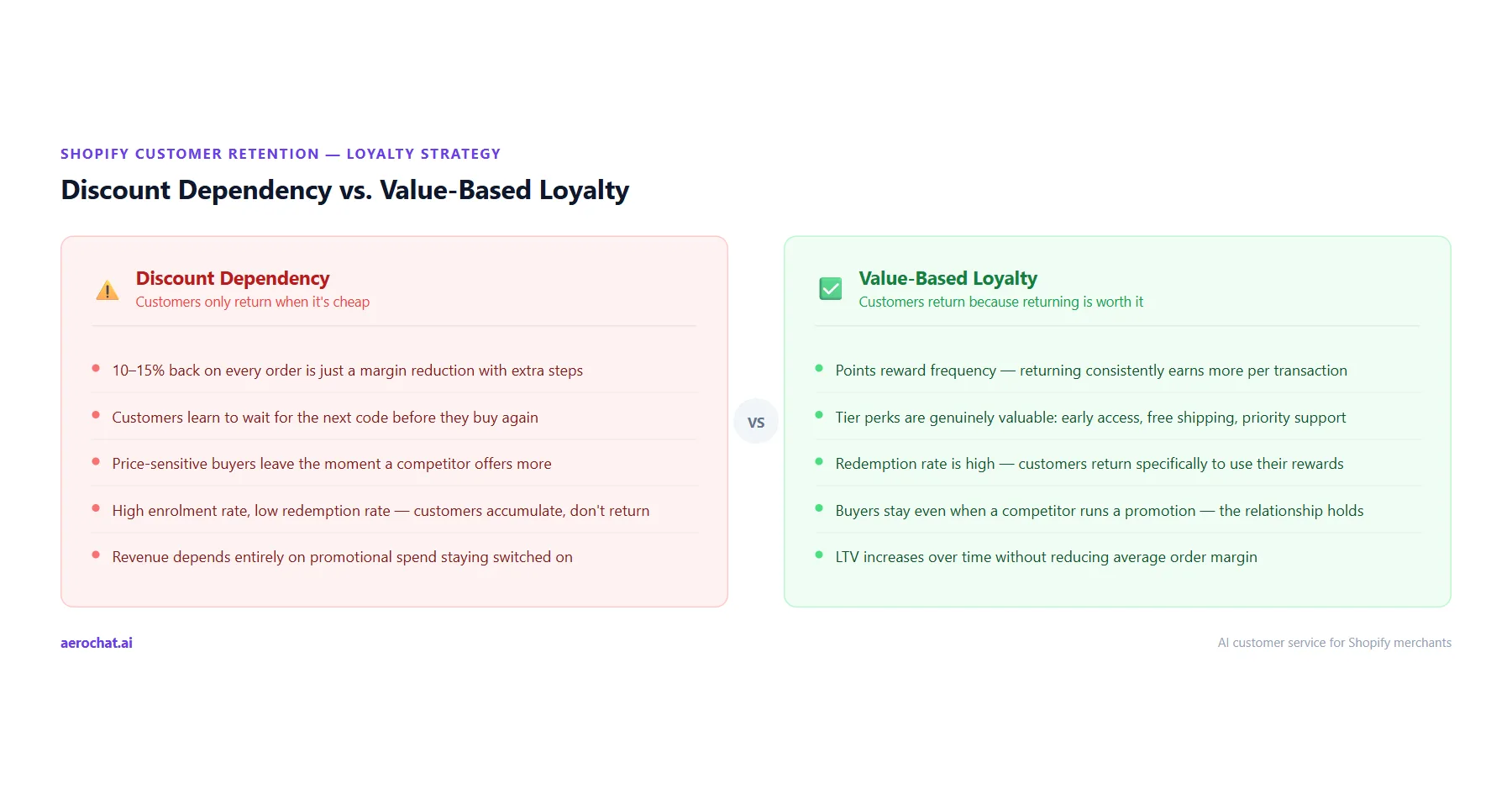
Watch redemption rate, not enrolment rate. High accumulation with low redemption means customers are collecting passively — they are not returning because of the programme, they are just earning rewards as a side effect of purchases they would have made anyway.
Days 14 to 60: How does personalisation increase repeat purchases on Shopify?
Personalisation at scale means that communications a customer receives are based on what they actually bought, when they bought it, and what customers with similar purchase histories tend to buy next.
For consumable products, this means replenishment timing: a message sent when the customer is likely to be running low on what they bought converts considerably better than a promotional email sent on a fixed calendar. For non-consumables, it means category-specific recommendations and new arrivals relevant to the customer's demonstrated interests.
Where to start with personalisation on Shopify:
- Segment by product category first — that single step already outperforms generic broadcasts
- For consumables, time the recommendation around when the customer is likely running low
- For non-consumables, surface new arrivals in the same category as their original purchase
- Avoid cross-selling between unrelated categories early on — it reads as random, not attentive
The practical entry point for most Shopify stores is segmenting by product category rather than attempting full individual personalisation from day one. That alone is meaningfully more relevant than unsegmented broadcasts and is achievable without complex tooling.
Days 60 to 90: How do you win back Shopify customers who have not returned?
At 60 days without a second purchase, a customer is approaching the point where re-engagement becomes significantly harder. A structured win-back sequence in this window — not a single email, but a short series with a clear purpose — recovers a meaningful proportion of lapsed buyers before they fully disengage.
The sequence should acknowledge the gap without labelling the customer as lost. "We have new arrivals we thought you would like" works far better than "We miss you." Show them something relevant to what they bought previously, and give them a reason to return that is not purely a discount where possible.
How to structure a win-back sequence that converts:
- Start at day 60, not day 85 — earlier in the window means higher recovery rates
- Send two or three messages spread over three weeks, not a single re-engagement email
- Feature products related to their original purchase — not your current bestsellers
- Early access and new arrivals pull customers back better than discount codes where possible
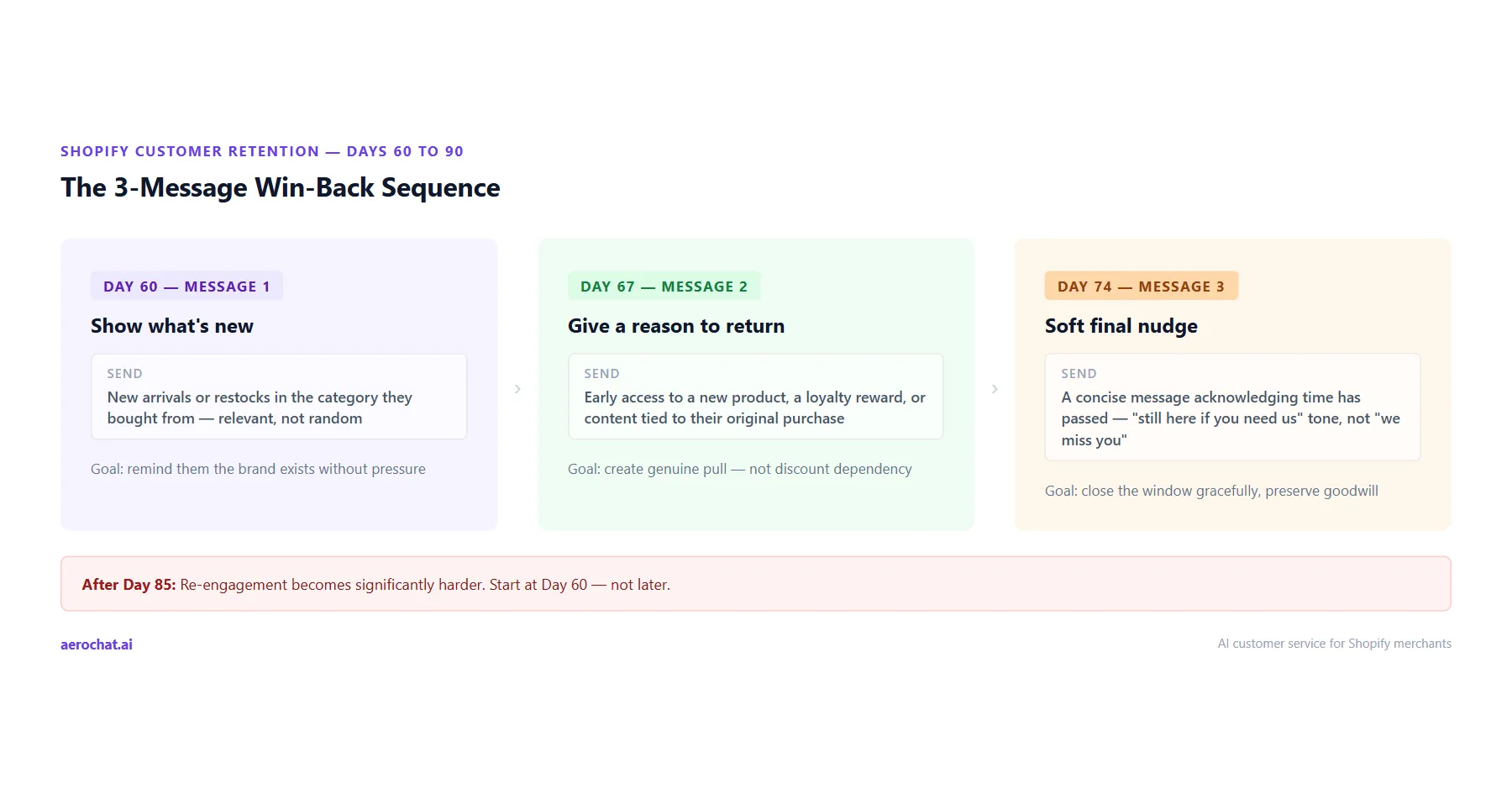
Sixty to 85 days is the efficient window. After 90 days, re-engagement takes considerably more effort and converts at much lower rates. If a customer has not returned by then, they are not gone forever — but they are considerably harder to reach.
Any stage: How do WhatsApp and Instagram increase Shopify customer retention?
Most retention thinking defaults to email. Email matters, but it operates in a saturated environment where customers actively manage and filter their inbox. Messages that reach customers through WhatsApp and Instagram DMs operate in a fundamentally different context: channels they check continuously, where the expectation is conversational rather than broadcast.
Channel by channel — what works for retention:
- WhatsApp: delivery updates, delay alerts, and time-sensitive nudges — open rates far exceed email
- Instagram DMs: post-delivery follow-up and new arrival announcements for visual products
- Both channels: win-back messages when the customer has gone quiet on email
- Website chat: real-time support during the purchasing process itself
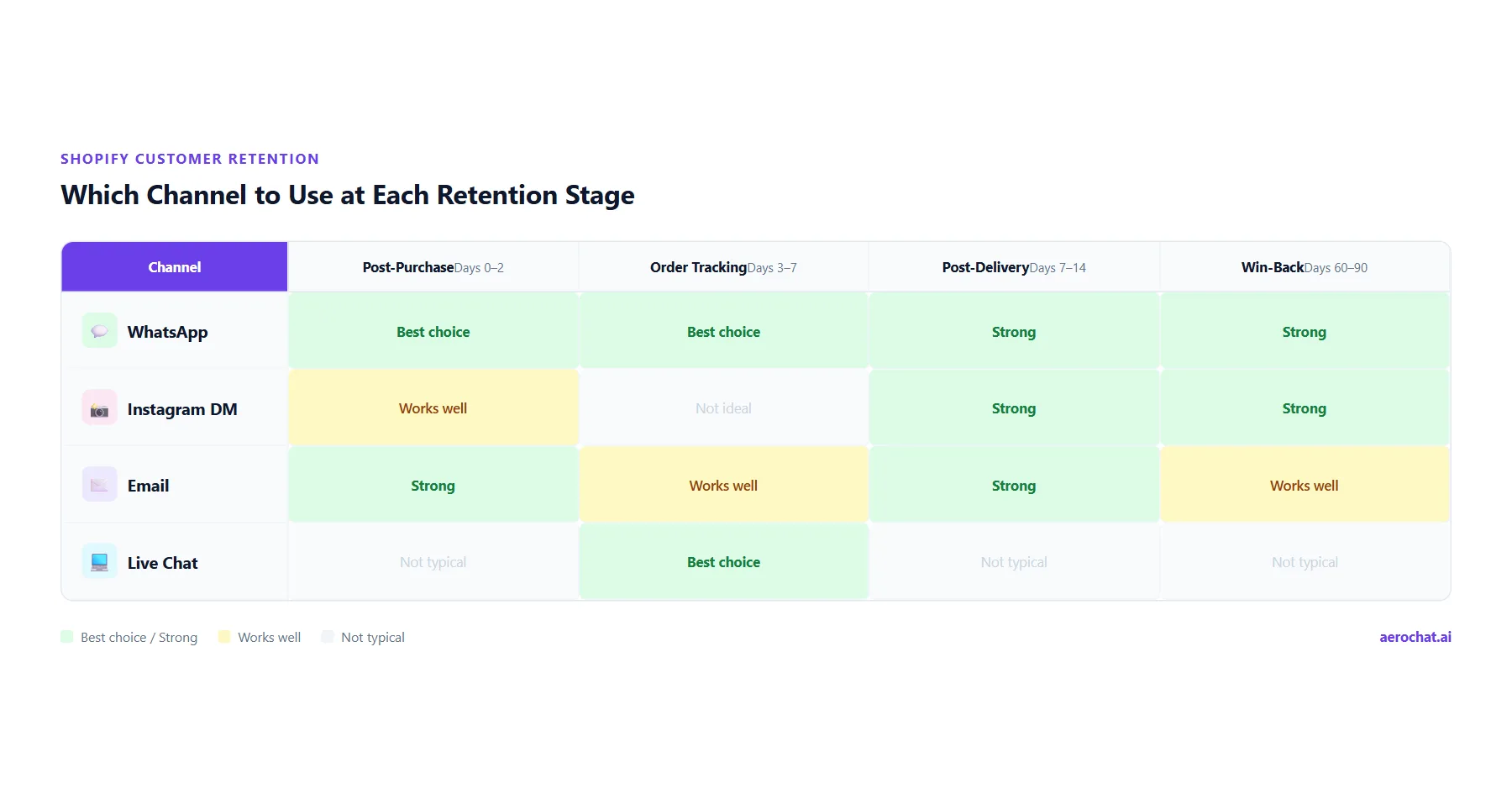
Pulling all channels into one inbox — website chat, WhatsApp, Instagram — means the right message reaches customers through the right channel rather than defaulting to email for everything. WhatsApp in particular suits time-sensitive retention touchpoints: delivery updates are read immediately rather than sitting in an inbox until the customer happens to check.
Any stage: How do you measure whether your Shopify retention strategy is improving?
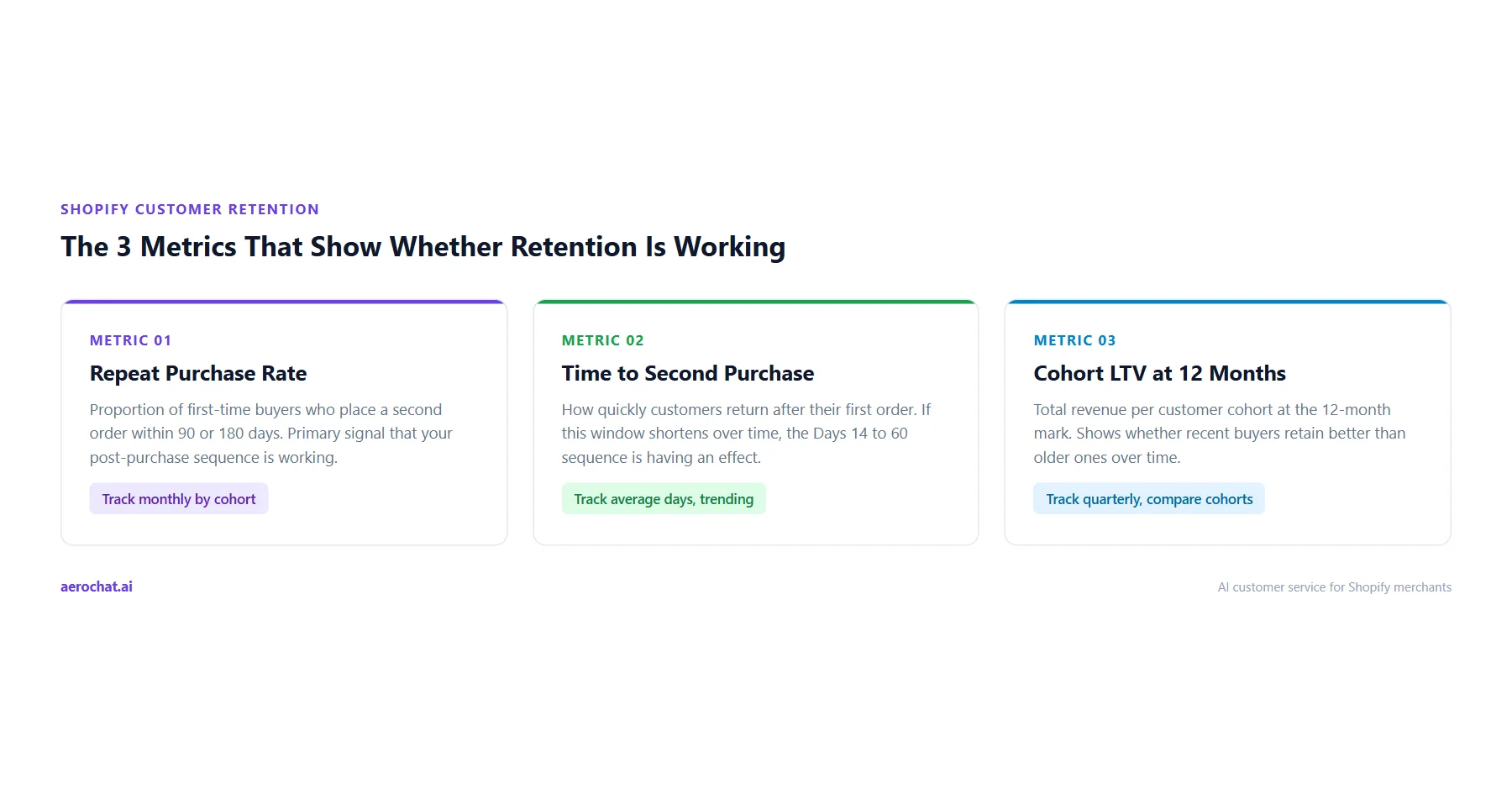
Retention strategy is only useful if you can tell whether it is working. Three metrics cover most of what a Shopify store needs to track:
Repeat purchase rate: the proportion of first-time buyers who place a second order within a defined window, typically 90 or 180 days. This is the primary signal that the post-purchase sequence is working.
Time to second purchase: how quickly customers return after their first order. If this shortens over time, the Day 14 to 60 sequence is having an effect.
Customer lifetime value by cohort: grouping customers by when they first purchased and tracking how their LTV develops over 12 months. Cohort LTV shows whether recent customers retain better than older ones — the most reliable signal that systematic retention work is compounding over time.
How the full retention timeline comes together
The nine strategies above work best as a connected system rather than individual tactics deployed separately.
| Window | Strategy | What it builds |
|---|---|---|
| Days 0 to 2 | Post-purchase confirmation and expectation-setting | Trust and confidence after the first transaction |
| Days 3 to 7 | Proactive order tracking and delivery updates | Feeling looked after without having to ask |
| Days 7 to 14 | Post-delivery check, review request, contextual cross-sell | Engagement when the experience is freshest |
| Days 14 to 60 | Support speed, loyalty enrolment, personalised recommendations | The primary repeat purchase window |
| Days 60 to 90 | Win-back sequence for customers who have not returned | Recovery before the 90-day cliff |
| Any stage | WhatsApp and Instagram as engagement channels | Meeting customers where they actually are |
| Any stage | Cohort measurement and repeat purchase tracking | Understanding what is working |
The stores with the highest repeat purchase rates are not running ten separate initiatives simultaneously. They have a working version of each layer above, and they improve one at a time. The sequence matters: getting the Day 0 to 14 experience right before investing in loyalty mechanics is more efficient than the reverse, because the loyalty programme only works if the first experience was good enough that customers want to use their rewards.
How does AeroChat improve Shopify customer retention?
AeroChat is an AI agent platform that helps Shopify merchants run customer service on autopilot. It connects directly to Shopify product and order data, enabling it to handle the support layer of retention automatically: proactive delivery updates, instant answers to post-purchase questions, return and refund queries — immediately and accurately, 24 hours a day, without requiring a team member to be available.
For retention specifically, AeroChat removes the friction points that cause customers not to return: the unanswered question that made contacting the brand feel like effort, the delayed update that left someone anxious about their order, the support interaction that took too long. It operates across website chat, WhatsApp, Instagram and Facebook Messenger from one platform, so proactive retention touchpoints reach customers through the channel they actually use. For stores building out the wider retention stack, the ecommerce customer success toolkit varies considerably depending on order volume and which layer needs the most attention.
When a conversation requires a person — a complex complaint, a sensitive situation, a customer who asks to speak to someone — AeroChat passes it to a human agent without the customer losing context or having to repeat themselves. Complaint handling is one of the highest-stakes retention moments in ecommerce, and how it is managed often determines whether a frustrated customer becomes a loyal one.
Best for: Shopify merchants who want to automate and scale customer service without extra manpower and costs.
Frequently asked questions
What is a good repeat purchase rate for a Shopify store?
Repeat purchase rate varies significantly by product category. Consumables and replenishable products naturally see higher rates than one-time purchases like furniture or electronics. The most useful benchmark is your own trend: if repeat purchase rate is increasing quarter on quarter, the retention system is working, regardless of where the absolute number sits relative to industry averages. Tracking your own cohorts over time is more actionable than chasing an external benchmark.
How long does it take to see results from Shopify retention strategies?
Post-purchase sequences and support improvements show measurable changes within 30 to 60 days because they affect customers who have already purchased. Loyalty programme results take 90 to 180 days to show meaningfully, as they require customers to accumulate and redeem rewards before the behavioural impact appears in the data. Win-back campaigns show results within the window they target — typically 60 to 90 days after first purchase.
Is retention more important than acquisition for a Shopify store?
Both are necessary, but the emphasis should shift as a store matures. Early-stage stores need acquisition to build a customer base. Once a store has consistent monthly order volume, retention typically delivers a higher return per pound spent than additional acquisition budget — because every retained customer reduces the effective cost of the initial acquisition. The practical signal to shift focus is when monthly new customer numbers are stable but revenue is not growing: that is the retention gap showing in the numbers.
Do loyalty programmes work for Shopify stores?
Yes, when they are designed around frequency rather than spend alone. The programmes that underperform are those functioning as permanent discounts: they attract price-sensitive buyers who leave when the offer stops. Programmes that reward consistency — returning customers earn proportionally more than occasional buyers, tiers unlock benefits that are genuinely valuable — build behavioural loyalty rather than transactional loyalty.
How do you retain Shopify customers without relying on discounts?
Post-purchase communication quality, support response speed, proactive order updates, and relevant personalisation all drive retention without reducing margin. Customers return to brands that feel attentive and reliable, not only to brands that are cheapest this week. The most durable retention is built on the quality of the buying experience — which means the investment goes into the post-purchase sequence and support infrastructure rather than promotional spend.